3 Step Coaching Framework Part 1: Observe Yourself [#147]

Click below to listen to episode 147, 3 Step Coaching Framework Part 1: Observe Yourself:

Listen on Apple Podcasts | Listen on Spotify | Watch on YouTube

Key themes from 3 Step Coaching Framework Part 1: Observe Yourself [#147]:

  • Self-Observation as a Tool for Transformation: Observing your internal states—thoughts, feelings, and nervous system reactions—can help you identify the root causes of stress and burnout, both in teaching and in your personal life.
  • Non-Judgmental Awareness: Self-observation isn’t about self-criticism but about understanding your thoughts, feelings, and behaviors without judgment. This awareness allows you to recognize patterns that affect your well-being.
  • The Impact of Internal Dialogue and Cognitive Distortions: Our automatic thoughts and deeply ingrained beliefs shape how we react to life’s challenges. Identifying and challenging these cognitive distortions, like all-or-nothing thinking, is crucial for mental and emotional balance.
  • Differentiating Thoughts and Feelings: Understanding the difference between thoughts (mental activity) and feelings (emotional experiences) helps in managing emotional responses more effectively, demonstrating that perception often shapes our emotions more than circumstances.
  • Expanding the Space Between Stimulus and Response: Drawing from Viktor Frankl’s principle, the power to choose our responses lies in the space between what happens to us and how we react. Practicing self-observation helps expand this space, allowing for more mindful and considerate actions.
  • Acceptance and Processing of Emotions: Embracing emotions rather than suppressing them helps reduce stress and burnout. Radical acceptance and compassionate self-awareness are crucial for emotional regulation and personal growth.
  • Teacher Burnout and Self-Care: Understanding the systemic and personal factors contributing to teacher burnout is essential. Prioritizing self-observation and self-care can lead to meaningful changes in how teachers manage stress and maintain their passion for teaching.

Taking a step back and really observing yourself can be a total game-changer. Whether you’re teaching the next generation or just trying to get through your own day, self-observation is like hitting the reset button on your life. So, grab your coffee, put on your comfiest jeans, and get ready to dive into some real talk about why paying attention to your inner world might just be the key to revitalizing your life and your teaching. You in? Let’s do this!

How Recognizing Internal States Can Transform Your Approach 🎯

Kelsey digs into her 3-step coaching framework, starting with Step 1: Observe Yourself. Listen, life throws a lot at us, especially in the classroom. But when you start noticing your thoughts, feelings, and those pesky nervous system reactions, you can figure out what’s really driving your stress and burnout. It’s all about learning how to manage you, so you can be the best version of yourself—for your students, your family, and most importantly, for you.

Self-Observation: Your First Step to Taking Control 🚦

Think of self-observation as watching a movie about yourself—but with no judgment! Just like newbie teachers learn by observing the pros, you’ve got to take a look at your own actions, thoughts, and feelings without critiquing them. It’s not about finding faults; it’s about finding answers. Start paying attention to those patterns, beliefs, and emotional triggers that keep showing up, and you’ll uncover what’s been guiding your reactions all along.

Your Inner Dialogue: Friend or Frenemy? 🧠💬

We all have that little voice inside—sometimes it cheers us on, and sometimes it’s a real buzzkill. Kelsey talks about how our automatic thoughts often come from past experiences and core beliefs. Maybe you’ve caught yourself thinking in extremes, like “I’m either crushing it or I’m a complete failure.” Recognizing these patterns is step one in flipping the script and changing the way you react to life’s ups and downs.

Thoughts vs. Feelings: Knowing the Difference 💭❤️

Our thoughts and feelings can feel like they’re all tangled up, but they’re not the same thing. Thoughts are the words running through your mind, and feelings are the emotions you physically experience. Understanding this helps us see that it’s not the situation itself that affects us, but how we perceive it. Take a vacay to Maui—one person’s thrilled, another’s stressed. Same place, different thoughts, totally different vibes.

Viktor Frankl’s Secret to Freedom 🔓

You know that split second between something happening and how you react? That’s where the magic happens. Viktor Frankl, said it best: between stimulus and response, we have the power to choose. Practicing self-observation expands this space, giving you room to respond thoughtfully instead of just reacting.

Recognizing and Challenging Cognitive Distortions 🌀

Kelsey dives deep into cognitive distortions—those sneaky little lies our brains tell us, like all-or-nothing thinking or jumping to conclusions. By recognizing these, especially in the classroom, we can start to change them. Imagine going from “I’m the worst teacher ever” to “Hey, today was tough, but I’m learning.” Total game-changer, right?

Feel Your Feelings, Don’t Fight Them 🌊

Suppressing emotions only bottles up stress, and trust me, you don’t need that in your life. Instead, try radical acceptance—acknowledge your feelings without judgment. By accepting what we feel, we calm our nervous systems and find balance. It’s like putting down a heavy load you’ve been carrying way too long.

Teachers, We See You: Let’s Beat Burnout Together 🔥

Teacher burnout is real, and it’s not just about the job. It’s about the patterns we fall into and the pressure we put on ourselves. Kelsey’s Instagram poll says it all: 78% of teachers put their jobs above their own needs. It’s time to flip that script! Start by observing the why behind the burnout, and you’ll begin to see the path to change.

Compassion and Curiosity: Your New Best Friends 💫

Let’s ditch the self-criticism and pick up a little compassion and curiosity. When you start observing yourself without judgment, you unlock a world of growth. You’ll get to know what makes you tick, and that’s where the real transformation happens. Kelsey’s book, “Educate and Rejuvenate,” offers more tips and tricks to help you dive deep into this practice, and let’s be honest, we could all use a little more self-love.

Conclusion: Keep Going, You’ve Got This! 🌟

Embracing self-observation isn’t a one-time deal; it’s a lifelong journey. The more you know about yourself, the more you can tweak, improve, and find balance. So keep showing up for yourself, stay curious, and be kind—you’re doing amazing. And if you’re ready to dive deeper, grab a sneak peek of Kelsey’s book, “Educate and Rejuvenate,” and start making those changes that’ll keep you shining, both in the classroom and out.

Visit educateandrejuvenate.com/book to preview the first chapter and start making impactful changes today.
Take our Podcast Quiz

Do you love Educate & Rejuvenate: The Podcast? Take our podcast quiz to get a personalized playlist of episodes you don’t want to miss! 

Resources Mentioned:

Connect with Kelsey:

Read the transcript for 3 Step Coaching Framework Part 1: Observe Yourself [#147] below:

Imagine what life would be like if you felt more in control with your teaching, more connected with yourself day to day, and ready to take on whatever comes your way. In today’s episode, we’re going to start diving into the 3 step coaching framework that I developed while writing my upcoming book. Today, we’ll talk about how becoming an observer of yourself is the key to revitalizing your teaching, renewing your spirit, and reigniting your passion for life. And I’ll also share a little bit behind the scenes of how I put together this framework to begin with. Welcome to Educate and Rejuvenate, the podcast, a 3 step framework to revitalize your teaching, renew your spirit, and reignite your passion for life, part 1, observe yourself. Welcome to Educate and Rejuvenate. The podcast to help you revitalize your teaching, renew your spirit, and reignite your passion for life. I’m your host, Kelsey Sorensen, a former teacher, current homeschool mom, published author, and certified life coach.

Whether you are a teacher in a traditional classroom, homeschool from your kitchen table, or anywhere in between, I am on a mission to help you not only survive as an educator, but thrive. Get ready to up level your skills with incredible insights from guest experts and discover the missing piece, rejuvenating yourself. Are you ready to both educate and rejuvenate? Let’s go. I am so excited for today’s episode. It is the first time I am doing a 3 step series here on the podcast fully dedicated to the framework that I developed while writing my book titled Educate and Rejuvenate, a 3 Step Guide to Revitalize Your Teaching, Renew Your Spirit, and Reignite Your Passion for Life. And the book comes out in just 2 days when you’re listening to this, when it goes live. Like, I cannot believe it. It has been such an amazing project for me.

It has been Honestly, I created this book for you. I poured my heart and soul into the pages, into as I typed every word of this book, and the teacher goals team helped me edit like 10,000 words out of it, while keeping the meaning for all of you to make it a quick and easy book for all of you to read and understand, and really take this work that we do here on the podcast to the next level. And as a side note, because the reason the book is out here, the reason it exists is not for me, but for you, it was such a personal development experience writing this book, researching to find sources to cite for everything that I mentioned in the book, and coming up with a framework that really put everything we talk about in the podcast into something concise and easy to understand, because we’ve talked about the self coaching model. But then, that’s not the only thing you need, because there’s also, what about our nervous system? What about when we’re activated? What about our feelings? What about processing emotions? What about goal setting? What about intentional scheduling? Everything we’ve been talking about here. And when I was writing my book, at first, like, it was just a bunch of, like, individual chapters. And I was like, how do we, like, put all of this together? How do we put it into, like, a framework? And I was actually working with my original life coach, Lizzie Langston, who I’ve had on the podcast before. And also, if you have been to any of our educate and rejuvenate events, she’s always done the yoga at it. She’s amazing.
She actually was my book coach, which was a fun thing because she’d actually never been a book coach. And it was really just kind of I wanted this full circle thing where I’m like, you were my original coach. I just needed someone to bounce things off of, to share where I’m struggling with writing, where I’m stuck. And one of the ways I was really stuck was just like, how do I put this together into something that makes it easier to understand where it’s not all these disconnected, disjointed things where I can make it so you can be like, oh, yeah, this tool falls under this part of the framework, or it can be used in these different parts or whatever. And I wanted to create just something that’s 3 simple steps. A lot of books have sections. Right? And I felt like 3 just felt like a good number. 1, 2, 3.
Like, when you think of, like, kinda the 3 steps to do anything. What Lizzie asked me, she’s like, well, if there were 3 steps to what it is, kind of the process, when you work with a client, what is it that you take them through? And I couldn’t even answer that right in the moment. And what I did is I actually got out my KindleScribe. Those of you who are in the club, you know that I love my Kindle Scribe because not only can I read on it, but I can write and it’s just amazing? But I got it out and I journaled for about 15 full note pages on my Kindle about what is the transformation that I want my reader to have. And what is the process that, when I work with a client, I take them through that I could do on the page in a book? And what I finally realized is everything falls under these 3 categories. 1st, we need to observe ourselves. But it’s not just our thoughts. It’s observing our feelings, our emotions, our nervous system, and that’s really what we’re getting in today getting into today.
And then we use those observations to choose what it is we want consciously. Because up until the point where we start becoming an observer, we are unconsciously doing it. I mean, we are choosing, but we’re not doing it with our conscious mind. And that’s what we are learning how to do is make decisions more consciously, more in tune with ourselves, more in tune with what it is we need, what it is we want. And that’s when we’re choosing our direction. We’re more starting to consciously think and be like, what is it I wanna think? What is it I want? And let’s create a map, a goal, like, of what it is I want to do so I kinda know what I’m doing. And then the third step is to align yourself, to follow through with that, to notice when you get off track, to bring yourself back, to assess, and all of that. So that is the simple three steps that really makes it so easy to understand.
Even when one of my editors was writing it, she’s like, I learned so much, and yet this framework is so simple. And that’s the point. I wanted it to be simple. So let me say the framework, you’re like, oh, this is so simple. It’s easy to utilize and understand. And that is that was my goal with this. It was not simple to put together. It was like a heart and soul pouring out, figuring out how is it that I can make these concepts easier to understand.
And I am really excited with how the finished product turned out. And I want to give that to to all of you here today on the podcast. All the work that I poured into these pages, into coming up with this framework, I wanna make sure that you all have it for free. Like, the framework is out there. Anyone can learn it and utilize it. Like, it’s here on the podcast. I’m sharing it with you today. Well, not just today.
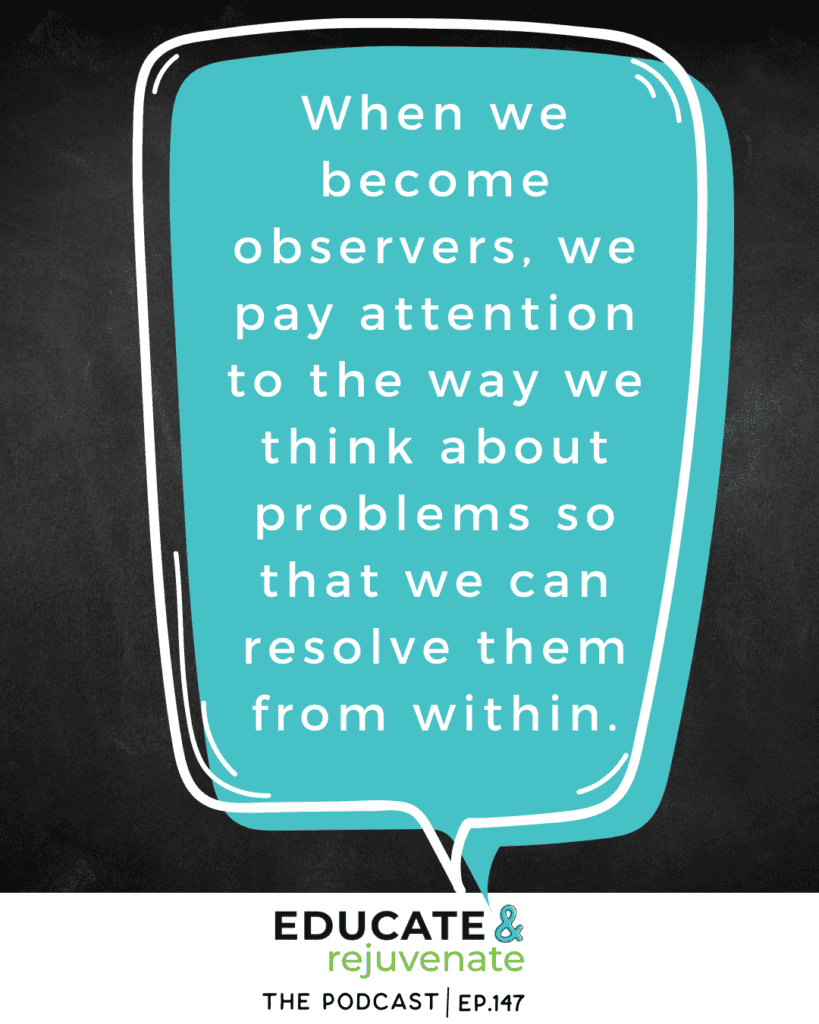
The next 3 weeks, I’m doing an episode dedicated to each section of the book, each section of the framework. So today, we are going to talk about observing yourself. And I actually want to read to you the section introduction. I wrote a little section introduction to go before each one. So before the you observe yourself section, what I wrote was, normally, we just go with the flow of our lives. We don’t take the time to notice what we’re thinking, feeling, or experiencing. Our brain sees problems outside of us, and naturally overlooks the solutions that can come from within. When we become observers, we pay attention to the way we think about problems so that we can resolve them from within.
So what does it mean to be an observer? You might be like, okay, I observe myself. What does that even mean? And really, that just means you’re paying attention to your internal experience, like it says from within. It’s not all about everything outside of us, what everyone else is thinking, what everyone else is doing, what is going on outside of us. That’s what we pay a lot more attention to. That’s what our mind is usually ruminating on. But when we’re observing ourselves, we want to really pay attention. What is going on inside my mind? What is going on inside my body? How am I experiencing all of this? Not just what is happening outside of me, but what is my experience? Am I activated? What’s going on in my nervous system? That is such an important part of it too. So within this section, there are the 3 things we observe, and then we also wanna keep in mind, like, how do we have so much compassion with this? How do we not judge ourselves? How do we just come in super curious? And that is the whole idea of being an observer.
We’re just coming in with a lot of curiosity. And that is why, and I have mentioned this on the podcast before, but in case you haven’t heard it yet, I want to share it again. And I actually want to explain it a little bit better because the great thing is, as we learn as teachers, right, we realize like, oh, I’ve been explaining something this way, and someone asks a question. And you’re like, oh, like I should have made that a little bit more clear. So I wanna talk about the analogy that I have talked about on the podcast before, but I want to make it even more clear of when whether we want to observe ourselves like a principal coming in to observe with a checklist of, like, these are the things that I’m looking for, or whether we want to observe like a student teacher, not like a student teacher who’s teaching, but a student teacher who is starting their observations of veteran teachers and trying to see like, oh, what is going on? What is it that they’re doing that I like? What is it that they’re doing that I’m gonna change up or whatever? But there’s not, like, drama or anything attached to it. Right? And that’s more what we wanna come out of. We don’t want to come in and observe ourselves, like, with a checklist, like, oh, we better be doing this. They better be doing that.
Why am I picking that? That’s dumb. We don’t wanna be doing that. We don’t wanna have this judgment. We don’t wanna have expectations of what it’s supposed to be like. We really want to come in and just be curious, and also offer a lot of compassion and realize, oh, this makes so much sense. Like, it makes sense that I’m reacting in this way because I’m thinking this thought, or because I’m activated, or because there’s this thing in the past that my brain has seen a pattern and it’s repeating that pattern. There’s just so much to it. So the reason that this section comes first, and the reason why it’s so important, and the reason that it has 5 chapters while the other sections have only 3 is because it really is the most important.
And really, it is continually weaved throughout the rest of the book too. And you’ll notice in chapter 6 and beyond of the book when once you read it, that you were still observing the entire time. And when you get the your copy of the book, you’ll see that even it’s kind of like a staircase where it builds on top of each other, but you’ll see that the other staircase is still the foundation underneath the additional steps because we’re always going to be observing ourselves. So it’s the most important because we need to be conscious. This is really our awakening. It’s our understanding like, okay, I’ve been unconsciously been my whole life. I haven’t really been noticing what I’ve been thinking. I haven’t been noticing my internal experience.
And this is most of us. This is most of us if we aren’t, if we haven’t been consciously doing any inner work. And some of you might have been already. You might be like, oh no, I’m doing this. But really, most of us at some point, there’s a point where we weren’t, and then there’s a point where we’re like, okay, something needs to change. I need to do some of this internal work. And we are hoping to kinda bridge that gap in the future, like for future generations. And that’s why we need to do this work on ourselves.
And we’ll be talking about that even more in a few weeks when we talk about social emotional learning on the podcast and how, like, wouldn’t it be amazing if we had learned some of these things more growing up? But we can start now. Right? And that is what we’re doing. We’re observing ourselves. We’re seeing what is going on. We’re becoming more conscious of our thoughts, of our feelings, of when we’re triggered in our nervous system. And we’re not trying to change anything. This is the other thing. When we are are observing ourselves, we’re not looking to change.
We’re not even looking to immediately fix or be like, oh, I’m doing that. I gotta switch that right now. Because really, what we’re trying to get by observing ourselves is just a deeper understanding. It’s kind of like when a student has a failing grade. Right? Think about it. We have a kid, or if you’re teaching your child and they’re not understanding, we don’t wanna just be like, oh, well, like, she’s doing it wrong, or he’s doing it wrong, or why is she not doing that right? Or, oh, she just doesn’t get it. We need to just change that grade from an f to an a and put that band aid on it and she’ll figure it out or, you know, just kinda move along. We need to really see what is going on with that child.
Where is the where is the gap? What is it that needs to be taught differently? Where is it that maybe I wasn’t clear enough? What what is going on? And again, it’s like my mom, for example, hey, mom, if you’re listening, you probably are. Love my mom. She has a shoulder injury right now. And if she were just like, I’m gonna just put a band aid on it and just keep doing what I’m doing with it, or I’m gonna just try to fix it without actually understanding what’s going on. Right? That wouldn’t work. Right? We need to she’s been going to doctors. She’s been going to physical therapy. They’ve been looking into it for months.
It hasn’t been an overnight healing experience. And that’s the same thing in life. Like our bodies don’t heal overnight. We might need to see multiple doctors. We might need to, like, try this one thing, maybe that didn’t work, then we need to try a surgery or whatever. Right? We can’t just immediately be like, oh, here’s a quick fix, and try to immediately as soon as you notice it, just like fix it, fix it, fix it. Right? We need to kinda be like, why is this happening? To get the right fix, we need to look at the why, we need to look at what is actually going on with the shoulder, Like where is the joint or the bone? And again, I’m not the doctor. I don’t know everything that’s going on, but like, we need to look at the why.
And that is what we’re doing when we’re becoming an observer. We need to get a holistic picture of what’s going on. And what’s going on with a lot of teachers right now is burnout. Right? And I did a poll on Instagram very recently that showed I asked a question on my Instagram stories. And the funny thing is my Instagram on Educate and Rejuvenate, for a while, I didn’t have a lot of time to put a ton of effort into it. So we’re just kinda posting stuff, but the last like month, we’ve really been trying to get more intentional with it again. And so if you don’t follow us on Instagram, come on over, follow, like, comment, definitely helps me out. I posted a poll on our stories and I got over 300 votes in this poll, which again, because we’re just kind of starting to put emphasis on it again.
That was a lot of people for our Instagram. And I asked the question like, how often do you feel like you put teaching above yourself? Or it was something like that. And it was 78% said, almost always. And it was then 3% that said rarely. And in between, it was sometimes. So really, we have like 78% of teachers who feel like almost always they’re putting their job ahead of themselves. And that even I feel like that’s a more accurate statistic than even the one I cite in the book, where the Gallup panel is 44% say they burned out all the time. And it might even be maybe it was the wording change.
Maybe they’re like, oh, I’m not burned out. But, oh, I do put teaching above myself. I’m not sure the exact thing, but all I know is every time I coach teachers, overwhelm comes up, stress comes up, like, all these different feelings of overwhelm. And so, we need to understand that there’s a reason behind that. And there are, obviously, circumstances, right? There are things that have changed. There’s COVID. That was a big thing. There are more students that are at varying levels than ever before, and it was that way before COVID, but we’re still, like, recovering from that.
It’s been a years long thing, right? And we’re still looking at the why. Again, all of this work, all this healing, it’s never overnight. Right? And there are also tons of other things, like, and this podcast isn’t about that, but there are so many things we can’t control. But in this book, we’re looking at what we can control, and it’s actually a lot more than we think, but we need to start by the observation, by understanding what is it that I’m doing that might be contributing to the problem, or what I’m not doing? Like, how am I not taking care of myself enough? How am I not allowing myself to move through the stress cycle? How am I getting stuck in this activated state because I’ve just go, go, go all the time when I’m never taking that time for myself to rest or recover. Really, what we need to do is just understand what is going on for us. Observe like that student teacher who really is just like wanting to know what is going on. In the book, I mentioned that it’s really like I’m almost pulling back. Like, I am somebody watching what’s going on.
I am watching as an outside observer. Like I have a diet Coke. I’m at a movie. I’m watching the movie of my life and I’ve got this diet Coke and this popcorn. And then was just sitting back and watching the show, watching all the suspense, watching all the, you know, everything and just seeing what is happening. I want to get a deeper understanding of that. And we want to watch for how you treat yourself, your internal dialogue, your emotions throughout the day, and which seem the most common, which seem to be coming up a lot. What patterns are we seeing? What do you do when you get overwhelmed? When you get stressed? When you get sad? How does each how do each of those emotions feel in your body? What is the internal experience? One thing I’ve noticed, like, a lot of times when I’m coaching is that I ask somebody, how do you feel? And they just start telling me more thoughts.
They just start telling me, oh, I feel like And they, like, again, it’s all the thoughts that are ruminating in their head. And it’s interesting because it shows that we are so in our heads that we aren’t as connected with our internal experience. Again, it makes sense that you would answer a question like that, like, how do you feel? Because we also tend to say things like, these kids are making me so frustrated, or I feel like these kids don’t care, or whatever. And that’s us attributing the circumstance to our feelings, right? Or it is saying that I feel a thought. We’re really getting mixed up on these different parts of the self coaching model that I talk about on this podcast. So what we wanna do is get really clear. Like, what am I thinking? That’s what’s going on in my head. What am I feeling? That is the experience in my body.
So let’s talk about that for a sec. So our thoughts, right? Like I mentioned, we tend to think our circumstances are what are causing our feelings, right? But it’s our thoughts, right? So we see things like, I’m so excited that so for example, I’m going to Maui tomorrow with my husband. And again, not obviously 2 days before my book comes out, as I’m recording this episode. And I might say, I’m excited because I’m going to Maui tomorrow, but honestly, it’s not that. So I’m excited that I’m gonna get some time to rest and rejuvenate, because I’m thinking like, oh, this is gonna be so restful, or, oh, I’m going to get to spend some time with my husband, or, oh, it’s gonna be really cool to have these different experiences. Some people might have very different thoughts about that. Right? And again, there are ones that are more common, right, that people might have more similar thoughts about it, but there is always something in between, right? It’s not the circumstance that makes us feel a certain way. For example, I could be like, Oh my gosh, I have so much to do before my book launch.
Like, this is terrible timing for a trip, and I’m just anxious about going there. Right? That’s an example. Like sometimes, like a trip can actually feel overwhelming depending on, oh, what are the other things? What am I thinking about it? All of that. So in my book, I also mention a story of Viktor Frankl, and he was at Nazi concentration camps. He is the author of the best selling book, Man’s Search For Meaning. And obviously, he went through a horrific experience, unlike anything else. So a lot of times we’re like, oh, no, this, like, thinking about our thoughts, it doesn’t work. And again, there are times where we need to do other things.
That’s why I’m saying it’s not the only thing. But even Viktor Frankl, in Nazi concentration camps, he talks about how it was his perception that was the reason why he was able to make sense of this experience, why he’s been able to go on and do great things in his life, even after having such horrific times. And one thing that he said is between stimulus and response, there is a space. In that space is our power to choose our response. In our response lies our growth and freedom. But before we can choose, we need to actually notice, right? Because we’re gonna talk about choosing our direction, but we need to notice, right, what kind of thoughts are troubling us. All kinds of cognitive distortions we have, and those are just distorted ways of thinking. I talk about this a bunch in the book.
For example, there’s all or nothing thinking, like, you know, everything is amazing or it’s terrible. Like, oh, I have to do my classroom to the nines, or it’s awful, right? Or saying over generalization that’s things like, oh, I always mess up. I always mess up during my lessons, which that’s not true. Right? But then your brain is going to look for the evidence that all the times you’re always messing up. Or should a statement, like, I shouldn’t have been doing that, or the student shouldn’t be doing that, or I should have done it this way. Like, all of these things that we think that are very distorted, that aren’t always based in reality. I talk about it on the podcast a lot, but again, it’s not those external circumstances causing our feelings, it’s our perception of it. It’s our thoughts and our deeper ingrained core beliefs that are what kind of our automatic thoughts are based off of.
Right? And I talk about this in the book too, that it’s not just like these thoughts don’t just come from nowhere. There’s these preconceived core beliefs, our the way our neuro pathways are wired, our experiences. That’s where our automatic thoughts come from. Right? We can’t control every thought that comes into our mind. Right? So when we’re observing, we’re gonna notice these thoughts come up, but we didn’t choose all these thoughts. Right? We can’t control every thought that comes into our mind, but when we become an observer, we can start to notice the thoughts. We can notice how they are shaping our feelings, actions, and results. And we can decide, wait, do I actually want to keep thinking that thought? Do I want to believe it? We can question it.
But if we don’t ever observe, if we don’t ever get conscious, we can’t question it. The next thing we really want to observe and pay attention to, like I mentioned, is our feelings. And we think we feel our feelings, but frequently, we do everything we can to try to not feel them. And a quote that I found for the book that is widely attributed to Austrian neurologist, Sigmund Freud, says, Unexpressed emotions will never die. They are buried alive and will come forth later in uglier ways. So basically, we can try to bury our feelings, but they’re still there like zombies. They’ll arise and wreak havoc if they aren’t dealt with. And that’s why it’s so important to allow and process our feelings rather than resist them and try to push them away and bottle them up or have an emotional outburst with them or just head to our pantry and stress eat or doom scroll.
We want to really dive in and feel the feelings. We want to dive in and really notice what they are. Like notice what our feelings are, tap into our body and what we are actually experiencing. Not just everything that’s going on outside of us. We can notice what feeling is there. We can without judgment, without being like, why am I feeling this way? I shouldn’t be feeling this way. Just notice that it’s there. It is.
Have some radical acceptance. So just be, yes, I am feeling this feeling. I’m feeling anxious right now. I am feeling stressed right now. I am feeling overwhelmed right now. And even just naming that feeling, like I mentioned in the and I mentioned all the research behind it in the book, but just naming that feeling alone helps to help it simmer down. It actually helps to regulate our nervous system if it’s activated at all. It helps bring in like, oh, I’m okay.
It helps soften it a little bit. And that is why noticing that feeling is so powerful. Breathing it in. What does it feel like in my body? And I talk about so much more of that in the book as well, about how we can move through our feelings, how we can process them, how naming them in different ways is so powerful, and understanding what it is we’re feeling. And then the last thing we need to observe and keep in mind is our nervous system, right? Because it’s not only our thoughts, Right? Sometimes it’s our body trying to protect us that is causing us to feel stressed or activated or freeze. We might fight. We might, like, suddenly have this burst of energy. We might wanna run away in flight.
We might wanna freeze and just be, like, why did I just forget everything when my principal walked in for an observation? We might find ourselves people pleasing, but again, there’s people pleasing and then there’s fawning, the trauma response of it, where it’s like, I have to do this to be safe. If I don’t do this, then I’m in danger. The reason this is, is because our body, our nervous system is always scanning for safety and danger. And even when that perceived threat is just an everyday thing, our body doesn’t know the difference of if we’re actually like being attacked, like actually, like, we are about to be in a car accident or something, or versus, like, there’s a stressful situation in the classroom, or my child is having a meltdown. Our body doesn’t know the difference. Either way, it’s going to react the same way. So that’s why when our nervous system is activated, it’s just like, oh, there’s danger. It doesn’t be like, oh, it’s this kind of danger.
It’s just that there’s danger. Right? And even when the stress goes away, for example, try to say, for example, we get to slam on your brakes, then you realize, oh, I’m okay. Right? We didn’t get an accident. We’re safe. Does your body immediately, like, be like, Oh, I’m all good. No. Right? You still feel that heightened stress. You still feel that blood rushing through you.
And it takes some time for that to simmer down. And that’s because the stress and the stressor are different things. They’re not the same thing. And even when the stressor goes away, we need to deal with the stress itself. And I talk about that in the book too. And there are different ways that we can do that through deep breathing, through movement, connection with others, all of these things can help. And as we get better at noticing and regulating our nervous system, building that into our regular routine, we can also see our window of tolerance, like the amount of time that it takes to come back to homeostasis, to be not activated anymore. We can see that window increase.
Right? We can handle more, we can deal with more stressors as we befriend our nervous system and get to know it and learn how to regulate it. That can really help us. So this is really the three things we want to observe. We want to observe our nervous system, we wanna observe our feelings and our thoughts. And it’s funny, I used to say like, Oh, feelings and nervous system, they’re both in the body, then thoughts are our mind, but really our mind is our body, right? It’s all our internal experience, right? And how it all comes together is really And we have this nice flowchart in the book, and this was inspired by Leah Davidson, who I had on the podcast a while back. If you have not listened to the episode, Get to Know Your Nervous System with Leah Davidson, you must listen to that episode, it was so good. So I also used that interview for my book, and cited it in there, and Leah, and all her work. And she showed a flowchart, and we had a variation of it in the book that was just only very slightly different.
But it’s basically when you feel stressed to check-in and like, Am I safe? Yes or no. If you’re not safe, definitely get to safety. If you are safe, but you don’t feel safe, you regulate your nervous system before you try to use the thought model or process your emotions. Right? And the way you’ll know is if you try, because again, if you’re like, I don’t know, I’m gonna try to do the model, I’m gonna try to process my emotions, you’re not gonna be able to do that because you’re not going to be able to use your rational mind or really tap in when you’re super activated. So once you’re able to regulate yourself, then you’re able to come back, and you’re able to look at your thoughts, look at your feelings, and there’s no right or wrong in that sense. You can pick which just makes the most sense for you in the moment to do that. And it No matter what you’re doing, whether you’re using the thought model, you’re observing your thoughts, you’re seeing how your thoughts are driving your feelings, or you’re really just tapping into those feelings, and how they feel getting into that internal experience. It’s so important.
It’s so important to have tons of self compassion all along the way. It’s so easy to beat ourselves up, especially with the self coaching model, I feel like. Like, why can’t I just think differently? It’s me. Hi. I’m the problem. It’s me. And sometimes we are, but that’s okay. That’s just what we learn from it and say, Oh, that’s interesting.
Do I want to keep that thought? Remember that the way you’re thinking right now makes sense. It’s coming from somewhere, And change isn’t going to happen overnight. It took however long to wire your neural pathways the way they’re currently wired, and it’s going to take time to rewire them again, but you’re also gonna see progress along the way. And even those who’ve been in the club with us for a few months, they do see that progress. It just takes time. It’s always gonna take time. It’s not this thing that’s meant to be overnight. In fact, it’s a thing that’s really meant to be our whole lives, right? For us to continue learning and growing, and getting to know ourselves, and getting to know how we can support others, and support ourselves, and contribute to this world, and teach the kids, and take care of ourselves too.
That’s really what all this is about, and that’s why we’re doing this. It’s because yes, we love teaching. And that’s why I mentioned like a few teaching examples in this, but really a lot of this book, it’s more about you and taking care of yourself. And it’s because that really is that missing piece, that that educate where yes, we’re educating, we’re not stopping that. We’re teaching the kids, we’re helping the kids, we’re helping our colleagues, we’re, you know, want to have other relationships in our life and all that. But we also need to rejuvenate ourselves. That is often the missing piece that I see for educators. That’s why teacher burnout was at an all time high.
And that’s why this work is so important. And so I hope that you will snag a copy of educate and rejuvenate if you haven’t already, or maybe even 2, or snag another copy if you just snagged 1, because we have a lot of extra bonuses. If you grab 2 copies, we call it our teacher bestie bundle. You and your friend will both get into our Winter Educate and Rejuvenate Conference for free. You’ll get not just $30 to our shop, but each of you will get $60 in resources to our shop. Everybody who purchases a copy of the book gets to join a book study where we’re going to dive so much deeper into this. You’ll get to read the book, but you’ll also get the workbook with all the exercises, videos that I took to help you walk through them. And you’ll also get to join me if you buy it now while this is And maybe you’re listening to this a year later.

If so, you’ll get the replays. But between now December, we’re going to be doing a book club where every few weeks, we’re going to have a call. We’re going to talk about it. Going to get some coaching. Even if you’re not in the club, this is the only time our book club is open to those not in the club. It’s open to anybody who purchases a copy of the book. And I would love to see you there. I would love to work with you to putting this 3 step framework into action.

So go to educatemerchimmunity dotcom/book to learn more. We’re going to have the pre order link in the show notes as well, and how you can claim all your bonuses and everything. And also, stay tuned here on the podcast, because this is part 1 of the 3 part series. The next 2 weeks, you’re going to learn next week about choosing your direction, and the following week about how to align yourself. So thank you again, and I hope you have an amazing day, and just kind of observe yourself. How are you taking care of yourself today? What are you thinking? What are you feeling? Tune in, and I will talk to you next week. Thank you for joining me on Educate and Rejuvenate the podcast today. If you love what you heard in this episode, be sure to hit subscribe so you don’t miss the next one.

And if you’re hungry for even more, be sure to check out the book that I wrote. It’s called educate and rejuvenate a 3 step guide to revitalize your teaching, Renew Your Spirit, and Reignite Your Passion For Life. It takes everything you learn here on the podcast and that I teach our members inside the Educate and Rejuvenate Club into a guidebook you can refer to again and again. One of our early readers said it was like clarity for her brain. Plus, it’s not only a book. With your purchase, you’ll get a full PDF guide with exercises and links to videos and more so that you can not only consume, but apply everything that you learn. If you’re ready to make and rejuvenate, not just a podcast you passively listen to, but a lifestyle that you put into action, it’s time to grab your copy on Amazon today or head to educate and rejuvenate.com/book to read the first chapter and the introduction today.

More about Educate & Rejuvenate: The Podcast

Being an educator is beyond a full-time job. Whether you’re a teacher or a homeschool parent, the everyday to-do list is endless. Between lesson planning, grading, meetings, and actually teaching, it probably feels impossible to show up for your students without dropping the ball in other areas of your life.

Educate & Rejuvenate: The Podcast, is the show that will bring you the teacher tips, practical strategies, and inspiration that you need to relieve the stress and overwhelm of your day-to-day. Your host, Kelsey Sorenson, is a former teacher and substitute turned homeschool mom. Tune in weekly to hear Kelsey and her guests cheer you on and help you thrive as a wife, teacher, and mommy. Because with a little support and community, you can do it all. To access every single Educate & Rejuvenate resource, join the club at educateandrejuvenate.com/club.

Leave a Reply

Your email address will not be published. Required fields are marked *

Educate & Rejuvenate is the virtual teacher conference that you can not miss! Find out more about our summer and winter events. 

Inside Educate & Rejuvenate Club, you will get access to our weekly teacher-life coaching AND our Pre-K to 6th grade resource library to achieve more of a work-life balance.

kelsey sorenson

Hey there, new teacher bestie! I’m Kelsey, and I created Educate & Rejuvenate just for YOU! I blog about teaching and create elementary school and homeschooling resources to make your life easier. Be sure to sign up for my FREE email newsletter!

Then, follow me on Instagram and join the Facebook community to stay connected. I can’t wait to connect with you!

Oh, and don’t forget to listen and subscribe to Educate & Rejuvenate: The Podcast.

Let's Connect

Sign Up for Free Sub Plans!

Grab your FREE sub plans and you’ll be subscribed to get news about upcoming events, blog & podcast updates, subscriber deals, and more via email. You also agree to our privacy policy.

Mindset Masterclass

Join us for this FREE webinar to help you deal with feelings of overwhelm and bring balance to your life!

COOKIES

This site uses cookies.  Read our privacy policy to find out more.