

Listen on Apple Podcasts | Listen on Spotify
Hey y’all! Let’s get real for a second—how many of you feel like you’re running on empty, constantly feeling rushed, stressed, or overwhelmed during your teaching day? I hear ya! It’s like you’re just barely hanging on, and finding that “flow” feels like a distant dream. Well, today’s blog is all about productivity practices and finding flow solutions that’ll help you get back in the groove, and trust me, you do not want to miss out! We’re bringing in some major insights from the fabulous Angela Watson of Truth for Teachers, who’s all about transforming the way educators approach their work.
Let me introduce you to Angela Watson—a true game-changer when it comes to mindset and productivity for educators. Angela’s got the credentials to back it up: she’s a National Board Certified Teacher with a degree in Curriculum and Instruction, over a decade of classroom experience, and more than ten years of coaching teachers. She’s also the brains behind the 40-Hour Teacher Workweek program, which has helped over 55,000 teachers, coaches, and administrators maximize their time and reclaim their lives. So, when it comes to productivity practices and finding flow, Angela knows her stuff.
Now, what exactly is this “flow” we’re talking about? Flow isn’t just about getting more done—it’s about getting into that sweet spot where everything just clicks. Angela dives deep into how finding flow in the classroom can transform the entire teaching experience, not just for you, but for your students, too.
She’s passionate about her project called “Finding Flow Solutions,” which incorporates flow theory into education. Imagine a classroom where both you and your students are so engaged that time seems to fly by—that’s what flow is all about. Angela explains that focusing on flow, rather than just hammering through productivity tasks, can lead to deeper satisfaction and a more positive environment.
Angela’s first tip? Simplify and streamline your routines before you even think about adding anything new to your day. I mean, how many of us are guilty of piling on more responsibilities without first clearing out the clutter? Angela’s advice is to look at what you’re already doing and see where you can simplify. This could mean reorganizing your planning, cutting down on unnecessary meetings, or even tweaking your classroom layout to make things run smoother.
Angela emphasizes that identifying time-wasters is key. We all have those little things that suck up our time—email rabbit holes, endless paperwork, or those tasks we keep putting off. By pinpointing and eliminating these distractions, you’re not just saving time; you’re creating space for flow to happen naturally.
It’s not just about getting yourself into flow; it’s also about helping your students get there, too. Angela shares strategies for developing crucial skills like time management, attention management, and energy management, which are essential for experiencing flow. She points out that teaching students how to manage their time and focus their attention can lead to a more engaged and dynamic classroom.
One of Angela’s favorite productivity practices is the Pomodoro Technique, which can be adapted for both teachers and students. It’s all about working in short, focused bursts with built-in breaks, which helps keep everyone on task without burning out. Plus, it’s a great way to model effective time management for your students.
If you’re struggling to find that balance between work and personal life, Angela’s 40-Hour Teacher Workweek program is a game-changer. This program teaches educators how to trim down their workloads and focus on what truly matters, so you’re not burning the midnight oil every night. Angela breaks down how identifying time-wasters and setting boundaries are essential steps toward creating more flow and less hustle in your day.
Finding flow and implementing productivity practices isn’t just about making your to-do list shorter; it’s about making your teaching life richer and more fulfilling. Angela Watson’s insights remind us that when we prioritize flow, we not only become better educators, but we also create a learning environment that’s vibrant, engaging, and downright fun.
So, if you’re ready to stop surviving and start thriving in the classroom, dive into these flow solutions and productivity practices. It’s time to reclaim your day, find your groove, and get back to doing what you love without the overwhelm. Want to know more? Be sure to check out Angela Watson’s work—trust me, your future self will thank you!
Do you love Educate & Rejuvenate: The Podcast? Take our podcast quiz to get a personalized playlist of episodes you don’t want to miss!
Kelsey Sorenson [00:00:00]:
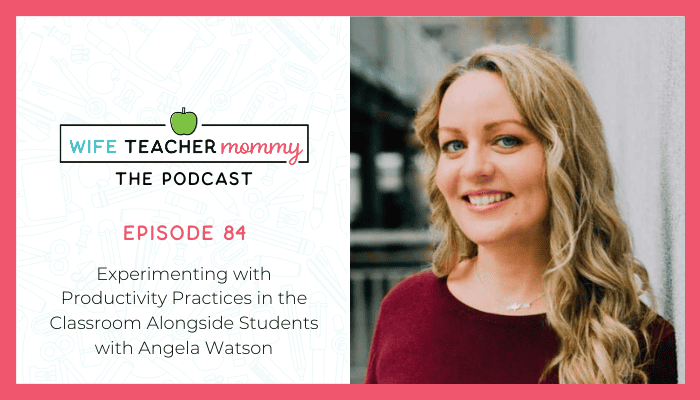
You are listening to episode number 84 of Wife Teacher Mommy, the podcast, Finding Flow experimenting with productivity practices in the classroom alongside students with Angela Watson. If you find yourself feeling rushed or stressed or overwhelmed as you’re teaching, this.
Angela Watson [00:00:14]:
Episode is for you.
Kelsey Sorenson [00:00:20]:
Hey, teacher is all you. Someone gotta take care of you, whether it’s the time or resources you have. Why? Teacher mommy. They have got your back. They’ll bring the galaxy to mom. They’ll break the galaxy between your family. They’ll break the galaxy in the place.
Kelsey Sorenson [00:01:00]:
Welcome to wife. Teacher. Mommy. The podcast. I’m Kelsey Sorensen, former elementary teacher and current homeschool mom. And even though I’ve been a resource creator since 2014, I’ve realized that printables alone aren’t all you need in order to thrive as a teacher or homeschool parent. That’s why I also created this show and got certified as a life coach to help you finally kick burn out to the curb and feel confident with whatever challenges come your way. With the right mindset, strategies, and new teaching inspiration, you’re going to be well on your way to your best teacher life. Now let’s go. Okay. I am so excited for you to listen to today’s conversation as I’m recording this. We are scheduling this a bit ahead of time and I just pins the needles. So I’m so excited by the time you’re listening to this that this episode has dropped because Angela is such an inspiration to teachers everywhere and I will read her bio because if you haven’t heard of her, you will be so excited that you heard of her today because she is incredible. What we are going to be talking about today is all about finding flow in your teaching and your productivity. And finding flow is different than time management. We’re talking about that in the episode where with time management, it feels very structured. It feels very like I’m doing this this way every single time. Where you’re finding flow, it’s a little bit of a different way to look at it, which we’re going to talk about in today’s episode. I’m really excited for you to hear it. And Angela is also a featured speaker at Educate and Rejuvenate. When you join us at the event, you’ll be able to easily find her session because we really want you to.
Angela Watson [00:02:35]:
Be able to watch it.
Kelsey Sorenson [00:02:36]:
It’s going to be great. She’s going to be talking about doing fewer things better, which is a big part of Finding Flow. So this episode is kind of not really a preview, but a complement to what you’ll get when you listen to Angela educate and Rejuvenate. So I would love for you to join us at the event as well. We’ve got less than a month until the event by the time you’re listening to this. So if you love what you hear from Angela today, be sure to go to Educateimrejuvenate.com to grab have your ticket so you can watch her session at the event. Now, let me tell you a little bit about Angela and then we’re going to get right into this interview because this is a really good one. I want you to listen to it and learn how to find that flow. And the great thing about this episode is it’s not only about how you’re finding flow for yourself. We talk about that a lot at the beginning of this conversation, but by the end we’re talking about how you.
Angela Watson [00:03:19]:
Do this together with your students.
Kelsey Sorenson [00:03:22]:
So it’s really a great way for you to not only make a big difference in your own life, but how you help your students. And if you’re a home school parent listening to this, it really applies to you, too. I’m going to use a lot of these skills with my own children as well. So I am going to read this bio to you all about Angela so you can get really excited about who you’re about to hear from and know.
Angela Watson [00:03:41]:
That she knows her stuff.
Kelsey Sorenson [00:03:43]:
So Angela Watson is a productivity and mindset specialist, author, and motivational speaker for educators. She is a National Board Certified Teacher and has a degree in curriculum and instruction along with eleven years of classroom teaching experience and over a decade of experience as an instructional coach. Angela is best known for the 40 Hours Teacher Workweek Program, which has supported over 55,000 teachers, coaches, and administrators in maximizing their contractual time so they’re not working endlessly on nights and weekends. She’s also maintained the website now known as Truthforteachers.com for nearly 20 years, publishing articles, books, courses, curriculum and professional development services. Her Truth for Teachers podcast has over 7 million downloads and offers biweekly encouragement to make teaching more effective, efficient, and enjoyable. Okay, teacher friends, it’s time for us to learn all about finding flow. Angela, thank you so much for coming on the show today. I’m really excited to have you.
Angela Watson [00:04:37]:
I’m so glad to be here with you.
Kelsey Sorenson [00:04:39]:
Yeah, we’re really excited to have you on the show. And you’re going to be a speaker at Educate and Rejuvenate. You’re one of our featured speakers who everybody is going to really look forward to seeing. So exciting. But first, before we even get any of that, I would love you to tell us about yourself, like your background, what you do to help teachers, and how you were kind of called to help teachers in the many ways that you do.
Angela Watson [00:05:02]:
Sure. So I was a classroom teacher for eleven years, and then I moved into instructional coaching, which I’ve been doing now for over a decade. I also have a podcast for teachers. I’ve written six books for teachers. I have courses. And basically I think of myself as a person whose full time job is basically listening to teachers and creating resources that support them. Because I feel like there’s not a lot of people out there who are truly listening to what teachers say they need and being responsive to them. That’s something that I think teachers deserve more of. And so I feel really honored that I’m able to kind of step into that position and really think about, okay, what are the things that are really difficult to solve for teachers? What are the things that they need more support around and how can we create more systemic solutions so that educators stay in the profession that they love?
Kelsey Sorenson [00:05:51]:
Yes, and I’ve been hearing so much that they love teaching, but there’s so much, like you said, all these systemic issues and so many things going on that they do they need more support and people who are like their cheerleaders. And I love how you and not just cheerleaders, but who really get to support them in the ways that they need. And I just love that you are able to offer so many. You have multiple books, you have your podcast that is incredible, and your 40 hours Teacher Work Week program. I’ve heard great things about it. So I’m really excited to really learn more about what you have to offer. And also this discussion today about finding flow in your classroom, which is what we’re going to talk about. When you brought that topic, I was like, oh yeah, I think that is perfect. I think our teachers need that. Actually one of our members, on a recent call, they were just talking about, they literally said they felt rushed, like they were just going from trying to figure out, like, oh, I’m trying to work out in the morning. But then I get to school too late. And then balancing all of these things and just feeling rushed both inside and outside the classroom. So when they notice this is happening, what can they do about it?
Angela Watson [00:06:58]:
Yeah, I think that’s really common just in our society in general. I don’t think it’s something specific to teaching. I think it presents unique challenges for teachers, though, because it’s not the kind of job where you get a lot of downtime. Most jobs have like slow periods or you get a whole hour for lunch or something and there’s just not a lot of downtime. And in addition, a lot of teachers are also parents or caregivers. They may do elder care for a family member. And so it just feels like you never have a moment to yourself. You never have a moment just to think or to process. So I think this feeling of being rushed all the time, of having too much to do and not enough time to do it, is really common. And there are specific things that we can do that we can choose to do, to really introduce a little bit more margin in our life, to have a little bit more space so that we’re just not constantly going from one thing to the next and feeling like we never have a moment to breathe.
Kelsey Sorenson [00:07:55]:
Yes, and I feel like, so many of us feel that just not having that moment to breathe and how do you imagine that teachers could find that moment to breathe, even with all of this going on?
Angela Watson [00:08:06]:
So one of the easiest and simplest things that you can do to instantly have a little bit more margin in your life and a little bit more downtime to process is to notice when you have that, say, ten to 62nd time period in which you’re tempted to just fill it with something else. Usually our phones, right? So you’re sitting at a stoplight, you know, it’s a long one, and you’re like, should I just sit here and just breathe? Should I just be? Can I process? Can I enjoy this moment of no one’s asking me for anything, I don’t have to do anything, I don’t have to be anywhere but in this moment? No. We take out our phones and we start scrolling, right? Or you have that two minutes in between classes and it’s like, well, let me just check my email real quick. Well, two minutes is not enough time to read and respond to emails. So now all we’ve done is just burden ourselves now with feeling like, okay, now there’s one more thing hanging over my head now that I have to remember to do later. So when you have those little pockets of time, and I don’t even just mean, like, 1520 minutes, those are big pockets of time for a lot of teachers. I’m talking about, like, 30 seconds in the day. Notice if you rush to find something else to do. So it could even be when your students are working. There are those magic moments in the classroom where everybody’s more or less on task and no one is demanding your attention. Take that in, because it doesn’t happen all the time. Stop, take it in. Look around the classroom, be like, wow, look at all of this. I have taught my students how to work like this. Look at them collaborating. Look at them focusing. Look at them learning the things that I’ve taught them to do. Let me just sit here and appreciate that instead of immediately rushing over to, like, let me go see what this kid is doing, and is this person really on task? And, oh, let me go clean up this area of the classroom real quick. Really trying to slow down, be more mindful and be more present, I think can keep you from feeling like you’re just running from first thing in the morning until last thing at night. We have those moments in our days, but we’ve just been trained culturally to keep filling them with more stuff and to seize those moments back for ourselves is really powerful.
Kelsey Sorenson [00:10:11]:
Oh, Angela, I love that you shared this, because this is something I’ve been trying to work on myself because one of my coaches brought it up. And I know you love coaching too. It’s a lot of what we do to help our teachers, but it’s noticing that sometimes we just think, oh, that’s not enough time to take a break. I need like an hour in order.
Angela Watson [00:10:30]:
To take a break.
Kelsey Sorenson [00:10:31]:
That’s what I need. But really, those little pockets of time, just like two minutes here, five minutes there, they can really make a big difference. When you take that time to breathe or to process an emotion, you’re feeling like you notice you’re feeling anxious rather than just like, scrolling on your phone or like you said, you check an email and then you feel like it’s another thing. Instead of really taking that moment to process that’s right.
Angela Watson [00:10:53]:
We distract ourselves rather than dealing with the feelings because it’s easier. And that makes sense.
Kelsey Sorenson [00:11:00]:
Yeah, it feels easier, but then in the short term, it feels easier, but then in the long term, we’re just adding more of that stress and overwhelm, and we’re making sure that we don’t get those breaks that we’re like, no, I’m not going to take it because I’m going to fill it up.
Angela Watson [00:11:15]:
That’s right. And you make such a good point about these time periods. There’s no such thing as a time period that’s too small to get things done. I find often if I only have like ten or 15 minutes, I can get more done than if I have a full 45 minutes or an hour because I know the time is limited, I can really focus and dive in and take care of things. So just noticing that even ten minutes here, 15 minutes there, you can rest, you can take a break, you can get ahead on a task, whatever it is you need to do. But just being really intentional with that time, instead of just sort of going through the motions every day and doing what you’ve always done, really be thoughtful about, okay, what do I need right now? Do I need to take a break? Or would it be better for me to grade the stack of papers that has been bothering me and that I’m going to feel like I can’t sleep well tonight if it’s not done? Really paying attention to what it is you need in that moment and tending to your own needs, really tuning into them, can make a huge difference.
Kelsey Sorenson [00:12:08]:
I love how you mentioned that, because it not that we’re saying that. Oh, you have to always, every time you need to stop and breathe, it’s really taking that time to check in, because a lot of times, we just don’t take that moment and we go grade the papers without being like, is this what I feel I should be doing right now? I love that.
Angela Watson [00:12:24]:
Okay.
Kelsey Sorenson [00:12:25]:
And this really kind of ties into what you were mentioning about when we were trying to figure out what to talk about on this podcast about finding your flow in teaching. And I love that just even how it sounds like finding your flow. Can you kind of tell us a little bit about what you mean by that?
Angela Watson [00:12:39]:
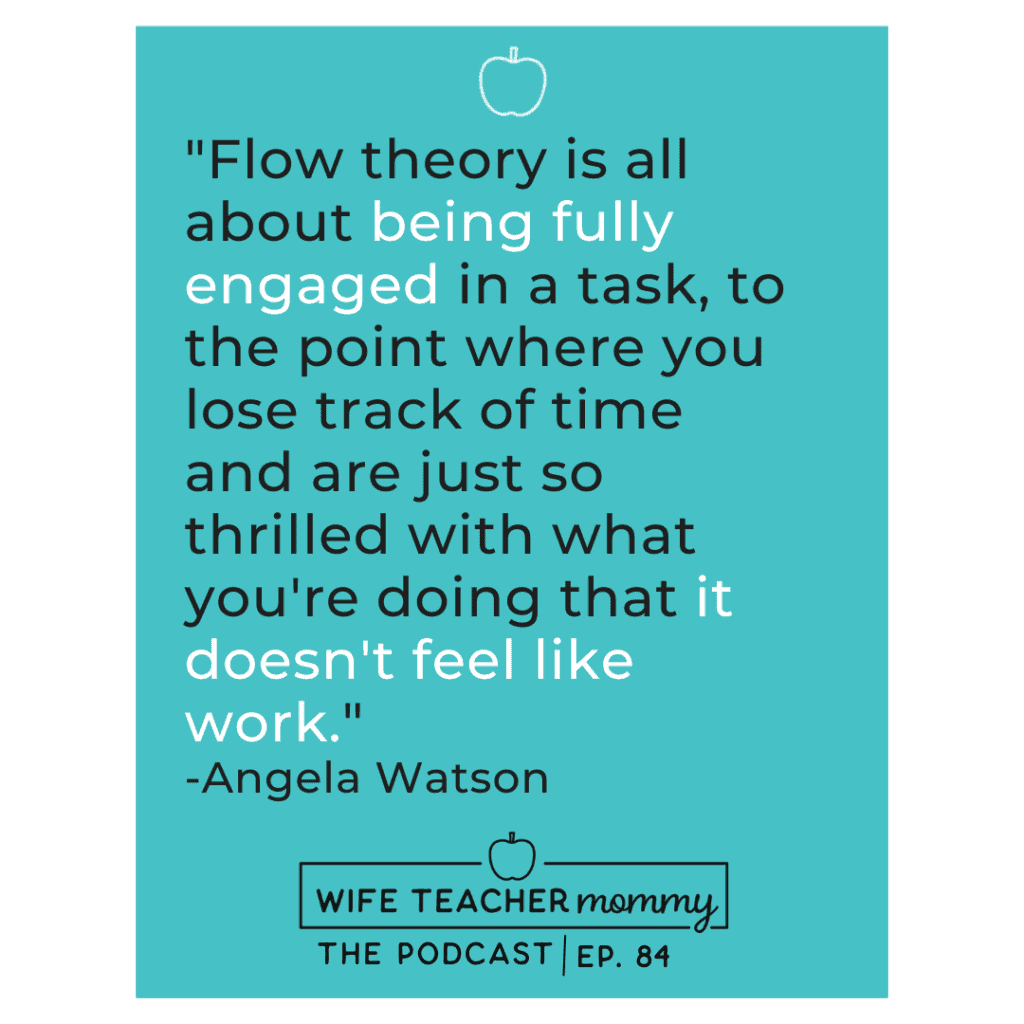
Yeah, so this is something I’m really passionate about. This is like my main project right now is on this set of curriculum resources called Finding Flow Solutions, and it’s based on the work of Mihai Chikset Mihai, who was a Hungarian American researcher in the 1970s, and he’s the one who coined the term flow theory. And what he observed in watching surgeons, in watching chess masters, in watching athletes, was that they would get lost in what they were doing. They would be so absorbed in the task that they would lose all sense of time. And the really interesting thing about his research to me, for educators, is that in all of these moments, these are not passive leisure activities. Yes, we can lose track of time just scrolling through social media or watching Netflix or whatever, but this sense of flow where you are so engaged and you feel so satisfied afterwards, you feel accomplished and you’re improving in your skills as well. You’re getting better, you’re practicing what you’ve done and you’re sort of leveling up, that’s something that applies to actual tasks that we have to do. It’s not necessarily tied to leisure time. And so when I really started thinking about that, I was like, that’s really the direction we should be thinking about in the classroom. Because kids are being asked to do work related tasks all day long. And they are hard, they’re complicated, they require focus. And it’s much more enjoyable to do a task when you’re in that state of flow. And that’s really what I want to help kids tap into as well as teachers, is that sense of flow. We’ve all experienced it as educators, right? We’re like, oh my gosh, I can’t believe the class period is up. I was so absorbed in working with my small groups or whatever. It’s the best feeling, and you’re working hard during those times, but you’re in this mindset where you’re just totally engaged, you’re not thinking about anything else, and you’re totally present on what it is you’re doing. And I think that’s something that we can actually teach students to experience, not every moment of every day, but to look for certain time periods and actually teach them the skills for this. Because we can teach them about time management, attention management, energy management. All of these things sort of fit together to help with finding flow. But I like the idea of flow versus time management or productivity because those terms tend to focus more on getting things done. And that has a totally different connotation than finding joy, finding ease, finding this sense of deep satisfaction in your work. I mean, that’s what we want kids to experience. And if we can help them tap into it, it’s going to help us experience flow so we can kind of feed off of each other. So I think that’s a really powerful application for the classroom. And I’m excited to just delve more into what might that look like for students and teachers.
Kelsey Sorenson [00:15:22]:
This is really cool. I love that you’re diving into this, and I love the idea of finding flow versus time management. Like you said, both of them, we are learning how to like you said, when you’re in flow, you’re enjoying it, you’re being efficient, you’re getting the things done, but it just feels like so much less pressure. There’s joy and ease in getting all of that done. So I love what you had to say about that. How would you imagine so we’re teaching our students how to do this. How would you imagine that we do that?
Angela Watson [00:15:50]:
So I think by the time the kids are in middle school, they can start getting explicit instruction in this, maybe even as young as fourth or fifth grade, depending on your students maturity level. But teaching them about how to concentrate and what does it look like when you’re fully engaged in your task and actually practicing that. So you can set a timer, teach them about it, set a timer and practice finding flow, reflecting on it afterwards, and helping kids find different strategies that help them. The Pomodora technique is a good one for a lot of kids, where you set a timer for a short time period and then you take a break, so it might be 15 minutes and then a five minute break or something like that. So there’s lots of different things like that that we can teach kids and practice. And the idea is that we’re teaching them that this is a lifelong experiment and it’s highly personalized. What works for one person is not going to work for the other. And one thing that I’ve noticed a whole lot in my own practice is that what works sometimes will not work always. So I’ll find a routine that is perfect for a week and it’s like, oh, okay, yeah, that’s not motivating anymore. And I’m realizing that’s normal. That is not a failure on the part of the person. That’s not a lack of willpower. There’s a limit to the amount of willpower that we have and certainly a limit to the amount that children have. Their self discipline and ability to just power through. That’s a really tough skill. So what if we can find this joy and ease through flow? What if we can think about ways that we can sort of prime ourselves to learn, prime ourselves to work, and just keep experimenting with it? If something doesn’t work, then you can come back to it later. That doesn’t mean it will never work for you again. Maybe it just wasn’t the right strategy for you that day. And to keep thinking about how can kids add to their toolboxes of strategies and keep collecting strategies so that they have something that works in different moments and really trying to give them the space and the freedom in the classroom to exercise those strategies, to realize that I need a break. My brain is full. I can’t keep going with this. So what I need is I need to go stare out the window for a couple of minutes and just, like, clear my head. That’s an okay thing to do. Adults have to do that. So just teaching kids that these things there’s nothing wrong with you. This doesn’t mean that you’re lazy. It doesn’t mean you don’t care about your education. It means you’re human. And you need to learn how to train your brain in the same way that we train the rest of our muscles in our body.
Kelsey Sorenson [00:18:12]:
Right?
Angela Watson [00:18:13]:
Like, you have to grow them, you have to stretch them, you have to practice making them stronger. And kids can do that with their thought processes, too, if they have the tools to do so.
Angela Watson [00:18:23]:
I’m Angela Watson, creator of the 40 hours teacher workweek program. We’re kicking off the next cohort of 40 Hours this summer, and I want you to join us. Over fifty five thousand K. Twelve educators have already used the 40 Hours Program to maximize their contractual hours and stop working endlessly on nights and weekends. Visit fortyhtw.com to learn more, including how to attend our free online summit on July 9 and 10th, where you can learn time saving tips from other classroom teachers. That’s 40 htw.com.
Kelsey Sorenson [00:18:58]:
I feel like there were just so many golden nuggets in there that we could go so many different directions. But I love this and how you mentioned that it’s different for every child. We all know this from working with children and how it can change one week to the next. I even find that as a grown up, it changes one week to the next. So for our students, we have to be very mindful of that, that it’s not always going to look the same. It’s kind of like you mentioned. I was listening to your podcast with Elena Aguilar, and you mentioned something about finding flow, being like water, like a waterfall, and how it’s not always exactly the same. And I loved that visualization of that. Do you have anything else to add about that?
Angela Watson [00:19:38]:
Yeah, I think that’s a really important thing to think about, about how it’s always a little bit different because we can get really down on ourselves as teachers. Like, I tried this and it didn’t work. How many times have we said that?
Kelsey Sorenson [00:19:49]:
Right?
Angela Watson [00:19:50]:
And a lot of times what we mean is, like, I tried it once, or I tried it for a day, or I tried it with one kid and it didn’t give me the results that I was looking for. But come back to it, and more importantly, teach these things to children, because there’s no way as a teacher that you can monitor what every single student needs. That’s a big problem with the personalization of learning. And differentiation is that so much of it is on the teacher to figure out what do kids need in every single situation. You cannot do that, especially if you teach multiple classes. It’s just not possible. Especially since, again, kids need different things on different days.
Kelsey Sorenson [00:20:25]:
So just because you figured out what.
Angela Watson [00:20:26]:
They need on Monday doesn’t mean you’re good for Friday. So what we have to do is show students like, okay, I’m trying to decide, should we do this standing up or sitting down? What’s going to be better? Rather than me figuring that out for you, I’m going to give you the choice and I want you to notice. Did you concentrate better? Was it better for you to do this alone or with a partner? Did you work better with this person or that person? And really training kids to notice what helps them focus so that they have this collection of strategies and you can just say choose from your strategies. We’ve talked about this, this, and this. You can have a chart up or some sort of reference point for them and then let them choose like, what do I need in order to concentrate and focus so that you as a teacher don’t have to memorize all of that and try to tune into every single child every moment of every day. You can’t. It would be lovely if you could. You can, right?
Kelsey Sorenson [00:21:18]:
In the perfect world, right?
Angela Watson [00:21:20]:
Yeah.
Kelsey Sorenson [00:21:20]:
But I love how you talked about building their toolbox of strategies. And even that self reflection you’re talking about, that is a major strategy in and of itself. How many of us don’t take that time to self reflect? So if we’re teaching our students or our children how to do that, that alone is a valuable skill and being able to self reflect and evaluate on what they need, that’s right.
Angela Watson [00:21:43]:
And that really goes back to the piece that lot of teachers worry about with kids, is that they just want to be told what to do. Like, I give them choice or I give them projects and they’re like, just tell me what to do. They don’t want to think is the complaint sometimes. And what it is, is they don’t know how to think. They don’t have the practice because we go from standardized test prep to student director projects, and the kids are like, whoa, I haven’t done anything but fill in bubbles all morning because that’s what the district made me do. And now all of a sudden, wait a second, so we can teach them to reflect, teach them how to think, and then they’re less averse to it because they have strategies. They know what to do when they get stuck.
Kelsey Sorenson [00:22:18]:
Oh, I love this. Okay, so my next question and something we were going to talk about is kind of as we’re working on this finding flow and everything, and again, we’re not going to be guilting ourselves or anything, but what are some time wasters that you think sometimes happen in the classroom and how teachers can identify what ones might be happening in their classroom?
Angela Watson [00:22:38]:
Yeah, I think figuring out your time wasters is really important because they’re big impediments to flow. There’s not enough time in the school day, obviously, for everything that we need to do. So we really have to sometimes eliminate the good to make time for the best. For most teachers, I think there’s not a lot of things that are happening during the day that are just total waste of time. There’s stuff that’s maybe less effective, right. Or maybe doesn’t move the needle quite as much for kids. That’s the stuff that we’re talking about because if you had a whole hour of your day that you were just totally wasting, this would be very easy to solve. We’re having to eliminate the good to make room for the best, really thinking about what has the biggest impact for kids and moving in that direction. And it’s going to be different for every teacher and every set of students. What might feel like a waste of time to one teacher, another teacher can give me ten good reasons of why that’s so beneficial for their students. So I don’t think it’s like a list of right or wrong, even though sometimes that’s what people want. Again, tell me what to do.
Kelsey Sorenson [00:23:39]:
Right.
Angela Watson [00:23:40]:
It’s a lot easier if you give me this checklist. But the self reflection is the most important piece, just like we were talking about with students, is really analyzing what are the times of the day when students are really engaged, what are the times that I just cannot get them to focus, what are the activities that they just are slog, just nobody enjoys it. How could we do that differently and make use of our time? So the reflection pieces is really important.
Kelsey Sorenson [00:24:07]:
I agree with that because like you mentioned, it can be different for every teacher and it’s really a great time for us to practice that self reflection that as teachers, we might wait for observations to look at what was given, the feedback that was told to us, and then evaluate from there. But it’s really important for us to self reflect on, like, okay, what went well today? And everything. So that can really help us get into flow, like you mentioned. But some teachers, they may be listening to all this and think, I love all these ideas, but they feel like it’s more for them to do. And now they’re feeling overwhelmed, like, oh no, I feel like I’m not in flow. That’s another thing I need to do. I need to figure out flow. How do you think they can handle any of those feelings that are coming up when they’re thinking about getting into flow?
Angela Watson [00:24:56]:
Yeah, I think that is totally normal too. You hear about another practice like, yeah, that would be great, but now I have to. Figure that out, how am I going to make time for all of this? So recognizing, first of all, that that is a normal reaction. There’s nothing wrong with that reaction. And also to realize that this is something that goes back to the intentionality piece. It is a practice. It’s a lifelong practice. So this isn’t something that you just master overnight. The more you do it, the better.
Kelsey Sorenson [00:25:22]:
You get at it.
Angela Watson [00:25:23]:
And the real key, again, is just intentionality. It’s starting to notice, checking in with yourself, checking in with just the vibe of your classroom, what’s going on, what’s working, what’s not. And a lot of times that can be done. Again, in those small little moments, you think you don’t have time during the day, but maybe kids are taking a test or something, and you have just a couple of minutes. That can be a time to sit and reflect. Like, okay, what are we doing for the rest of this afternoon? What’s going to be the best and highest use of our time? What’s something that I could maybe streamline? And just continually checking in like that and noticing when you’re feeling like, I’m trying to add too much and think about, what can I eliminate? So before you’re going to add anything new to your day, you have to think about, okay, what’s something that I can simplify or streamline first so that I have the time and the mental bandwidth for this. And again, doesn’t have to be a lot. It might just be one thing. There might be one routine that you do in your classroom that is something that is just less effective, or maybe you don’t need to do it as often. And that’s something that you could use. You could use that time period instead to bring in resources to talk with kids about flow. And that’s why I’ve created this curriculum, because I really want to make it super easy for teachers that it’s a Google Slideshow, and there’s a student journal, and you just click through the slideshow, and it shows you how to teach the lesson. It guides you right through. It’s got the video clips embedded. You just do exactly what’s on the slide, and the kids reflect in the journal. So it’s meant for teachers and kids to learn alongside each other. Because if you as a teacher have to master this stuff before teaching it to students, we’re talking about a long delay then, and we want to get this going right away. It’s something you can learn with your students, practice with your students, model for them, and talk with them about and say, I was really trying to get motivated to grade your test last night. I couldn’t do it. I was just so tired. And I decided it was going to be better for me to sleep and come in well rested. So I’ll have this test for you tomorrow. And using some of that shared vocabulary, shared reflection ideas together so they understand this is a human thing. This is not just kids. It’s not just them. And there’s nothing wrong with any of you. This is what it’s like to be a human. And when you can kind of come alongside kids like that, you’re removing the dynamic of like, I am the authority figure who needs you to do something. You need to complete this assignment for me. And instead, these are the tasks we need to get done together today. I’m a little tired, I’m a little sick, I’m a little grouchy. I’m distracted by something, and so are you. And so what strategies can we use to push through? Because it’s going to be rare. We have a day when all of us are 100% alert, well rested, not hungry, totally ready to focus. That’s not reality. The reality is this is how we’re going to feel. We’re going to have lots of tired days. We’re going to have lots of grumpy days. We’re going to have lots of distracted days. So what do we do? Here’s what I’ll do as the teacher. Here’s what you’ll do as the student. And really just supporting each other through that is just as a normal state of being rather than as a problem that we have to get rid of or pretend doesn’t exist. Like drop all your problems at the school door. How do you do that? How do you drop everything that’s bothering you at the school door? It is going to impact you in some ways. And so learning how to deal with that and modeling that for kids is powerful. Yes.
Kelsey Sorenson [00:28:39]:
And when you model that and you learn it together, kind of like you were mentioning, that is just so powerful. Do you have information about that yet, about your findings?
Angela Watson [00:28:47]:
Low I do, yes. So the first set of resources is out for it’s really geared towards teenagers, so probably grades eight to twelve. But the first unit is free for anybody to download. So you can just download it, your kids, you can see what works, what doesn’t, try it out, but all of the resources are@findingflowsolutions.com and there will be more and more coming out. This is my main project over the next year and a half, so I’m going to be really focusing on building this out for elementary all the way up through secondary. And my hope is that the lessons will sort of scaffold, right? So we start exposing kids to these concepts when they’re young and then develop it more in middle school. And then by the time they’re in high school, they’re ready for really explicit instruction on how to practice and internalize these understandings.
Kelsey Sorenson [00:29:34]:
That is an awesome project. I hadn’t heard about that yet, so I’m like, wow, I love it.
Angela Watson [00:29:38]:
Brand new. It’s a brand new thing.
Kelsey Sorenson [00:29:40]:
Yeah. Super cool. And then in the meantime, while you’re developing that, you also have your.
Angela Watson [00:29:48]:
40.
Kelsey Sorenson [00:29:49]:
Hours work week program.
Angela Watson [00:29:50]:
It’s a mouthful, usually not for some.
Kelsey Sorenson [00:29:54]:
Reason in that moment it was, but I’ve heard amazing things about it. I’ve actually had some of my members say they’ve done it along with our membership. They’ve done both together.
Angela Watson [00:30:03]:
Oh, cool.
Kelsey Sorenson [00:30:04]:
Complimented each other really well. So I think that’s awesome. I would love to hear more about this, and I would love for our listeners to hear more about your program too. So can you tell us about it?
Angela Watson [00:30:14]:
Sure. So this was a program, the 40 Hours Teacher Work Week, that I started in 2015. So we have now had 52,000 teachers go through this program. So we’ve got a lot of user feedback because, as I said, I really try to listen to teachers about what works, what doesn’t, what new challenges are on the horizon. And we just keep developing it updating. It changing it to be responsive to whatever’s happening in education. But the goal is to maximize your contractual hours. So the goal is to stop working endlessly on nights and weekends. It’s not necessarily to get down to a 40 hours week. It’s just that 40 hours is the amount of hours that most teachers are contracted to work. So it’s designed to really make you think, okay, I’m only getting paid for 40 hours. The expectation is somehow I’m supposed to get this job done during that time. How could I maximize those hours? Because I don’t want to have to keep working on my own time on the nights and weekends. And there are a lot of things that you can do during your, you know, before school, during your instructional day, and after school that can really help streamline. And again, a lot of it is about simplifying and eliminating it’s, noticing what are the things that I’m just doing? Because they’ve always been done, or I assume they have to be done, but maybe they don’t, or maybe they don’t have to be done that way. 40 Hours really just provides a lot of templates and just resources to help teachers think through their practice and find more efficient, effective ways to do everything from grading to lesson planning. All the resources are in PDF, so you can read or in audio. If you’re an audio person, you can just listen instead, which is really helpful if you have a commute or something like that. So it’s a year long program, and it’s just designed to keep giving teachers support through each season of the school year, and then you have that community to bounce ideas off of. So it’s a really awesome program that I think lays the groundwork for teachers to think about, how do I want to be more intentional with my time? What really matters to me? So that you can start spending more of your time focusing on the things that are really making a difference and not feeling like you’re just constantly busy. Like we were saying at the beginning, I love it.
Kelsey Sorenson [00:32:24]:
So if they want to learn more about this program, where should they go?
Angela Watson [00:32:27]:
So they can go to fortyhtw.com. So it’s fortyhtw.com and learn more. We have our full year program. We have a program for leaders that administrators can take that is designed to shift school culture and really try to change the expectations around email, meetings, that sort of thing, to give teachers more of their time. There’s a whole unit in there about how to protect teachers planning time so they can use that to prepare for their classes and not have it constantly taken away because there’s a staff shortage or whatever. So it’s a lot of that sort of thing. And that’s really what I hope ends up happening, is that we have teachers and administrators doing this together. That really is the ideal kind of situation. We get administrators on board so the people making decisions can help shift the culture. And it’s been really exciting to see principals buy into this because they’re overwhelmed too. They’re not working their contractual hours either. They’re also exhausted. So what are ways that we can make everything more manageable for all of us?
Kelsey Sorenson [00:33:33]:
Yeah. And how can the Admin and the teachers work together to implement all of these strategies? I love that you’re incorporating both teachers and administrators in the program. Is there anything else you have to share about the program with us?
Angela Watson [00:33:47]:
We are going to be opening up our new Cohort. It opens June 15 as early bird and then it starts in July. So that’s the time to get in this summer. And like I said, it goes through the whole school year. So it’s not something you have to keep up with or do every single week. And you never lose access to the materials either. But the idea is that you’re continually getting new things throughout the school year to help support you. So we have everybody join together as a Cohort over the summer and then you have that community of teachers who are also working through the program who can help you out.
Kelsey Sorenson [00:34:18]:
That’s awesome that they can join in June and then it’ll also open again in July you mentioned, right? So June and July they can join and then in addition, you’re also speaking at Educate and Rejuvenate. Can you tell us a little bit about what you will be sharing there?
Angela Watson [00:34:32]:
Yes, I’m going to be talking about Fewer Things Better and that’s that intentionality piece that we’ve talked about so much here. Fewer things, better. The courage to focus on what matters most is the title of one of my books. And so this presentation is based on that, about really thinking about how do we challenge the status quo, how do we challenge the expectations and education. This idea that teachers are supposed to do it all for the kids and do whatever it takes, which whatever it takes. It’s too much for individual educators to do, it’s too much for a school to do. We need a lot more support and resources. So really thinking through, like, what is my responsibility to carry, what is not my responsibility to carry, what are my gifts and talents that I can use to really make a difference for my students, and what are the things that I can maybe let go of? So that presentation will really help teachers think that through.
Kelsey Sorenson [00:35:26]:
Amazing. I cannot wait to hear your presentation. And where can our listeners connect with you? Online, like your podcast or your books?
Angela Watson [00:35:34]:
Social. Yeah. So the best place is Truthforteachers.com. That’s got links to all my social channels, the podcast books. You can even get to 40 hours from there. So truthforteachers.com.
Kelsey Sorenson [00:35:46]:
Awesome. Makes it nice and easy for you to find whatever you need. If you love this interview with Angela, which I definitely have, she’s such a wealth of knowledge. And thank you so much for taking the time to come on the show today.
Angela Watson [00:35:59]:
Yeah. Thank you, Kelsey.
Kelsey Sorenson [00:36:00]:
I appreciate it.
Angela Watson [00:36:01]:
It was a great conversation.
Kelsey Sorenson [00:36:08]:
If you enjoyed this podcast, be sure to hit subscribe so you don’t miss an episode. And if you’re ready to take the next step, come grab your ticket to join me at Educate Amber Juvenates the Education Event of the Year on June 27 and 28th, 2023. This year we have two incredible live keynotes joe Jamrowski, aka Mr. D, and bestselling author and video creator, Christina Kismich. We have over 60 incredible speakers speaking on topics such as math, language arts, reading, social, emotional learning, classroom management, homeschooling and tackling burnout. We start the day with a workout together each morning we have panels with the presenters and you’ll even get to join live coaching with me and even raise your hand if you would like to be coached. Plus, we give away tons of prizes throughout the event too. It is the best PD you could ever attend. And all of this is happening from the comfort of your own home. It’s just $19 for a ticket. And past attendees have said that this is what finally lit a fire under them to enjoy teaching again and that it was well worth every penny. Go to Educate Andrewjuvenate.com to learn more about the 2023 event. Or if you’re listening to this later, that link will show you what’s up next. As we will continue to do events like this, I hope to see you at Educate and rejuvenate.
Being an educator is beyond a full-time job. Whether you’re a teacher or a homeschool parent, the everyday to-do list is endless. Between lesson planning, grading, meetings, and actually teaching, it probably feels impossible to show up for your students without dropping the ball in other areas of your life.
Wife Teacher Mommy: The Podcast is the show that will bring you the teacher tips, practical strategies, and inspiration that you need to relieve the stress and overwhelm of your day-to-day. Your host, Kelsey Sorenson, is a former teacher and substitute turned homeschool mom. Tune in weekly to hear Kelsey and her guests cheer you on and help you thrive as a wife, teacher, and mommy. Because with a little support and community, you can do it all. For access to every single Wife Teacher Mommy resource, join the club at educateandrejuvenate.com/club.


