

Listen on Apple Podcasts | Listen on Spotify | Watch on YouTube
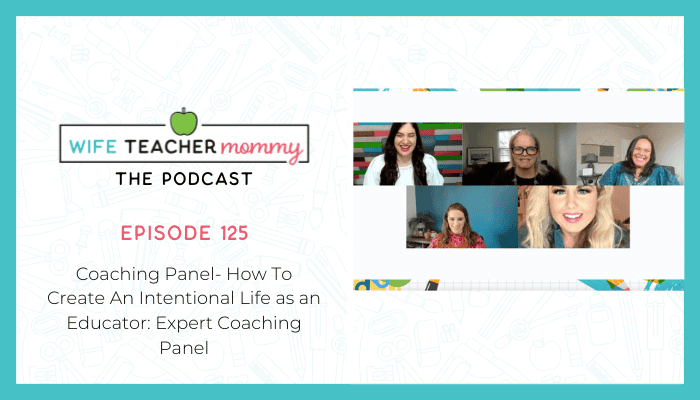
In episode 125 of Wife, Teacher, Mommy: The Podcast, our life coaches including, host Kelsey Sorensen, Bonnie Wiscombe, Chrissy Nichols, Francini Estes, and Kamee Bisson share their insights and personal experiences, focusing on how educators & homeschool parents can create intentional lives and alleviate burnout and overwhelm.
One of the key themes the coaching panel discusses in the episode is the importance of self-care and effective time management within the context of an educator’s busy schedule. Our coaches emphasize the significance of daily care, goal setting, and scheduling backward design. They share valuable insights on time management and befriending the calendar. “Me time” is highlighted as essential for maintaining balance, including practical suggestions for integrating self-care into daily routines, such as utilizing pockets of time during children’s activities for personal rejuvenation.
In the episode, our coaches delve deep into the power of mindset and personal empowerment in combating overwhelm and reclaiming a sense of control. They emphasize the necessity of recognizing one’s agency in navigating overwhelming circumstances, by encouraging listeners to assess their priorities and release unnecessary burdens to alleviate stress. Additionally, they advocate for using the phrase “I choose” to reclaim personal power and regain control in daily decision-making so that you can make intentional choices aligned with your well-being.
A central focus of the discussion is the delicate balance between professional responsibilities and self-care. Our coaches highlight the importance of setting an achievable “minimum baseline” with your daily goals. Plus, they advocate for a mindful approach to balancing internal thought patterns and attitudes by journaling and reframing your thoughts to manage overwhelm and find joy in the face of challenges.
The insights and strategies offered by coaches in this episode present actionable steps for educators and homeschool parents to cultivate intentional lives and navigate the complexities of their professional roles. The wisdom shared by the panel underscores the significance of self-care, empowerment, mindful scheduling, and flexibility as foundational pillars for creating intentional and fulfilling lives in the education field. By embracing these principles, educators can foster resilience and well-being, ultimately enhancing their effectiveness and impact in the classroom and beyond. With practical strategies and transformative perspectives, our Wife Teacher Mommy coaches illuminate a pathway for educators and homeschool parents to embrace intentional living, nurturing self-care, and ultimately crafting lives of intention, purpose, and fulfillment.
Speaker A [00:00:00]:
You are listening to episode number 125 of Wife, Teacher, Mommy, the podcast sponsored by Educate and Rejuvenate. And today, we are going to have our life coaching panel, how to create an intentional life as an educator. So you do not want to miss this. I have 4 incredible coaches on this panel and then myself as well. I share some tips here and there. So we are going to be talking all about the different ways we create an intentional life. So let’s go. Welcome to Wife, Teacher, Mommy, the podcast.
Speaker A [00:01:15]:
I’m Kelsey Sorensen, a former elementary teacher and current homeschool mom. And, even though I’ve been a resource creator since 2014, I’ve realized that printables alone aren’t all you need order to thrive as a teacher or homeschool parent. That’s why I also created this show and got certified as a life coach to help you finally kick burnout to the curb and feel confident with whatever challenges come your way. With the right mindset strategies and new teaching inspiration, you’re going to be well on your way to your best teacher life. Now let’s go. For this awesome panel today, we did this live panel yesterday as of when I’m recording. We had a great audience with us with some engagement, but the reason we did this panel was to put it on the podcast. So I’m really excited for you to hear from 4 incredible coaches who I just adore.
Speaker A [00:02:09]:
These 4 incredible women, I met each of them on my coaching journey. Chrissy is the coach who, when I wanted to add coaching to wife teacher mommy club, I stalked her and added her onto our coaching membership before I had even certified as a coach. You can hear that whole story near the beginning of the podcast, the first episode I did with Krissy. And then Francini, I met next. I met her at a coaching event with Jody Moore. She just happened to be sitting next to me, and I just loved her. And I was like, you know what? I already have a coach, but someday I’m gonna look for other coaches, so keep me in mind. And then 2 years later, here she is on our coaching panel.
Speaker A [00:02:42]:
And then I met Cammy and Bonnie during my own coaching certification. We went through coach training together. So it was really fun to come all together, and this is the first time we put a full panel here on the podcast. I put a partial panel on the podcast a couple of months ago. We had done a panel for our club members, and I put part of that on the podcast while I was writing my book. So today, we decided to do another panel. It was so much fun, and I think we’ll do this just on different topics every now and then. So today, what we’re talking about is how to create an intentional life, because I know a lot of educators, especially at the end of the year, when you’re feeling a little burned out and overwhelmed.
Speaker A [00:03:20]:
You’re feeling like, okay, something has to give. I’m just feeling so much fatigue. I just need to make it to the end of the year. But maybe you don’t wanna just be surviving at the end of the year, or during the summer, or as you go into the next school year. So we’re talking about how you can create an intentional life right now, and enjoy it more. We talk about how each of us creates our schedules. You see there are a little bit of differences in the way we think about it, but also a lot of similarities too. So I want you to listen to this panel, take what works for you, leave what doesn’t, and just figure out what, from this panel, you’re likely gonna get some great inspiration of what is going to help you create an intentional life.
Speaker A [00:04:00]:
Because at the end of the day, what is going to work best for you? And as coaches, we are here to help you uncover that for yourself. We’re not necessarily here to tell you what to do. So I’m really excited for this panel. We’re gonna just jump right into it. We are so excited to be here for our live coaching panel today. So welcome, welcome, everybody. How is everybody today? How are all of our incredible coaches here?
Speaker B [00:04:35]:
Awesome. Glad to be here.
Speaker C [00:04:37]:
Snow good. It’s sunny out. It’s sunny in my area, and it’s not usually sunny, so I’m loving today.
Speaker A [00:04:42]:
I’m so nice here too. Okay. Well, we are going to we have a really fun panel today. This is going on our podcast as well in a couple of weeks, but those of you who join us here on this stream on Facebook, you’ll get to see it first. So lucky for you. Okay. So let’s start and just have each of the coaches introduce themselves quick, and we can start with, Bonnie’s the first one on my screen. Are we all seeing the same one where it goes Bonnie, Chrissy, Francini, Cammy? Perfect.
Speaker A [00:05:14]:
Okay. So, Bonnie, let’s go ahead and have you start.
Speaker B [00:05:17]:
Yeah. Hi, friends. I am Bonnie Whiskum. I am a life and business coach. I help content creators and coaches start up their business, and I’m also a mom of 10 kids. I homeschool 8 of 8 of them with the help of a tutor. So I’m all home things homeschooling, and I love education too. So glad to be
Speaker D [00:05:34]:
here. Hi, everybody. I’m Chrissy Nichols, and I am a life coach for teachers and also in a beautiful place where more and more teachers and learners are coming to me for executive function. So learning about my own brain, learning more about my own ADHD means that I am the executive function coach as well for educators and anyone out there who just wants to get their shizzle done. So, Bonnie, with those 10 kids, come to me, my beauty. It’s really wonderful to be here. Thank you so much, everyone at wife teacher mommy, but I love teachers. I love learners.
Speaker D [00:06:13]:
I love everyone in between. Hi.
Speaker E [00:06:17]:
My name is Francini Estes, and I am a life coach for mamas of struggling children, including those with ADHD and autism, fetal alcohol syndrome, anxiety, and all the challenging behaviors in between. I help mamas feel better so they can help their children thrive. I’m also a mama. Actually, I went from 3 to 5 this last year. We got a bonus child, and we are fostering to adopt a new baby. So we’re super excited. So I’m a mama, a wife, and a former formal teacher. So I’m super excited to be here.
Speaker C [00:06:59]:
Hello, everyone. My name is Cammy Bissen. I am a certified life and wellness coach. I help moms lose the weight for good through focusing on wellness as a whole. We cannot be well in our body, right, unless our mind is well. So we don’t need another diet plan. We just need to figure out. I help moms figure out, like, why are we not taking action on the nutrition or diet plan that we have been avoiding? I also am a homeschool mom.
Speaker C [00:07:29]:
I have 4 kids ages 2, 4, 7, and 8, And I’m from the northwest, so I love hiking, anything outdoors. I love spending time with friends. I also really love audiobooks and podcasts, and I am happy to be here.
Speaker A [00:07:48]:
Awesome. Thanks everybody for introducing yourself, and we’re just gonna have such a great time. Really quick, if anybody doesn’t know me, I’m Kelsey Sorensen. I am also a certified life coach and the owner of wife, teacher, mommy, and educate and rejuvenate. So we’re all excited to be here. All of us are life coaches. All of us can work with you. Bonnie, Chrissy, Francini, and Cammy all have their own private as well, but they also coach inside our club community too.
Speaker A [00:08:18]:
So, really excited to all be here together for this panel that is for the podcast, but we thought we’d go ahead and do it live, kind of like the live podcast recording. So much fun. Okay. So next question. We today what we’re talking about is how to plan our intentional life. And because a lot of educators right now, teacher or homeschool, whatever you’re teaching, feel burned out, lots of end of year fatigue right now. And so many of us just keep overloading our plates, like more and more. What I want each of you to answer is how can our listeners stop the constant cycle of overwhelm and burnout.
Speaker A [00:08:56]:
So we’ll start with Bonnie again, and the next time we’ll go the other way. How about that?
Speaker B [00:09:02]:
Yeah. Sounds good. Okay. So, yes, totally can relate to this one. I think what happens is by the end of the school year, we’ve added so many things to our plate for good reason. Right? We wanna do this fun thing with our family and this fun thing with our class and then and volunteer here and help with this. And then in addition to that, we have obligations piled on top of us that we didn’t ask for maybe from admin at school or maybe from, you know, a community organization you’re a part of somewhere else. So I think the most important thing to remember at this time of year is that we are still in control of our lives.
Speaker B [00:09:30]:
Nothing has gone wrong. We have just accumulated so many wonderful things in our lives that all of a sudden we’re feeling a little bit tapped out. And we know through working on with the model that there’s a reason why we feel tapped out because we’re thinking thoughts that are yielding the result of overwhelm or or something else that that yields stress. Right? And so we get to, number 1, take a look at what we are still in control of. There are going to be things that you wanna keep on your plate. You probably wanna keep your job. Right? Probably not gonna quit at this time because you feel overwhelmed. You probably wanna keep your family and your home and the most important things, but there are so many things that you could still let go of.
Speaker B [00:10:04]:
What around the house could you let go of? Right? Step into that power and acknowledge that I’m still in control of my life here, and there are going to be things that I’m gonna keep the next month or 2 until things calm down for summer. And there are going to be things I can also let go. And that might look like some household obligations, maybe some relationships you say, hey. Can we touch base again in June? Right. We just kind of look at the things that we still have power over.
Speaker A [00:10:24]:
Love it, Bonnie. Okay, Chrissy, go for it.
Speaker D [00:10:27]:
Yeah. So the question about how to really keep our power, I love what Bonnie said is that just reminder. And I want you to remember that that is re smallredashmind, capital m, capital I, capital n, capital d to remind yourself that you choose and that you are powerful. As Bonnie said, towards the end of the year, we get overwhelmed, we get stressed, there’s testing, there’s all sorts of, assemblies or new things in our school life that come and hit our plate. But I think just using the powerful words I choose. Right? I choose this. I choose this moment. I choose this phone call.
Speaker D [00:11:10]:
I choose this grading time. I choose this time with my husband. I choose to look at my students in their eyes. I choose to take a nap. I choose to say yes to a request. Anything that you are feeling like you wanna have more power about, it starts with those two words I choose. And I challenge everyone listening to this right now to remember, even in their daily life in the smallest moments, I choose to stand up right now. I choose to go to the bathroom.
Speaker D [00:11:40]:
I choose to go into the faculty room. I choose to have this conversation that might not serve my time, but it might serve the relationship bank with this colleague. I choose to say no. I choose to say yes. Just practice those words, I choose. And I really think you’ll start getting your power back if you’re feeling less powerful.
Speaker E [00:12:01]:
When I think about burnout, I just we are fostering a child out of state, and we’re trying to adopt him. And then I think about Brenau, I think about packing up his our bags to go on a we go have to go out of state every month. So we go from Texas to California every month. So that reminds me a little bit of burnout every time they have to back pack that bag. And the first time we went to from Texas to California, I packed that bag so full because I was so afraid that I was going to forget something when I need something really bad. And so that had that bag was so packed. And sometimes I feel like we do that. Right? Like, our lives is this beautiful journey, and we’re carrying this backpack on our back.
Speaker E [00:12:46]:
But if we don’t really take the time to think about what we’re putting in our backpack, Sometimes we’re gonna be carrying weight, extra weight that’s really not needed. And sometimes it’s not even about the weight itself, but why we perceive certain things. So sometimes we think that we burn out because of the number of things that we have to do, but sometimes it’s not so much about the the number of things, but how we perceive them and how we think everything is so urgent and so important. So the first step, I would think it would be, like, have a mindset makeover. Like, just take a minute and check it out. Really just even dumping everything on a piece of paper and just what is all these things that’s in my mind that I think it’s so urgent, so important, and then really think about your priorities and your values and see, is that really aligning with really it’s important? So I I really like to think about the that mindset makeover and then, of course, having an effective system that supports me and that, and that journey of just, like, really scheduling the things that really matters and being friend with my calendar because we have this thing sometimes. At least me think that my calendar was my boss, and I’m feeling controlled by it. So it’s really important for us to see the calendar is like when you go on a hike.
Speaker E [00:14:10]:
And we have a navigation system. And sometimes we feel like, oh, this this thing is telling me where to go. Stop telling me we don’t say that. Right? We want the navigation system to tell us where to go. That’s our calendar. We put it at there. Right? We put the things that’s going on on the calendar. So take a minute, put everything in a piece of paper, and then find out what really matters to you, that what aligns with your values, what really aligns.
Speaker E [00:14:33]:
So the mind, I think the mind chatter and the noise and all of that, number 1, just slow like, it just goes way down. You’ll be able to stay more present because I think by now it comes with it because we have such a hard time being present because our mind is just like, oh, forget that, and remember that you have to do that, and that’s really important. Remember this is urgent. So just being able to sit down, put everything on a piece of paper, figure out what you want, and then what really actually matters because our brain thinks everything is urgent, and then just loving that the navigation system because number 1, what you’re gonna put in that calendar is me time. And I know it’s hard for us sometimes to think about that, but put me time there and just start having your calendar as your friend and not your boss. It is your futuristic companion. Oh, I
Speaker A [00:15:24]:
love that, Francini. That’s so good. Kikiomi, you’re up next.
Speaker C [00:15:30]:
Yeah. So I I would like to ask what like, for the teachers, what are you thinking that’s leading to this burnout? You know, I know a lot of times we always wanna look externally, like, what’s going on? We have test at the end of the year. You know, we have all these papers to grade. But really sit down and check-in what is going on internally. Right? Like, we know that there’s a teacher out there that has, like, 30 rowdy kids feeling very overwhelmed, just going crazy every day. Right? But we also know there’s a teacher out there who has the same 30 rowdy kids, and they might actually be, like, enjoying the challenge. Like, they’re enjoying those wild spirits. So it’s like, what is the main difference there? And it’s what the teacher’s thinking.
Speaker C [00:16:16]:
Right? So teacher b, who’s enjoying the wild classroom, is probably thinking thoughts like I was made for this or I enjoy this challenge. And teacher a, who’s feeling overwhelmed, is probably thinking things like this is too hard, these kids are super obnoxious, like I don’t wanna do this. So whenever you’re feeling overwhelmed, if you can just take a moment, get your journal, pen to paper. There’s something about pen to paper, like, sure, we can think about it, but you gotta journal on it. Go inside internally and ask yourself what’s going on with me? Like, what am I thinking right now? How could I make today more fun? How am I like the perfect teacher for this classroom? And then as you continue to do it, you will be shocked at how fast your mindset will shift. Not overnight, of course. Don’t expect it to happen overnight. It’ll take a little bit, but soon enough, you’re gonna be like, wow.
Speaker C [00:17:16]:
Like, I’m playing a little less overwhelmed. I’m feeling a little more calm. Calm down. And then another thing to remember, I like to teach my clients is the 3 d’s, which is whatever you choose to do, delight in it or delegate or delete in it. So if we’re gonna choose to do it, actually delight in it, enjoy it, do quality work, do the best that you can, have fun doing it. And if we don’t wanna do it, totally okay too. Right? We’re just gonna strategize. Who can I delegate this to? Maybe I wanna hire an assistant.
Speaker C [00:17:54]:
Maybe I can get another TA. Maybe I can ask a team member like, hey. I need help with this. Can I do something for you and you can help me with this and delegate it to someone else? Or we can also do the last option, which is just delete it. Delete it entirely, and we can choose that. I know a lot of times it seems like we can’t, but we can totally choose that. For example, is your laundry piling up at home? Is it just taken over? We can absolutely choose to not do it. We can choose to wait until next week, or we can try to get one of our kids to do it, of course.
Speaker C [00:18:28]:
But we can literally can just choose. Like, nope. I’m not doing the laundry. I’m not gonna do it for 30 days. Done. And then just have zero guilt in it. But if you’re gonna do that laundry, enjoy it. Put music on.
Speaker C [00:18:39]:
Put a podcast on. So just remember the 3 d’s, delay, delegate, or delete.
Speaker A [00:18:45]:
I love that, Cammy. And I talked a bit about that in my upcoming book as well, but I mean and it’s important to remember there are certain things that as teachers, like, okay. We do have to do this, but it’s kind of like you said, we do have to do our laundry. Right? I guess we could not do the laundry, but I think most of us would be, yeah, I want clean clothes for myself and my family. So we can find a way to enjoy it more even if it’s like, okay. Yeah. I do need to talk to those parents or I do need to do this or, you know, just finding a way to make it more fun. Okay.
Speaker A [00:19:13]:
Our next question is and this is a really fun one because what I wanted to look at is how each of us plan out our week and kind of see the similarities and differences. Because whatever each of us say you can take what works for you and then leave what doesn’t. And you’ll see that we probably all do some things the same, but others different. So I just thought it would be really cool for each of us to share how we plan our week. Let’s actually, I’m gonna mix it up because Cammy was just talking, but Bonnie has been starting every time. So, Chrissy, do you mind if we start with you? Alright. Let’s go for it.
Speaker D [00:19:48]:
Not at all. I love this topic. And in our upcoming educate and rejuvenate, I wanna talk about time strategies, especially if you feel like you’re scattered, smart but scattered. That’s how I kind of came to my own journey of just my own attention deficit and how I was compensating with so many strategies and actually how smart my brain was in and out of the classroom despite feeling kind of all over the place. So how do I plan for the week? The very first thing is I know what I need for my daily care. I know that I need water. I need to do my thought downloads and maybe do a model or 2 every morning. I need meditation.
Speaker D [00:20:32]:
We need to do some kind of light stretching. Doesn’t matter what it is. It could be 2 minutes or a few downward dogs, but maybe a cat cow or 2. But I know that I need that for my daily care, so I make sure I block that in. I look at daily goals, weekly goals, and then 2 weeks out. For me, monthly, sometimes that seems long term. And so I really focus on the daily, the weekly, and every 14 days and what I wanna see. I go through, and as Francini was saying, I plan for my own self care, my own self time, and make sure I get those in the margins.
Speaker D [00:21:07]:
That kind of starts to already dictate my day. I know if I need that stuff in the morning, if I have to wake up maybe half an hour earlier, 6 instead of 6:30 or whatever your time frame is, I’m gonna make sure I’m getting to bed the night before. So just like in teaching using backward design or starting with the end in mind, I start with my day in mind the night before. And then I just really get very clear about kinda using divergent and convergent thinking in all of our brain research. The divergent thinking is the blue sky kind of pie in the sky. What do I want for myself? And if I had unicorns and rainbows, what would I do to get there? The conversion thinking then is once we do all that brainstorming, it is taking all of that and really penning it out. Okay. How much time do I need each day? So for my big goals, I really go through that process, but I make sure that I make myself proud with my daily goals, with my weekly goals, and then with my 2 week goals, and keep myself on track that way.
Speaker A [00:22:14]:
I love that, Chrissy. And, also, by the way, Chrissy is such a champ being here today. She texted this morning. She’s like, I’m going sick. I’m not sure I’m going to make it. And, again, I told her if she couldn’t, it was totally fine, but she’s here. I’m so happy you are because I just always love everything you have to share.
Speaker D [00:22:31]:
Thank you, everybody. That does that does explain my amazing voice and very dripping nose. So if you hear a lot of the, just know this is real life. This is Real Coach Life. Thank you for your patience.
Speaker A [00:22:45]:
Oh, like we said, it’s just that, like, sexy voice. Right? Okay. Francine, we were all chatting before we got on here live, so that’s where
Speaker E [00:22:53]:
that came from. Okay. Francine, you’re up. Awesome. My days are a lot like Chrissy. It used to before the baby. We yeah. With the with our new baby, things changed a little bit.
Speaker E [00:23:08]:
But I like to think about when I think about scheduling, I like to think about mindset, systems, and habits. I am I have a little bit I was never diagnosed with attention deficit disorder, but I did diagnose myself a little bit because, yeah, my brain’s, like Chris said, a little scattered sometimes, and I have the tendency to just I used to have the tendency to hate being scheduled because I felt really controlled, So I resist it a lot. So that’s the reason when we first started this, for those that were not here when we first started, I talk about be befriending your calendar and seeing the navigation system as your friend because you don’t want to put the address there to help you find the address. It’s not making you go to the destination. You don’t want to put it there, and it’s gonna help you get there. So that was very important to me. It’s just before I tell you my system, I want to make sure that you don’t feel like that’s impossible. That’s not for me because that’s what I thought.
Speaker E [00:24:10]:
Like, when every time somebody said to to me, oh, schedule, I’m just like, not for me. So if you wanted, though, you are one of those. Like, I was one of those. I had really to become a friend be friend with my calendar, and it took me a while. And how it did help me was scheduling me time first. And when I say that, I know you’re gonna say, what are you talking about? I don’t have time for that. I decide to go back to college, so I’m a college student. I have my own business.
Speaker E [00:24:41]:
I work with bar teacher mommy. I have 5 children, and we are fostering, adopting 1. Yeah. If you think about all the number of things, yes. We do. We all do. Like, I’m not competing with you. I bet you have a 1,000,000,000 things just like me.
Speaker E [00:24:57]:
But guess what? You still have time for me time. I promise you do. Because sometimes we think with me time, we think about we have to go to the salon and get our nails done, but and that’s great. Just do it. If you have time and you love that, do it. But when I’m talk when I talk about me time, sometimes it’s just like I work from home. So instead of eating on top of my computer, I sit in front of a TV and I watch out a show on a TV, and it’s on my calendar. So if I have to get a call during that time, I said, I’m sorry you have an appointment.
Speaker E [00:25:28]:
I have a commitment, and that commitment’s me. So, yeah, I learned how to log my calendar. So what I do in the morning, I declutter my mind. I put in everything on a piece of paper. I do schedule. I try to schedule for the month and even for the year sometimes because when my mind is cluttered with all this stuff that I have to clean, the cabinet under whatever, I put it on the calendar maybe for 6 months from now. So I do have some things that I put it on a calendar. And when the when the branch other comes, remember they have to clean that cabinet? I was like, yeah.
Speaker E [00:26:02]:
It is scheduled for, you know, September 21st or whatever. But I really do put it on a calendar. And sometimes when it get closer, I change it around or not, but it does help me reduce the noise in my brain of remember that you have to do this and remember that you have that under the staircase. It’s a mess. And I’m just like, yeah. It’s the end of the year, new grading, and you have to finish writing IEPs. And you I’m like, the under the staircase is not that important right now. So, yeah, my system is in the morning, I declutter my mind.
Speaker E [00:26:36]:
I used to do some yoga poses because I love doing that, not so much with the baby right now. But I do put everything on a piece of paper. The things that are important goes to the calendar either for today, tomorrow. I try to do, my calendar in my calendar in, Monday early early early morning, and so the before the baby’s up. So I try to do 4 AM. I calendar my whole week. And, again, just be be found with your calendar. Put it right there, all you me first, and then put it.
Speaker E [00:27:10]:
I put it all the rest of the things. I am flexible, so I have a flex day. So Fridays is my flex day. So all the things that I put it in a calendar but couldn’t not get done for some reason because I have kids and they have needs. Right? I get the phone call that I have to pick up a child that’s struggling at school or all the things. So that thing goes to my flex time on Friday, and that brings me some, helps me feel good about it. Because I was like, it’s not that I have to do. I have this flexibility.
Speaker E [00:27:40]:
Right? So I schedule for that. There are things that has to happen, and there are the things that I know. But once you make friends with your calendar, you feel confident. So you feel like you don’t feel like, oh, I’m gonna procrastinate on this, or you don’t have so much of that brain chatter anymore. You just you said, no. No. I put it on that day. It’s fine.
Speaker E [00:28:02]:
I’m gonna do on Friday. So that is basically how I schedule some some flex time, but most very, very scheduled, beloved. My calendar has it’s my friend, so become friends with your calendar. It’s worth it.
Speaker A [00:28:22]:
I love that whole concept behind befriending your calendar. That’s what I try to do as well. And the other thing I love that you touched on is just, like, different seasons. Like, a few times you mentioned, oh, I did this before the baby, or I did this, but now with the baby or whatever. And just realizing that sometimes what it looks like is going to shift and change over time. So for example, if you have a baby or, like, you’re dealing with a health issue or you’re helping aging parents or whatever is currently coming up in your life, you might have to make adjustments depending on that. So I think that’s a really important thing to keep in mind that we might come up with the perfect schedule for a time, but that doesn’t mean it’s the perfect schedule for forever. I I love that.
Speaker A [00:29:03]:
Okay, Cammy. You’re up.
Speaker C [00:29:04]:
This is wonderful because I’m loving what everyone is saying, and I’m noticing a similar theme. So far, I agree with Christy and Francini. You know, we gotta take care of ourselves first. I’m always advocating for that. Take the first out if you can, half hour to an hour for yourself, parents, teachers. It’s only 2 to 4% of your day, so we really gotta make it a priority. And I love what Kelsey was saying too about different seasons. I plan my schedule so differently now that I have children, obviously, than when I didn’t.
Speaker C [00:29:37]:
Same thing when I was working at a hospital, my schedule was different. Excuse me, than it is than it is now as a life coach. So it really is just honoring what season you’re in. It it just that’s how you gotta do it. Right? We don’t wanna, like, schedule for a life we don’t have. That doesn’t even make any sense. We’re just setting ourselves up for failure. So right now, in my current season, you know, as a mom, homeschooler, business owner, when I sit down to plan my weeks, I consider all of that, and I plan for the interruptions, and I plan for the challenges.
Speaker C [00:30:10]:
You know, I expect it to most likely be inconsistent, maybe go for b minus scheduling. As long as I can get majority of my stuff done, I’m doing okay. And just to be okay if and when challenges do come up because when we get mad and we’re upset if our children or students interrupt us, what good does that do? That doesn’t do it. It doesn’t do anything. It doesn’t, like, make your task that you’re working on suddenly get done. It just adds on an extra layer of negative emotion. So we just need to know that’s gonna happen. We’re humans.
Speaker C [00:30:44]:
We’re gonna have human experiences. And just continue to plan for it. For example, I have a 2 year old who suddenly doesn’t wanna nap. He’s a pain a lot of the time. He’s going through that phase, which is a little bit annoying for me because I really like the hour for whatever I need to do around the house. I like to write my emails during that hour. So when he naps, I’m like, perfect. This is great.
Speaker C [00:31:12]:
Got everything done for the day. But on the days he decides he’s not gonna nap, which seems to be more often than not lately, I will do what like, Francini was saying, and I also it’s funny she said Friday because that’s my flex time too. I prefer to not work on Fridays, but if things don’t get done, I open that up and I’m like, okay. I’ll just get that done on Friday. No big deal. And then you’re not so upset when things don’t go as planned during that day because you allotted for it. You planned for it at the beginning of the week. This is when I’m gonna get it done.
Speaker C [00:31:45]:
And just that would be my biggest recommendation. It’s just really, I guess, go with the flow the best you can. Like, do your, like, be intentional, obviously. Plan your weeks. Take care of yourself. But part of taking care of yourself is, like, setting yourself up for success, knowing that there’s gonna be challenges, and just being okay with it and just moving right on.
Speaker A [00:32:06]:
Yes. I love what you were saying, Cammy, about just, like, how to expect the unexpected. I feel like as teachers or parents or whatever type of educator we are, we all know the unexpected is going to happen. So we need to make sure that we leave room for that. And that’s why I love the idea behind flex time, and I know that Francini and Cammy mentioned Fridays. But if you’re a classroom teacher, it might look a little bit different depending on, like, when I taught, we had we did have a bit of a shorter day on Fridays, but then we had, like, PLCs and all that. But you can still find it. Maybe it’s, like, in the evenings or maybe it’s in the mornings or on the weekends.
Speaker A [00:32:40]:
Like, you can figure out take whatever we’re saying and figure out how to make it work for you in your schedule as well. Vanessa said she loves the idea of flex time. Andrea says harder to have me time with kids. Schedule is so crazy these days. They are busier than me. And I think a lot of us, I’ll touch on that for mine, actually, and then Bonnie will go to you. And this isn’t even what I was planning, but I think a lot of us, we do. Like, for those of us who are parents, which are a lot of us, whether you’re a homeschool parent or you’re a teacher and you have kids, because me right now, running my kids to all their activities after I’m finished with my work.
Speaker A [00:33:14]:
It’s like, okay. I’m done, but now I need to run my daughter to her theater class, and now I I need to run my kids to their choir or to their soccer practice and all of that. Think about how is it you can make that me time. Like, we might have this picture in our mind of what our me time needs to look like. But what if it’s you turn on a podcast while you’re driving your kids to their activities? Or while they’re playing their soccer game, you take a few minutes to meditate or do whatever it is that fills your cup. It can be like 2 minutes. And sometimes in a phase of life, let’s say you just had a baby or your kids have a tournament that week or whatever is going on, it can be little pockets of time. It doesn’t have to be like a full even half hour all at once.
Speaker A [00:33:54]:
It might look different, but just when you make that priority, whatever it is, it it makes a huge difference. It might look different in one face than another, but just finding that time, whatever it is, is so so important. So, Kate Vonnie, I’ll let you go next.
Speaker B [00:34:11]:
I love that you said that, Kelsey. Actually, I’ve been known to take a book and either nap or read my book in the car when when my son’s at jujitsu because I just don’t have it in me to go inside and watch. I’ll be like, I’ll be out here in an hour, son. This is mom time, so I don’t die. Okay. So my 2¢ is this. Anytime we wanna do something and we put it on our calendar, like, early Monday mornings, it’s almost like January 1st. Right? I’m gonna get all the things done and slap it all on there.
Speaker B [00:34:34]:
It’s gonna be amazing. And then we forget that by Wednesday afternoon, we’re exhausted. By by Thursday evening, we’re, like, ready to just quit. Whatever. And so I I try to remind myself that there are only 2 main reasons why I don’t wanna do something. Either it’s a physical reason, like, it’s actually in my body as a sensation, or it’s an emotional reason that comes from my brain. Right? And this is the same thing in in eating healthy, meeting our goals, anything. Right? There’s there’s either a body that’s stopping us or our brain that’s stopping us.
Speaker B [00:35:00]:
So, when I go to let’s say that on Thursday afternoon, I have something scheduled, an appointment or something that I’m supposed to be doing. I and I don’t wanna do it. Then I need to ask myself, is this a a physical thing? Is this something where I am just so tapped out I’m exhausted? If I don’t get a nap, I’m I’m gonna be a terrible person? Then I’m gonna set it aside and I’m gonna go take my nap. Because if you’re not caring for your body, eventually, it’s gonna give out on you. Right? You’re not gonna be able to show up for your obligations. If it is an emotional thing, if it’s a I just don’t want to, then I take a look at it. And sometimes I honor that. Sometimes I think, no.
Speaker B [00:35:30]:
Actually, I think I prioritize this when I shouldn’t have. I’d rather be with my family right now. I’d rather take something else on. Then I can tackle that at that point. But very often, especially as a business owner, it’s something I don’t wanna do because it’s gonna require something hard. It’s gonna require me to feel uncomfortable. It’s gonna require me to do something that that is a little bit awkward or, you know, get on a panel in front of a bunch of people, and I’m feeling and thinking things about that. Right? So that’s a really good play way to check-in with yourself.
Speaker B [00:35:56]:
Is this something is this a sensation in my body that I need to take care of? Like, am I actually physically hungry right now? Do I actually physically need a nap? Do I actually physically need some silence right now because I’m going a little bit crazy? Or is my brain chattering about this saying, do you really wanna do that thing? Is that really gonna be you know? And then you can take a look at it and choose yes or no. But sometimes differentiating those 2 can be really, really powerful to acknowledge both our body and our mind are getting what they need, and we’re not allowing ourselves to say no to something just because it’s gonna be a little bit uncomfortable.
Speaker A [00:36:25]:
So good, Bonnie. I just think it’s so important for us to prioritize that self care. And what Katie just said here. She said it’s so hard to take care of oneself first. That was what she typed while you were talking there, Bonnie. So I wonder if we could all take because we have a little more time than I initially planned on. So we can start with Chrissy. I wonder if we could all just take, like, a quick little nugget to share.
Speaker A [00:36:49]:
Why is it so important that we do take care of ourselves first?
Speaker C [00:36:55]:
Yes. Are
Speaker D [00:36:55]:
you there, Kristin? Yeah. No. I’m good. I’m I’m I’m good. I just wanted to say what Bonnie said was so important and also what Francine said about befriending your time. I want you to I want everyone to really remember to set themselves up for success. And like Bonnie talked about, sometimes Monday, and in our coaching life, we call that sort of Monday hour 1 of setting up our entire week to get to Friday hour done or whatever feels right to you and good to you. It sometimes feels kind of like, oh, I wanna do this and this and this.
Speaker D [00:37:28]:
I know for me, I wanna do all the things. But I think using floor and seal and ceiling goals for me really helps. Like, for sure, I look at my calendar or a whole the whole list that Francini talked about, and I’m like, for sure, I can get 20% of these things done. And that’s my floor goal. But it feels a little bit like extra credit or, like, icing on the cake if I can get something else done. The other guiding thought that I think really helps me when I wanna befriend my calendar and talk about my girl time and just be like, my best friend time is thinking, I just don’t wanna do that to myself. Right? I just don’t wanna move from client to client to client to client with no rest in between. Or I just don’t wanna move from transition to transition to transition without taking care of myself.
Speaker D [00:38:24]:
So I just think about, like, my future self and how to care for her. And I always think the thought, like, I just wanna be kind to her, and I just wouldn’t be mean to her by packing it in and making her feel like she’s on a hustle struggle bus. So think about befriending time as if she’s your very good friend, and think about her like my girl time, my girl future, my best friend 15 minutes from now. And I just wouldn’t do that to her. I just wouldn’t put all that on top of her. So that’s kind of my piece that I gleaned from all of you that I really loved, and I just really want our listeners too. And our teachers out there, right, Just don’t use your calendar as another whip. Don’t use your time as another way to beat up on yourself.
Speaker D [00:39:17]:
Really befriend that future you, that higher self you. And what would she want for you? She will, like, calm and, like Fanny said, to take a book. I think it’s also helpful to think about it doesn’t have to look a certain way. Sometimes I meditate when I’m driving. I’m not closing my eyes, my friends, but I used to have the whole thank goodness. For the drivers out there, I used to have this whole thing. Well, okay. Meditation needs to be on my Zafu cushion, and I have to be wearing a beautiful kimono or a beautiful something.
Speaker D [00:39:49]:
And I have to be in this, like, crystals everywhere, and it has to look I mean, that’s, like, 3 hour setup. It looks like a movie scene. No. I do my 9 minute meditation. Sometimes in the car, I get the gist. I’m, like, breathing. I’m meditating. I’m still driving.
Speaker D [00:40:05]:
So, right, Bonnie has the thought, I don’t have to go into all the time. I’m not a bad mom for not doing it. I’m a great mom because I’m gonna be better when my son comes out of jujitsu because I’ve read a book, because I’ve taken care of myself. So ease up on yourself, befriend your girl time, and say, I’m just not gonna do that to myself.
Speaker A [00:40:28]:
I love that, Chrissy. And along what you were saying and what Bonnie was saying, we want to take care of like, you were saying your future self, or you could even think of, like, self as, like, when you were a young child or whatever, and taking care of yourself because we matter. And one thing that while I was writing my book that came up is a lot of us, we worry about being selfish. Like, we don’t wanna set boundaries, or we wanna people please because we wanna make people happier even if that people pleasing us with our kids, like, whether we go in with them or not. We think that we don’t wanna be selfish, but when you look up the definite definition of selfish, it’s putting your needs first at the expense of somebody else. And that’s the key word, like, that it’s at the expense of other people. But if you’re doing it because it’s like, you know, that would be like you’re like stealing their money or you’re like taking things away from them like doing something malicious. But if you are just trying to take care of yourself so you actually have more to give to your students or to your children, like, that is what we wanna do.
Speaker A [00:41:32]:
And the opposite of doing it at the expense of other people will be doing it at the expense of ourselves. So really, we just need that good in between of, like, how can I take care of myself and take care of other people? K. Who wants to go next?
Speaker E [00:41:46]:
Can I can I go next? Okay. I you said the word selfish because that’s exactly I was thinking about when every time that I have a mom that’s having a hard time is because they think it’s selfish. And the way I like to think about that is every time that I’m not taking care of me, of my own needs, actually, I’m being really selfish because I show up so needy to my kids. Like, after I do something for them, it’s like, oh, really? You’re not even saying thank you. I’m just like, I can see how I’m being selfish because I’m not I’m not being able to show up the way I want because I didn’t take care of myself. So taking care of you is the most unselfish thing you can do for your children. That’s what I do in my business. I help moms feel better so they can help their children thrive.
Speaker E [00:42:43]:
That is the only way to help your children thrive is if you are in a good place. So that is the most unselfish thing that you can do for your children is take care of you. Believe me. You will see when you need take care of you is how you show up to your children every time. Another very quick thing is I think sometimes we tie our self worth with productivity, and that’s the reason sometimes we have a very a hard time with our calendar and with the things getting done because I think if you don’t get this certain amount, some number of things done, we’re less than. We’re not worth. You know? So we have to be careful with that. That’s the reason I always talk about mindset first.
Speaker E [00:43:28]:
What is going through your mind or your belief system before you do that. So just those very quick things. And, Kelsey, I think, recorded I don’t know if it’s a podcast or it was inside my, wife teacher mommy, but she talked about minimum baseline. That is very, very important. I think that would help you if you’re having a hard time setting up your goals or working or putting scheduling yourself or having being friends with your calendar. That’s what helped me. Having a small manageable action that you can commit consistently. And even if it’s 5 minute walking at lunchtime while you’re pushing the baby in the stroller.
Speaker E [00:44:12]:
5 minutes. Okay. What is 5 minutes? 5 minutes is gonna do anything. It will help you feel confident knowing that you do what you said you’re going to do even though you didn’t feel like it. Like Bonnie said, you didn’t feel like it, but you committed to yourself so you have your own back.
Speaker A [00:44:33]:
I love that, Francini. And what she mentioned about minimum baselines, I just love that concept. She referred to when I was talking about it. I talked about it during the self love challenge, and then I also did a full call about it for the club as well. So if you’re in the club, you can find that replay. But what I love about it is when you’re creating a minimum baseline, it’s what Francine was talking about, like, that minimum standard. You want it to sound pointless. Like, well, that’s not gonna do anything.
Speaker A [00:45:00]:
But that’s the whole point is that it sounds pointless that it’s so easy that you can do it no matter what. Even if you’re feeling terrible, even if you have a cold. Like, you can still do it and you’re keeping that momentum. You’re keeping that promise to yourself, and it’s what Chrissy called it floor and ceiling. Right? Same concept. It’s like, I’ll do at least this much. Like, for example, one that came up, and I’ll I’ll end in just a sec, but is, like, reading to your kids at night. That was one that came up recently and asked a coach.
Speaker A [00:45:29]:
Like, I just have a really hard time doing that. I’m so exhausted by the end of the day. I feel bad that I’m not reading to my kids. So what I told that member is what if you make a minimum baseline of just reading 1 page reading 1 page to your children? And chances are a lot of nights you’re going to go beyond that, but, you know, that’s all you have to do. K. Cammy, you’re up.
Speaker C [00:45:52]:
I’m loving this, though. I feel like we can dedicate a whole hour to how we need to take care of ourselves. Right? Like, this is so important, and we’re also guilty of putting ourselves last. Moms, teachers, we think it’s virtuous to put ourselves last. We don’t wanna take care of ourselves, but it’s like taking care of us is taking care of the classroom, is taking care of the children. We got it a little bit backwards. I just think if we can remember that and, like, the cliche saying, you know, you can’t pour from an empty cup. We’ve all heard it a 1000000 times, but it’s so true.
Speaker C [00:46:25]:
Like, take a empty cup right now. Turn it upside down. Tell me if you get anything out of it. You’re not gonna get anything out of it. So just to remember that you really can’t. And if you don’t have, like, your health, mental, and physical health, you have nothing. Right? We all think, like, we have a bajillion problems going on, and we really think we do until we’re sick. Then we realize we actually had one problem.
Speaker C [00:46:49]:
Now we have one problem, which is, like, you can’t do anything if you don’t have your physical health. Don’t neglect it. It’s more important than anyone thinks. So take care of yourself. Fill those cups.
Speaker B [00:46:59]:
Okay. So go
Speaker E [00:47:01]:
grab it. Body.
Speaker B [00:47:01]:
Yeah. So to to to piggyback on Cammie’s empty cup analogy, I talked about this in my old podcast all the time because we had a parent parenting podcast. We would talk about filling that cup, and in our minds, we’re filling the cup until it’s full, and then our kid needs something. We pour it into his and into hers and into her, and by the end of the day, our cup is empty again. So instead the analogy we like to use is that we are constantly filling up our cup, so that it overflows all the time, and our cut our kids cups are at the bottom just getting all the overflow. If we can keep that in mind, then throughout the day, we are taking whatever is necessary to keep that cup full. It’s like all my kids converge on me at the same time and are all screaming they need something. And I’m like, please hold.
Speaker B [00:47:40]:
And I go to the laundry room and I lock the door and I sit there for a minute because if you give me 5 more minutes of being screamed at by all of you I’m gonna lose my ever loving mind and I’m gonna start snapping at people. So, I’m gonna go fill the rest of my cup, and I’m gonna come out and just overflow loving patients everywhere. And, sometimes it requires more than a minute in the laundry room, sometimes it requires 30 minutes in my bedroom, or going on a walk all by myself, whatever it takes, but constantly throughout the day. And this is especially important for teachers in the classroom because you have 30 cute little yipper yappers coming at you and needing something all the time. Right? So that analogy I loved so much. Whatever it takes to keep that cup full. And then the other thing I was gonna say is I’m gonna pick on a couple of you in the comments that are talking about how hard it is to take care of yourself because it’s very easy for us to be like, you’re right. It is hard, but as coaches, we’re not gonna do that to you.
Speaker B [00:48:24]:
Instead, we’re gonna say, no. Self care is neutral. Taking care of yourself is neither hard nor easy. There are examples we can find anywhere of it being hard and it being easy. That’s how we know it’s not a circumstance. Circumstances are neutral. Self care is neutral. It being hard is a thought.
Speaker B [00:48:39]:
So, an example I want to give you is right now I’m in a really good place with my exercise. I make time for exercise almost every day. Why? Because it’s easy. I found a routine and something I like to do, and it is not hard for me to get up and exercise every day. But for probably 20 years of my life, it was hard because I made it hard because I and also other circumstances were different. So I chose to home and take care of my baby instead of going to the gym, for example. But the thoughts I’m choosing to think every morning when I wake up is I cannot wait to get to the gym. It’s my favorite part of the day because it fills up my cup and I’m able to come home.
Speaker B [00:49:12]:
And my productivity and my kindness to my children is through the roof on the days that I work out versus the days I don’t. So what in your life is easy? Ask yourself that. Is it easy to shower? Maybe. Maybe not. Is it easy to drink water? Is it easy to get to bed? There’s probably something in your life that is easy to take care of when it comes to self care. Pick one of those things and ask yourself what you’re thinking about it. I’m probably for most of us, we wouldn’t go a day without brushing our teeth. It’s probably pretty easy to get up and put a toothbrush in our mouth because we’ve just it’s become a habit and it’s nonnegotiable.
Speaker C [00:49:43]:
We’re not gonna be like
Speaker B [00:49:44]:
my kids just needed me so much I didn’t have time to brush my teeth. Okay. That happens sometimes, but for the most part, we are thinking thoughts like, I’m not going downstairs and opening the door until I brush my teeth. That’s gross. Right? So, ask yourself, what are the easy things? How can I make a few more things become easy because it’s that important to me? So, just pushing back a little bit on those thoughts that we have.
Speaker A [00:50:04]:
Okay, Bonnie. I’m just over here, like, yes, mic drop with that one because I feel like that is the big thing. We’re telling ourselves it’s hard, but we can find ways to make it easier when we, like, really look at it and really question it and figure out maybe the way you’re trying to do it isn’t what’s going to work for you. Maybe you’re doing what somebody else is. You know, if for my workout routine, for example, I’ve recently realized, like, you know, what was hard for me was getting up and trying to do really tough, really intense workouts every morning. But now I start doing yoga, and I look forward to it every single morning. So what is there even just a little shift you could make that would make it easier for you? And then also, you could even do the mind training around, you know, if you wanted to do the intense workouts too. But it there’s shifting your thoughts and then also being like, what is working or how can I make this thing more fun? Like, I just wanna get exercise.
Speaker A [00:50:56]:
Do I care which way it happens? Right? Or take something that’s easy like brushing your teeth and tie it in with taking some deep breaths while you brush your teeth. You know? So have it stacking. I could talk about this all day long. I’m sure all of us could. Right? But it is about time for us to finish up. So what I want us to do is I want each of you to go through and just share where our listeners can connect with you outside of this podcast. Also, I will plug real quick that all of these incredible coaches are a part of wife teacher mommy club if you make the choice to join us in the club and work with all of these incredible coaches here. K.
Speaker A [00:51:40]:
Now let’s go in and start that everybody sharing where to connect with them. So, Bonnie, you can start. We’ll go around in the circle. Yeah.
Speaker B [00:51:48]:
Like I said, I am a predominantly a business coach. So anybody’s interested in starting a side hustle or wants help starting a business, that’s what I do. You can find me at my website, bonniewiscum.com. I also have a podcast for Christian entrepreneurs, and that is called burning brightly.
Speaker D [00:52:03]:
Hi, everybody. This is Chrissy. Oh, sorry, Kim. This is Chrissy Nichols. You can find me over at the Chrissy concept.com. I have a lot more over there for executive functions, so how to get it done, how to just take any big project and whittle it down to chewable bites, how to create loving time strategies for yourself. And please, if you’re not already in, tune in to educate and rejuvenate because I’m gonna talk way more about if you have ADHD as I recently, at a beautiful 49, I found out, oh, that’s been my issue the whole time. It’s been a game changer, and it shows me how well I’ve been compensating.
Speaker D [00:52:48]:
Also, over at the Chrissy concept brand new hot off the press, I’m featuring a amazing mindfulness retreat in Provence this summer and next September. So this is a bespoke custom small group, really combining coaching and mindfulness and sacred starts, as we’ve been talking about here, with also the beauty of Provence. So for all my French teachers out here, it’s a linguistic jump start.
Speaker E [00:53:16]:
So fun, Chrissy. Oh, wow. Yes. Come to educate rejuvenate. All of us gonna be there. I’m super excited about it. So I’m Franciniestas. You can find me at Franciniestas dotcom.
Speaker E [00:53:30]:
It’s my website. And I actually create an ebook just about mastering your schedule and living the balanced life you deserve just for this. So go there, and it’s gonna be on the menu for you to get download a free ebook on mastering your schedule and living the balanced life you deserve. I am a life coach for mamas with kids with challenging behavior and special needs like autism and ADHD and me having ADHD too. I know a thing or 2 of how to handle some of that. So if you are looking to help help yourself so you can be in a place to help your children thrive, Come find me at mommentalgym on Instagram, mommentalgymfresenieses.com, my website, and, Fresenius is going to on Facebook.
Speaker C [00:54:23]:
Okay. And my name again is Cammy Bissen. I didn’t put my last name in your, I noticed. So if you wanna come stalk me on any of the social medias, it’s b I s s o n. And I finally have my Facebook back, you guys. I’ve had it hacked for 9 months, so this is great. No one else cares except me, but I love it. Finally back so I can be in this group.
Speaker C [00:54:43]:
And then what else? If you can find me on coach kami.com. And I’m doing a podcast. It’s not quite published yet, but you’re gonna have to come check out the Kami show. You guys are the first to know about it, so that means you’re very special to me. So come on in. And then in the meantime, you can, subscribe to my weekly email. We also could do if you want any one to one private mentor sessions, come and schedule with me. I think I have room for 2 or 3 more, so we gotta get going before we have to add you to the wait list.
Speaker C [00:55:14]:
Otherwise, of course, like everyone else said, I’ll be at the event. We’ll be around and looking forward to it.
Speaker A [00:55:21]:
Okay. Thank you so much, Bonnie, Chrissy, Francini, and Cammy. I just love I handpicked all of these coaches, all these incredible women to be part of this panel, part of the club, and I just love and appreciate all that they do. So please follow all of them. If you are in the club and you’ve been following me, please follow them too. You can’t get too much of this goodness and inspiration in your social feeds and in your inbox, so just definitely do it. Oh, and we have some incredible comments here. I just wanna read out really quick before we go.
Speaker A [00:55:55]:
So Jennifer said, I’m a member and don’t always post, but it’s the best choice I made for me. I love that, Jennifer. Thank you so much for sharing. And Katie says join club, invest in you, save your time. Love it. And then, yes, I love just seeing what you all have to share here about the club. We just love having all of you here. Hannah says joining the club was the best decision I made for myself.
Speaker A [00:56:21]:
Thank you so much all of you for sharing these incredible planning tips. Any of you, any last news before we go?
Speaker D [00:56:28]:
I just wanna I wanna say we’re all so proud of you, Kels. Speaking of hard work and getting it done with your book, and just that was a huge, it’s a huge offering that you’re putting out to the world. So it will always be there. It’ll always be in print. It’ll always be a resource for all of us, and I know that was a lot. So way to go. Congratulations.
Speaker A [00:56:51]:
Know. Thank you, guys. That’s so sweet of you, Chrissy. I’m excited for the book. I will keep you all posted when when it’s releasing. Well, thank you, everybody, and we will see all of you soon either in the club or at educate and rejuvenate or, you know, go to all their websites, follow all of them. They’re all amazing. So we’ll chat later.
Speaker C [00:57:15]:
Thank you.
Speaker E [00:57:16]:
Thank you.
Speaker A [00:57:26]:
If you enjoyed this podcast, be sure to hit subscribe so you don’t miss an episode. And if you are ready to take the next step, I would love for you to purchase a ticket to join me live at educate and rejuvenate summer 2020 4, the education event of the year happening on July 16 17th this year. We have 2 incredible keynote speakers, Gaspar Van Dazzo, who’s a teacher and stand up comedian who was featured on Netflix on the show The Trust just recently, and Christina Kuzmic, who is an incredible best selling author, video creator, influencer, mom, amazing person who was also our keynote last year. She’s back. Everybody loved her so much. We have an incredible lineup of additional speakers teaching on topics such as math, language arts, reading, social emotional learning, classroom management, homeschooling, and tackling burnout. This year we have a super clear teacher track and a parent track for homeschoolers. And your ticket gets you access to whichever track you’d like, We could even watch sessions from both if you want to.
Speaker A [00:58:26]:
We will start the day altogether with a workout each morning. We’ll have panels with the speakers. Plus, you’ll get to join me for some live live coaching as well as with some of our other club coaches. It is the best professional development you could ever attend. There are prizes, lives, thousands of like hearted educators all coming together. And all of this is happening from the comfort of your own home. So go to educateandrejuvenate.com now to learn more about the 2024 event. Or if you’re listening to this later, that link will show you what is up next as we’ll continue to do events like these.
Speaker A [00:59:00]:
And I hope to see you at the next one.
Being an educator is beyond a full-time job. Whether you’re a teacher or a homeschool parent, the everyday to-do list is endless. Between lesson planning, grading, meetings, and actually teaching, it probably feels impossible to show up for your students without dropping the ball in other areas of your life.
Wife Teacher Mommy: The Podcast is the show that will bring you the teacher tips, practical strategies, and inspiration that you need to relieve the stress and overwhelm of your day-to-day. Your host, Kelsey Sorenson, is a former teacher and substitute turned homeschool mom. Tune in weekly to hear Kelsey and her guests cheer you on and help you thrive as a wife, teacher, and mommy. Because with a little support and community, you can do it all. For access to every single Wife Teacher Mommy resource, join the club at educateandrejuvenate.com/club.


