

Listen on Apple Podcasts | Listen on Spotify
Hey there, my friend! I hope you’re having a fabulous day so far. Today, I’m excited to share a shorter episode packed with quick tips to help you improve your students’ math fluency, specifically computational math fluency. I know how important it is to keep things concise, so let’s dive in. Whether you’re a teacher looking for new ideas or a homeschool parent eager to strengthen your child’s math skills, this post is for you! Let’s explore why math fluency matters and how you can implement it in fun and engaging ways.
When it comes to teaching math, I believe that both math fluency and higher-level math concepts should go hand in hand. There’s often a misconception that you have to sacrifice one for the other, but I strongly disagree. Teaching students how to understand the concepts behind math operations is essential. But once they’ve grasped those concepts, developing fluency with basic computations helps make everything else in math more manageable. Math fluency isn’t just about memorizing facts—it’s about freeing up cognitive resources for more complex problem-solving.
Think about real-life scenarios, like calculating prices at the grocery store or figuring out a tip at a restaurant. The ability to quickly and easily recall basic math facts can make these everyday tasks much simpler. In the classroom, it’s the same. When students can solve basic math problems quickly, they can focus more energy on higher-level math, like algebra or geometry, without getting bogged down by simpler calculations.
Before we dive into fluency, let me emphasize one crucial point: teaching the concepts behind math operations is vital. Students need to understand the “why” behind what they’re learning. This means using hands-on tools, like manipulatives, to demonstrate concepts and ensuring students can show their work. During this phase, accuracy should be prioritized over speed, as students are learning to fully understand the material. Skipping straight to memorization without conceptual understanding can lead to gaps in knowledge down the line.
That said, once the concepts are understood, it’s time to introduce fluency practice. Math fluency helps reduce the cognitive load on students’ brains when they tackle more complicated problems, as they won’t have to pause and think about basic computations. This is a huge advantage as they progress through school and begin encountering more challenging math.
So how do you develop math fluency in your students? Here are a few practical strategies you can implement:
Math fluency pages are a classic tool for building speed and accuracy. These worksheets focus on specific operations like addition, subtraction, multiplication, or division and can be tailored to your students’ needs. You can find fluency pages online from platforms like Amazon, Teachers Pay Teachers, or Lakeshore. I recommend setting a timer for one or two minutes and having students work through as many problems as they can—accuracy is still key, so encourage them to focus on both speed and getting the answers right.
To make fluency practice more engaging, consider using fun timers. YouTube has a variety of timers with exciting visuals like Baby Yoda, volcanoes, or monkeys that can help alleviate the stress of timed exercises. If timers cause too much anxiety for some students, you can take the pressure off by skipping the timer and simply tracking their progress over time.
There are tons of online games and apps available to help students practice their math fluency. While some links may change or become outdated, you can always search the App Store or Google Play for current options. Many of these games turn fluency practice into an interactive experience, making math fun and engaging.
We also offer digital versions of our math fluency resources, which are accessible and ad-free. You can download these for use in your classroom or homeschool.
Another great way to build math fluency is through board games or card games that incorporate math facts. For example, games like Sum’s in Space or Add Sum D help students practice mental math in a fun and interactive way. These games can be used year-round, whether in the classroom or at home.
We also offer print-and-play math games that you can use with your students. Each of our monthly sub plans includes a math board game, which gives students the opportunity to practice their fluency in a more relaxed setting.
For a creative twist on math fluency practice, try using themed I Spy activities. These resources include pictures with seasonal themes, and students count the objects before solving math problems based on their findings. Younger students can focus on counting, while older students can work on addition, subtraction, multiplication, or division.
This is a more indirect way to develop math fluency, but it’s an enjoyable method that keeps students engaged.
It’s important to emphasize that fluency practice should be about personal growth, not competition. Encourage your students to track their own progress over time and compare their current performance to their past performance, rather than to other students. This approach, often referred to as “the gap and the gain,” helps students focus on how far they’ve come rather than where they think they should be.
Math fluency is a skill that develops over time, and by using these techniques, your students can build confidence in their abilities while mastering their math facts.
I hope you found these tips helpful for implementing math fluency practice in your teaching. Stay tuned for next week’s episode, where I’ll be interviewing two incredible members of my team about social studies and differentiation strategies!
Until next time, happy teaching!
Do you love Educate & Rejuvenate: The Podcast? Take our podcast quiz to get a personalized playlist of episodes you don’t want to miss!
Hey, my friend, I hope you’re having a fabulous day so far. So today is going to be a shorter episode, I’m going to try to keep the content to 15 minutes as I know some of you love the short episodes, and I haven’t done one for a while. So today I have just a few quick tips to help with math fluency, specifically computational math fluency, and why it is so important. And also why I don’t believe that we need to do away with it to teach higher level math skills. In fact, while this episode today focuses on the fluency part, I think that teaching higher level math skills and math fluency together is what will set students up for success in math all throughout their lives. So yes, we want both of them.
So let me start with this caveat, I believe First, we should teach the concepts behind the skills, teach it conceptually and hands on, so they have a full understanding. We do not want to skip this step and go right to memorization because then they won’t understand the reasoning behind the math. And then there will be problems along the way as well. Either way, if you only do one or the other, there will be potential problems. So when we’re teaching the concepts, this is when we want to be modeling for students using hands on manipulatives and having students show their work behind their math. Doing this is absolutely essential. And I think that kids should definitely understand the why behind math. And this means that we want to focus on accuracy, rather than speed at this point while we’re teaching the concepts. So that was really a quick explanation of the teaching the concepts of the skills, because again, that’s not the content of today’s episode. But I just wanted to take a moment to reiterate that all of those things are crucial and necessary. Math fluency is not a replacement for teaching higher level math concepts and skills.
But once we’ve taught the concepts, though, it’s simply a fact that when you are able to quickly and easily recall the answers to math problems, it will make your life a heck of a lot easier when you get into more challenging math. And even in real life situations, like when we’re shopping at the grocery store and need to calculate which one is the better deal or whatnot. So when students are able to quickly recall information to simple math problems, it reduces the cognitive load on their brains when they are doing more complicated problems, because they don’t have to spend the time trying to figure out just the basic computations that would be slowing them down. If they’re having to solve every part of the problem, and they get to more complicated math in middle and high school, it is going to be much more difficult for them. So if we can help them out while they’re in elementary school to learn how to build a quickly recall those math facts, they’re going to be one step ahead.
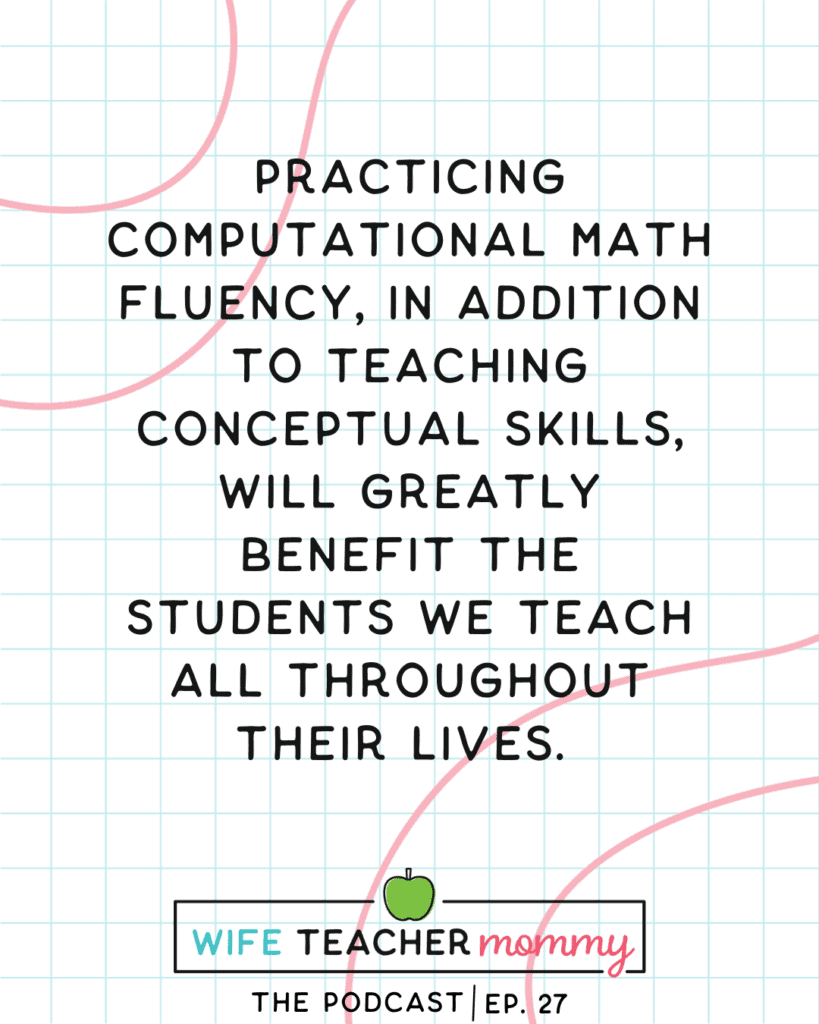
So doing math fluency even helps kids develop their number sense. They understand relationships between numbers, such as knowing they’re fact families, like four plus three equals seven, three plus four equals seven, seven minus three equals four, seven minus four equals three. Learning the math fluency helps them to be able to recall those more quickly. It will aid them in understanding using 10 as a base when they’re doing math. And honestly, when I was doing my elementary ed math classes, and we had to do math problems and bases other than 10 I don’t know if this is an every elementary ed math class but it was for us and it was kind of mind blowing, learning how much the math fluency that I learned to understand the base 10 helped me so much. And while it gave me a great understanding on how to teach the concepts, you know, again, we want them to know the why behind it. That is also important. But it shows how much knowing those math facts and helping me recall the information made the math so much easier. Again, while no means I think teacher memorization is the only way we should teach math, I believe that practicing computational math fluency, in addition to teaching conceptual skills, will greatly benefit the kids we teach all throughout their lives.
A way I think about it, too, is it’s like learning another language. So for example, if you are a native English speaker only like me, and you want to learn Spanish to travel, and you want to learn the rules of language, and how to conjugate etc. But then you also want to learn on knowing and learning individual words that you’ll use the most in that language to make things easier for you as you get out there. So doing both together helps you form a greater understanding of language. And in this case, that is the language of math.
So now that we’ve talked about the why, let’s get into the how. So one way to do this is by using math fluency pages, and you’re probably familiar with these. So these are pages full of math problems, they may be grade level specific, and like different types of operations, or it may be like one operation, or may then be specifically plus one plus two plus three, and they’re working on those. It’s really easy to find the use, you can find tons on Amazon or Lakeshore, and Teachers Pay Teachers. In fact, we have some too that have awesome feedback. And some math fluency pages may have a high point problem on the pages, a lot of programs like Acadians will have this on their fluency testing. So with the high point problem, it’s a bit higher level, and students might gain points for doing it, but they don’t lose any points for not doing it is just kind of a way to differentiate and evaluate honestly. So ours do include those. So then, once you have chosen your math, fluency resources, you can find a timer, I generally recommend doing like one minute, that’s easy to compute how many per minute or you can give them two minutes, if you’d like depends on how much time you have how you want to do it, set a timer, and have the students do the math problems. And remember, you want them to do them as quickly as they can while maintaining accuracy. So any of them that they get incorrectly will not count. So make sure they know that too. It’s not just about speeding through, but it’s about speeding through and getting them correct. And one thing you can do to make this a little more fun for your students is to go on YouTube or Google and search for fun timers. So there’s one that’s even like a baby Yoda timer. I mean, that was five minutes. So it might be a little bit long for math fluency. But a few that have shorter timers, there’s monkeys, there’s volcanoes, fun music, or there’s one with a dog. And depending on when you search it up, you might find different results. But if you can find something fun that your kids will be excited about, you can even switch up the timer, they’ll definitely really enjoy that. And it will make it kind of something they look forward to a little bit more. Maybe take off a little bit of the edge of the stress of it being timed. I hope for my team to put together a list of fun math timers for you as well. And when we do we’ll be sure to go back and link in the show notes in case you’re listening to this while after this episode is live, maybe that will be available. But as of right now, we do not have that yet, I would recommend searching YouTube or Google though because you’ll find the most up to date ones. If we put together a list like sometimes links will expire anyway. So you can probably easily find one that relates to what your students are excited about or your own children at home.
Okay, so another thing you can do if the timer is causing a lot of stress, or if that’s honestly just something you don’t want to do personal preference, you can lower the pressure by not using a timer, but focusing on the improvement of the skills and the kids if they’re able to finish the page and just you know the allotted time, but without a timer. Either way, whether you use a timer or not, I recommend having the kids track their progress, because we want them to compare themselves only to themselves, not to the other students around them. And I actually remember when I was a young child in second grade, and we did the math fluency, like I’m sure a lot of us did. But I was so competitive. And I was a very smart child and I wanted to always finish it. And there was one time that I didn’t I remember the timer went off. And I was like hurrying and trying to finish some and then another girl went and tattled on me that I was doing that. Because it was just such a competitive atmosphere. And I think making sure that students know that it shouldn’t be competitive. If they’re competing, it should only be against themselves. So remind your students of the gap and the gain. This is a concept from a book. It’s by Dan Sullivan and Benjamin Hardy. And I did a session about this at Educate & Rejuvenate our summer conference that we did earlier this year. And I also mentioned it on the podcast in Episode 16. I plan on doing another episode about this concept and diving in a little deeper. But basically the gist of it is you want to compare yourself to now from where you were. So look at the gain how far you come rather than now versus where you want to be. That is the gap. We want to always look at the gain and say Wow, look how far I’ve come. Now from here, I know it can only improve from there. And so you know, you want to improve, but you know that you can, because you’ve done it, you’ve improved before looking at that gain. So looking at it from that perspective, and the students as they see their progress throughout the year with their math fluency. And really, this goes for anything, it will help them to feel more confident in their own abilities, and even take the pressure off, like if they’re feeling a little bit of pressure at the beginning of the year. But as do they realize, oh, it’s not a competition, it’s just me doing the best I can. And me seeing my own gains my own progress, and I am doing an amazing job.
Okay, so another way that you can practice math fluency is by using online games or apps. And there are a lot of these out there. But as I was Googling, there were so many broken links. So I’m not going to name any specific ones, because I know even if I found ones that didn’t have broken links, they might become broken by the time you are listening to this episode, or looking at the shownotes. So I would recommend googling or going to the App Store in whatever program you use, whether it’s Apple or Google, and finding some online games, if that’s what you’re wanting to do. And we also have digital versions of our math fluency passages, if you want something more traditional and more accessible without ads, or anything that can be used digitally. So we have digital versions. So be sure to check those out there in the show notes.
Okay, so the things I’ve named so far are like traditional math fluency practice, but students can also develop their math fluency in other ways, too. So here’s an example. We just created some really fun, I Spy resources. And these are so fun. And if you’re listening right now, August 2022, or anytime throughout the year, basically, we have a growing bundle going on. So if you’re not yet a member of the club, and you want to try our resources, you’re not ready to commit to the club, that’s totally fine. We have a growing bundle for you. So you can check that out, get in on early bird pricing on that. So with those students will look in the I Spy, there’s like different pictures that are monthly themes. So for example, if you’re looking at like October for Halloween, there’ll be a ghost or a pumpkin or whatever. And it’ll be like how many of these are there so they look in the I Spy and see how many they can find. So all the grades no matter what they get to do this part, and it’s so fun. But then based on those numbers, those become like a key or whatever to the math problems that they do depending on their level. For younger kids, they might just be counting those that might be their practice. But for older children, they would then be doing addition or missing value, we’re adding and subtracting decimals, multiplying dividing decimals, whatever level they’re at. And that is a way they will practice those math facts in a more fun and engaging way. And while it’s not explicitly math fluency, like I do recommend doing some of the explicit math fluency. This is another way to get those math skills math fact practice in which will help them become more fluent as they continue to do those problems. Another great way to do this is by playing math games, like math, board games, math card games, there are tons of these that I named actually in episode number 11 of Wife Teacher Mommy, the podcast where I was talking about summer review. But in that episode, it was probably more applicable just to parents who homeschool. But in this episode, I really feel like it’s applicable to teachers and parents, because when you buy these games, you can use them all year long in your classroom or with your own children. So two of the games that I mentioned in that episode, are perfect for practicing math fluency. So one of them is called Sum’s in Space. And then the other one is called Add Sum D and pretty sure that stands for add sum divide. It’s a mental math game that has addition and subtraction, multiplication and division. And it’s differentiated with a star ranking. So I would recommend checking those out on Amazon, they’re on our Amazon list, you can find that in the show notes. But also, if you want to just have some games that you can print and use over and over. We have tons of options for you as well. We have some amazing board games that are ready to go print them out. They have math facts on it, they have language arts, too, you can pick between math, language arts, so our monthly math sub plans at our monthly homeschool lessons include a fun, themed game for every month with math facts. And they also include lesson plans for explicitly teaching math skills before they play the game, which as we discussed at the beginning of this episode is important for math fluency. So over time, as kids repeat the same problems or types of math with these games or activities, they will begin to become fluent. So it’s more indirect, but it’s a great way to build math fluency over time.
Okay, so those are some great ways to incorporate math fluency in your classroom or homeschool. Now I know we have a lot of Wife Teacher Mommy club members who listen to this podcast, we have over 1000 members and I know so many of you are listening. So I want to make it as simple as possible for you to just be able to come in and download the resources you need to put the ideas from this episode into action. So first, be sure to check out our 36 weeks of math fluency. This will give you a math fluency page for every single week of the school year. And these are based on grade level skills from the Common Core. And they also include a higher point math problem so there’ll be like one problem that’s from the grade above that you will be able to use to assess your students. You can also find math fluency in our home learning packets, our summer learning packets and are ready to go sub plans. And we are always adding new resources we take member feedback into account. So some members have said that they love are 36 weeks of math fluency, but they wanted it without operations being mixed up, they wanted to be able to have like just addition or just subtraction. So we have you covered, we have released sets by individual operations rather than grade level. And in those you’ll even have like plus one plus two plus three plus four, and be able to work through those and then there’ll be mixed together at the end. So you can pick which skills you want, you can grab those, download them from the club, we also have those monthly I Spy resources. So if you’re a Club member, you don’t need to grab that growing bundle I mentioned earlier, you can just download them each month as they come out. We also have our monthly sub plans and homeschool lessons, which include lots of great activities. And now teachers don’t be fooled by the title of monthly sub plans. Yes, they are ready to go for a sub. But you can also use them anytime during the year. They just have lots of fun activities, games lessons, you can use them however you’d like. Now, if you’re not a member of the club at this time, the links will also take you to these for individual sale. But if you’re listening to this episode, the week that it airs, you can also do a trial of Wife Teacher Mommy club for just $1. So during your trial, you’ll be able to download up to five resources, and explore and really see what the club is all about. So if you’ve been wondering about the club, be sure to try it out. I will put the link to the trial in the show notes.
I hope you found this episode helpful and that it will help you consider why kids benefit from math fluency practice and how you can implement it into your teaching while making it tons of fun. Now, I’m really excited for our next two episodes. I will be interviewing one of my team members Carrollton, Atlanta. She is a curriculum designer and honestly just all around amazing team member of Wife Teacher Mommy, and Megan Osborne. She helps with blogging and Instagram. And she’s even helped her products. She is amazing too. She’s going to be talking about social studies and Carol will be talking about differentiation to meet every child. So these next two episodes are going to be really fun. So be sure to stay tuned so you don’t miss out on these incredible interviews. I can’t wait for you to meet a couple of my team members. So we will talk then. Bye bye.
Being an educator is beyond a full-time job. Whether you’re a teacher or a homeschool parent, the everyday to-do list is endless. Between lesson planning, grading, meetings, and actually teaching, it probably feels impossible to show up for your students without dropping the ball in other areas of your life.
Wife Teacher Mommy: The Podcast is the show that will bring you the teacher tips, practical strategies, and inspiration that you need to relieve the stress and overwhelm of your day-to-day. Your host, Kelsey Sorenson, is a former teacher and substitute turned homeschool mom. Tune in weekly to hear Kelsey and her guests cheer you on and help you thrive as a wife, teacher, and mommy. Because with a little support and community, you can do it all. For access to every single Wife Teacher Mommy resource, join the club at educateandrejuvenate.com/club.


One Response
Great information as well as great tips for instituting math fluency practice.