

Listen on Apple Podcasts | Listen on Spotify
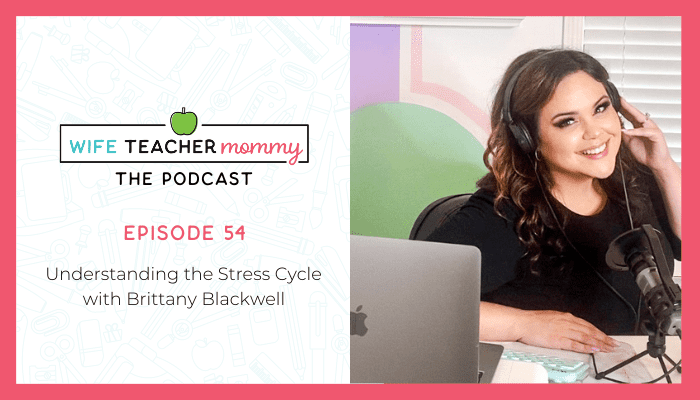
Are you feeling overwhelmed as a teacher or homeschool parent? You’re not alone. In Episode 54 of Wife Teacher Mommy: The Podcast, we dive deep into the stress cycle and its implications for educators. Join me, Kelsey Sorenson, as I chat with Brittany Blackwell, an award-winning special educator and the host of The Resilient Teacher Podcast. Together, we explore practical strategies for managing stress and preventing burnout, providing you with the tools you need to thrive in your teaching journey.
Today, I’m thrilled to be joined by Brittany Blackwell. I recently met Brittany through Sara Whitaker, the talented host of Podcasting for Educators. Brittany is a master’s in education holder and an award-winning special educator with over ten years of experience. She is passionate about empowering teachers and educational leaders to prioritize their mental health and develop sustainable resilience plans to combat stress and burnout.
In this episode, we discuss the concept of the stress cycle, which Brittany learned about from the Nagoski sisters’ book Burnout: The Secret to Unlocking the Stress Cycle. This book outlines how stress affects our bodies and minds and the importance of understanding this cycle in managing our well-being as educators.
Brittany explains that when we experience high stress, our brains activate the fight-or-flight response. This is a natural reaction designed to protect us in dangerous situations. However, in a teaching environment filled with constant pressures—like evaluations, state testing, and challenging classrooms—this stress response can become overwhelming and unmanageable. Over time, this ongoing stress can lead to burnout, leaving educators feeling trapped in a cycle they can’t escape.
Understanding the stress cycle is crucial for teachers because it helps identify the root causes of stress and offers strategies to mitigate it. Unfortunately, this essential knowledge isn’t always taught in teacher prep programs, and many educators may not even realize how the stress cycle impacts not only themselves but their students and colleagues as well.
Brittany emphasizes the need for teachers to engage in self-care practices, set boundaries, and seek support from friends, family, or mental health professionals. These actions are vital for breaking the cycle of stress and creating a more fulfilling teaching experience.
If you’re looking for ways to break free from the stress cycle, Brittany suggests starting with self-awareness. Take some time to reflect on your stress triggers and make a list of what causes you stress. By identifying these factors, you can begin to develop healthy coping mechanisms tailored to your needs.
We also discuss the importance of reconnecting with your body and recognizing its signals. Brittany shares practical exercises, such as breathwork and intentional sitting, to help educators become more aware of their physical sensations and emotional responses.
Throughout our conversation, Brittany provides valuable resources and insights to help teachers navigate their stress and build resilience. She offers two free guides: the Ultimate Teacher Vision Guide and a Breathwork for Burnout Recovery guide, which can assist educators in creating personalized plans for managing their well-being.
Remember, you have the power to break the stress cycle and create a more balanced and fulfilling teaching life. Don’t forget to check out the links to Brittany’s resources in the show notes. Until next time, take care of yourself and keep striving for your best teacher life!
Do you love Educate & Rejuvenate: The Podcast? Take our podcast quiz to get a personalized playlist of episodes you don’t want to miss!
You are listening to episode number 54 of wife teacher mommy the podcast stress management for teachers understanding the stress cycle with Brittany Blackwell. What is the stress cycle? And how does it more than likely affect you as a teacher or homeschool parent? Let’s find out how you can manage your stress together.
I’m so glad you’re here listening to wife, teacher mommy the podcast today. I’m your host Kelsey Sorenson, a former elementary teacher turned home school mom. Whether you are a teacher or homeschool parent, my goal at wife teacher mommy is to provide you with full teaching ideas and mindset tools. To help you live your absolute best teacher life. Be sure to hit subscribe on your favorite podcast app so you don’t miss an episode. Now let’s go.
Welcome to today’s episode, I’m so excited to be here with you again today, or for the first time so whether or not you’ve listened to this podcast before, I just want to remind you that the purpose of this podcast is to help you with finding ideas and resources to streamline your teaching, make the planning and teaching part easier. But then also find ways to manage your mind handle burnout and stress. I believe that both of these things are key as a teacher. And we are going all in on both we did in 2022. And we’re just upping the ante here in 2023. So it’s January beginning of January as I’m recording. If you’re listening live in 2023. I also want to tell you to mark your calendars for January 18. Now I can’t tell you why yet, but we’re doing something super exciting to celebrate that we almost doubled our product catalog in 2023. We added 713 listings. Now I definitely could not have done that all myself, right. I have this amazing, incredible team that makes it so we can do this podcast, we can continue releasing resources so we can coach you and host big elaborate virtual events. So not only did we add all that additional support through the podcast events and coaching, but we’re also not anywhere near done with giving you all the resources that you need to save time teaching. So exciting. So anyways, today I am excited for this interview with Brittany Blackwell. I recently met her through Sara Whitaker, who does the podcast podcasting for educators. And she’s really, who helped me get started with podcasting and has edited the podcast on so many things. She’s great if you are an educator who’s like I want to know about podcasting, but she held a meet and greet. And that’s where I met Brittany, from teaching mind body and soul and the resilient Teacher Podcast. And we both I feel like we just kind of clicked because we both love the mindset part of teaching. And she reached out to me like via email like right after and it was already on my mind. Like I need to email her. She’s probably like one of the first people I want to reach out to. So I think we both are just like, yeah, let’s get on each other show so much fun. And I want to do that with many of the other people I met to so many great podcasters out there. And I’m excited that Brittany was willing to come on the show, and she had me on her show too, will be soon. I’m not sure when she’s airing our interview, but be sure to check out her podcast. So when we were planning, she sent me a list of topics and I saw the stress cycle listed. And I just knew that we had to talk about that one, because I read the book come as you are by Emily Nagurski a few years ago. It is an incredible book if you haven’t read it yet. So we did it for one of our wife giveaways. And the reason we put it under that category is because this is a book about I mean, in case you have little kids that you’re listening to this with kind of about intimacy. And it is an incredible book. But it is about that topic as I was listening to it because I actually this is one a lot of times like to get a physical copy and an audio copies so I can like listen to it to get through the whole thing than the physical copy to like refer back to certain parts. It’s just like a time saver to me that makes it easier for me to refer back to and this is one of those books I did that with because it was so good. And I can see how the concepts not only applied to that topic, but also to everything in your entire life and then been ghosted. You sisters actually came up with a book that talks about this called burnout, which is in more of a general sense. They kind of created this concept of the stress cycle now Of course, they didn’t create how the world works or anything, they just kind of put it in this model of the stress cycle, kind of like Brooke Castillo did with the model that the self coaching model I talk about a lot on the podcast. But really knowing this stress cycle and understanding is really key to managing stress. So if you’re ever feeling stressed out with planning lessons, or balancing teaching and everyday life are the other roles that you have. That’s why we’re called wife teacher mommy, we know you have way more than just teaching that you’re doing in your life. This definitely applies to you. So before we dive in, let me introduce Brittany. So Brittany is a master’s in education, and she is an award winning special educator, podcast host of the resilient teacher, podcast and teacher, resilient strategist from South Carolina with over 10 years of experience working with elementary and middle school classrooms. Brittany is no stranger to teacher burnout and has a passion for empowering teachers and educational leaders to prioritize their mental health and develop individualized sustainable resilience and recovery plans to reduce stress prevent burnout and create the life you’ve been dreaming about Brittany’s digital approach to self care and resilience through digital planning, Vision planning, and sustainable strategies has reached the homes of 1000s of educators across the world. Also known as Miss Princess teach on tick tock Brittany social media following grew through her fast pace, light hearted tutorials and humorous real life experiences. Brittany helps teachers create their own individualized resilience plan by providing sustainable strategies, personalized coaching, mindset shifting and digital resources to reduce stress, automate the mundane tasks of teaching and prevent overall teacher burnout. Her approach gives support so that educators can maximize fulfillment and effectiveness in their personal and professional lives. Isn’t that incredible? You can just start to tell that this is a huge treat that we have Britney on the podcast today.
So let’s see what she has to say. Hey, Brittany, I’m so excited to have you on the show today, we’ve been having just so much fun. We just recorded an episode for her podcast over the resilient teacher and then we’ve just been chatting away. And I feel like we have like a lot of things in common and like our love for like personal development and teaching and helping teachers. So I’m just so excited to have you here.
Yes. And I’m so thankful that you invited me onto the show. Yeah. So before we dive into today’s topic, which is the stress cycle, which I’m so excited to talk about, um, tell us a little bit about yourself, like your teaching background, when and why you started the resilient teacher and then even just something fun and relatable about yourself.
Yeah, so my name is Brittany Blackwell. I am still in the classroom. As a special educator. I’ve been in education for 11 years. And I’m a previous Special Education Coordinator, which I loved. But I returned back into the classroom after my first daughter was born because I wanted to spend more time with her and actually have some work life balance. That’s funny, huh. But my husband and I, I remarried. We have five kids together so that we have a large family. And I’m all about simplification, reducing overwhelm. If I wasn’t about those things, I would go crazy because we have so many kids. But I dealt with some really heavy burnout personally, professionally. So I did some extensive research about self care, personal and professional growth. I stress management, brain science. I’m a huge nerd. And what really when we entered, you know, pandemic teaching, I started sharing tips, tricks, those sorts of things on tick tock things that were helping me with like technology, things like that. And what I noticed was, there were some really amazing teachers like a total passion and love for teaching that were leaving the classroom, and they were citing burnout as their biggest thing. And I’d been there like, I’d done that I bought the t shirt and learned all the things. And so at the time, I was like, You know what, I’ve already I’ve researched this, I need to share what I’ve learned over time and really synthesize it into a way that I can share that information with teachers. So I shifted my focus to teaching educators everything that I know about stress, burnout, simplification, boundaries, all that fun stuff that really isn’t discussed in teacher prep programs. And I started my agency teaching mind, body and soul and I began my podcast, the resilient Teacher Podcast in the summer of 2022. And that was just really help reach and teach more educators. So now what I do is I am a teacher resilience and retention strategist, so I help encourage and inspire overwhelmed teachers, leaders, schools and districts to really prioritize mental health individualized Elliott’s in burnout recovery. So we can reduce that stress, prevent that burnout create that life we’ve been dreaming about, and really make a change and our broken system of education.
I love that I love this work you’re doing. I think it’s so important that teachers are able to find ways to get through that stress and that burnout with all these tools that you’ve learned in your years of looking into that and everything. And I love what you’ve done with teaching mind, body and soul and your resilient Teacher Podcast. For some reason, I mixed up those names at the beginning. Sorry about that. No, that’s okay. No, it’s fine. But yeah,
I’m so excited to talk about this topic. So because like when you sent me a list of topics, you sent me a few. They were all great topics. But when I saw the stress cycle that really stood out to me, actually, because I loved the book come as you are by Emily, Nagasaki. Is that how you say her last name? Yes, yeah. Nick offski. I love her book. And her TED talk. I mean, and the book, I mean, it’s not related to teaching, it’s all about sex. It’s a really good book, because like I was listening to it. And a lot of the concepts were, I was like, Oh, this doesn’t just apply to the bedroom. This applies to everything. So yeah, I love that book. And I know they wrote another one that’s more just about burnout that I haven’t read yet, and is on my to be read list. So when I saw that topic, I was like, oh, I want to talk about that today. So like, it’s been a little bit since I read it, though. And I’d love a refresher. And I bet a lot of our listeners are like, what’s the stress cycle? So can you tell us a little bit about it?
Yeah, so actually, I haven’t read come as you are. But that is on my to do list. And I actually learned a lot about the stress cycle from the Nagurski sisters book, burnout, the secret to unlocking the stress cycle. So it’s an amazing book really led me into doing other research kind of synthesizing about stress and burnout. So when we say, the stress cycle, I kind of have to give a little background about stress and how it works. So you can kind of understand the cycle. So psychologically, what happens in our brains during high stress is we set off our brains fight or flight response is that heart beating faster, a bump, our blood pumping harder, our blood pressure increasing, and you breathe more quickly, okay. So that’s when you’re like, your muscles are tense, and your attention is lowered, and the hormones and the neurological things that are happening actually change your entire body and your mind in response to perceived threat. So that’s where that flight part comes in. And so our brains create these reactions within our body that tell us to run it’s a, like an evolutionary thing. So like, Take, for example, back in the day, you go out into the wilderness, you’re walking along, there’s a bear, and your body’s natural response is to just run right? Until you’re safe. So once that bear is gone, your body knows that it’s safe and the cycles ended. What actually happens in our bodies, when we’re in this constant state of stress, even when our brains activate that stress response, it doesn’t change the situation. So for us as like, teachers, we may be confronted by a stressful class, right? They’re rowdy, they don’t listen, the behavior is out of control. And our brains say, Run. So in our way, like we run, right, we get home that day, we switch on Netflix, and we disassociate to try to, like, forget that difficult class. And our brains like we escaped the bear. Okay, we’re good. And the next day that out of class hand, or the out of class hand, out of hand class is still there. So our brains tell us, you know, run again, yeah. Exactly, over and over and over for like a semester or more. So as educators, we have these layers of stress put on us one at like, at one time, we’ve got evaluations, we’ve got state testing, that rowdy class, that parental communication, so there’s more to the stress cycle than just one piece of the puzzle. And when we get stuck in this stress response, because, you know, we’re stuck in stress activating situations, it’s not always a bad thing. But when the stress piles up so much that it outweighs our capacity to really process it. We’re at risk for becoming burned out. Yeah.
Wow. And that’s just such a crazy thing to realize when you can kind of pull back and look at what’s going on and be like, Oh, my goodness, I’m in this cycle. And if days, I guess it’s just gonna keep going around and around and around. Like, that’s the definition of a cycle right over. Yes. So why do you think understanding the stress cycle is such an important for teachers to be aware of, especially right now in education?
So I think that the reason under stating the stress cycle is so important for teachers to be aware of is because I mean, the obvious, it’s not taught in teacher prep programs, it’s not something that is ever really brought up unless you search for it. Or you have the psychology professor in college that just had a knack, you know, for stress management, or you’re just a complete nerd like I am. And you just read constantly about how our brains work when it comes to stress and burnout. But c, your home life, all those things, so that we can live this happier, more fulfilled life, because it’s not really talked about teachers don’t even notice that the stress cycle is also you know, impacting their students. It’s impacting our colleagues. And so over time, what happens when we never intentionally like release, or, you know, us tools or strategies is it accumulates in our bodies. So it creates this long term, like neuro pathways that keep us in the state of fight or flight and they begin to creep into our identity, they attack us as individuals. And that’s not, that’s where we’re not really able to manage even even like seemingly minut little stressors, and they lead to physical illnesses, that can really impact us for the rest of our lives. So it’s also like a piece where we’re talking about, like, you know, on the news or on social media, teachers are leaving, and we have a shortage of teachers right now, because this isn’t something that’s talked about, you know, district and educational leaders aren’t really prioritizing that mental health piece of our educators. And so it’s not really just essential that we understand the stress cycle, how it impacts us, but also how it has to impact our students or colleagues, the system in general. And when we can really recognize and learn those tools and shifts that support us as individuals, then we become active participants of change for ourselves, but also for the broken system.
Oh, I love what you said about that. Because not that self is not important. We want to break this for ourselves too. But in the whole system is like in this cycle, too. So it’s like how is it impacting our students? How is it impacting administrators or the other teachers in the building? And yes, wow, that’s like a big, a big thing to just kind of think about and simmer on and be like, huh, this is really fascinating.
Yes, I am completely fascinated by it. But when we think about it, also, you know, the stress cycle, we’re obviously dealing with that. But if we think about students with like trauma, or even like our kids at home, you know, like our actual kids, recognizing that they can get stuck and the stress cycles to when we’re aware of it for ourselves, we can help them, move through it and get through it as well. So it’s not just about you know, us breaking that so we don’t burn out, but helping to regulate our kids, our students, other people, you know, all of those. It’s really it’s like a ripple effect.
It really is. And I actually, if you don’t mind if we go off script for a minute, because I had like this thought when you were talking about that flight, fight and flight and everything, because I think I mentioned with you that I’m working on my life coach certification. Why No, no, I did on our other podcast. And they actually talked about this with trauma responses, but they talked about it being the fight flight, freeze and fawn. Yes, there were two other ones. How do those ones do? Are you familiar with those ones and how they fit into the stress cycle to you? Well, so they they do they fit into it, but what happens is our bodies create these neuro pathways. So oftentimes, what happens is when we have a stressor, or over time, we’re in a stressful situation, our body starts creating these neuro pathways to where we’re going to that specific thing over and over and over. For teachers during the pandemic. It was always stressful. It was always, you know, like it was one thing after the other. And so when we have that freeze response, it’s often because we’ve exhausted the fight or flight response. So there’s this book called bears that I have normally on my books right here, but the Body Keeps the Score. And I’m obsessed with it. I’m obsessed with it. I love it because it really talks about how trauma gets stored in your body and it talks about the dog these dogs and how they were traumatized. And they had two separate sets of dogs. So what happened with the dogs that were constantly stressed was they did they they reached that Um, freeze or that fawn, and they just lay down and dealt with it. And you can see that with people also. But typically what happens is you, you want to run first. So over time as you get to that burnout stage, that’s where it’s like you’ve learned, okay, well running doesn’t do me any good. And you start to do that freeze or that fun.
Yeah. And the fun was a brand new one to me. I mean, I just learned it last week. I was like, Wait, fine. Like, this is new to me. And just for those who don’t know, it means accommodating and people pleasing to decrease the chances that you become the target of the
bear. Yep, I might think about that with teachers. Yeah. Yeah. Like, think about that with teachers, like teachers will learn, okay, well, if I can’t run, or if I can’t advocate for myself, then I’ll just say yes to everything. I’ll just, it’s fine. I’ll do that. You know. So that and that leads to more stress. Yeah. Because you’re not staying true to yourself. You’re not staying authentic to you. It continues that cycle, like, whether it’s fight flight, freeze, or fawn is you have that response, and it keeps going. Yep, over and over a mess, right? Do we have?
Yes, there are ways to end the stress cycle so that you don’t burn out?
Are you enjoying this episode of the podcast? If so, you will love the life coaching program inside wife teacher mommy club, you will get to join us in two to three live group coaching calls on Zoom every single month, we’ll pick a new topic for a workshop for our first call every month, and then have an open color to where members can bring their own questions. Every call will be available for replay on the members only private podcast so you can get more coaching via on the go podcast forum just like this. Plus, you will have access to our Ask a coach page where you can submit your own questions anytime for all your teacher struggles big or small. The life coaching alone is worth the small 2999 A month fee, I promise you won’t find life coaching for this price anywhere else. Plus, you’ll get access to our entire teaching resource library of over $4,000 worth of resources and growing every single month. Go to teach your life coaching.com To learn more about the life coaching inside the club. Yeah, so How can teachers determine the best way to end the stress cycle so they don’t burn out?
So the first thing I want to recommend is that what we do is we discover our why, or our triggers for the stress cycle. And so this means like taking just like 15 minutes, and making a list of all the things this year or this semester or even just this month or this week, and write down like what stressed you out? Was it a specific class or a task? Was it a specific person, K or co worker, like think about the things that really stressed you out, and don’t just like limit these things to like school things, because oftentimes, our out of work experiences can really impact our burnout at work as well. So when you do that, just think about the emotions you had what’s happening there, and you can categorize them into similar situations. But the purpose is to really just make your self aware of all the things that may have previously or you anticipate really to cause you to not in the stress cycle, or perpetuate it really. So once we know like some of those root causes, which I’m going to be honest with you there can be like a lot, we can begin to look deeper into the actions that we can take to really mitigate the stress from those specific causes. But what we need to do is be able to develop healthy coping mechanisms. So it’s really important to develop those to manage stress and prevent burnout. And I talk about this a lot on my podcast, like ways that we can do that. But this is like exercise in the book from the Nagasaki’s because Nagasaki sisters, they talk about there’s like five main ways that we can do that. And they sound super simple. But the majority of us don’t do it daily.
Works like oh, yes, you exercise. You’re like, oh, yeah, I know, I should do that. But it’s hard.
Yes, exactly. And it really kind of perpetuates stress as well. So it has to do with developing those. So not really focusing on all of the things all at one time, just maybe one, but just to reduce those stress levels or you know, deep breathing those types of things. And then this I hate this term, but there’s no other way to say it, like practicing good self care. I know I No, no, no, no, I don’t like it either. Because when people hear self care, they’re like, I’ve already heard this at the PD the other day, you know, but like taking care Have yourself is really crucial for managing that stress and preventing burnout. Like, when we’re self aware, we can really self care. I know, I know. But this is like getting enough sleep that eat that eating healthy, that engaging in activities that really bring you joy and fulfillment. And another way is to really seek support. So oftentimes, we see teachers that don’t have this supportive community. And I think that’s a really big piece of support from friends or family mental health professional, I’m a huge proponent for any teacher who’s really struggling with the stress cycle, because they can be addicted to stress, which is a whole nother topic. But that talking to a professional, there’s nothing wrong with that. And you should totally do it. Because it can become a self awareness practice, but also teach you some of those skills and help you to do that without overwhelming yourself. But then, the other way that we can really end the stress cycle is to set boundaries. We can’t do that without being self aware, without really focusing on what is that main cause that’s causing us to become stressed? What are what is that trigger that’s happening? So setting boundaries, is really important for preventing that burnout, maintaining that healthy work life, I don’t like the word balance, but alignment. So this is like setting, like limits to what we’re doing. delegating tasks, saying no to those unnecessary commitments, that maybe is from that fun, that people pleasing that we were talking about. But when it comes to really ending the stress cycle, really just telling yourself, the number one thing that’s not gonna work is telling yourself, it’s gonna be okay. Because I’ve always hated it, when people told me just don’t think that, you know, like, just remind yourself, it’s going to be okay, there’s a reason that doesn’t work. The fact is that completing that stress cycle is not really an intellectual decision, like Nagurski said in her book, like it’s a physiological shift, right? It’s like, we don’t have to tell our lungs to keep breathing or our stomach to digest food. And even if we did, our body’s going to do what it wants to do. So you can’t really complete the stress cycle through a deliberate choice, you give your body what it needs, to complete the physiological responses it’s designed to do.
Yeah, and this is so fascinating, because I feel like there are like, different ways we need to take care of ourselves. Because kind of, like I’ve mentioned, like, you know, I’ve been working on this certification, we talked a lot about this model, where it’s like, you know, there’s our circumstances and our thoughts, our feelings, drive actions and create results. But like we talked about, that is only an awareness tool, it doesn’t mean that you can say, I’m gonna change my thought, and now everything is better. Like, you can’t just say, oh, everything’s gonna be okay, great, I’m done. Because that doesn’t work. Like, you don’t have thought. So how on earth? Is that gonna work? Like, you would have to believe it? So right? Sometimes we have to go to our bodies first and like, take care of them and figure out okay, what do I need for my own self care and to take care of my body. And we don’t always like to think about that. Like, I remember, like, when I first started this personal development journey, I wanted it to be more intellectual, and not about feeling, but feeling is such an important component of it.
Yeah. And, you know, when we think about, like, what our bodies are telling us when we’re, if you’re in burnout, which I, you know, like I said, I’ve been in burnout, I’ve been burned out professionally. And personally, it was like, I was disconnected from my body connect disconnected from my identity and all of these different pieces of myself. It’s like, I lost myself. So really being intentional with looking at what what stressing you out and moving to that piece of self awareness is really that key to beginning to make that change.
Yes, that’s so fascinating. And, and what would you say like, you know, so people are starting to, like, look at their body become aware of these things, all the stuff we talked about, like how do people like you know, they’re so in their head, and they have a hard time getting into their bodies and feeling all those things? What would you recommend that they do to be able to start breaking the stress cycle by getting comfortable with even just the idea of that it’s not intellectual.
I think the hardest part about getting back into your body is, especially if you’re a stress addict, is that you feel really weird just sitting and not doing anything, right. Like we learn to disassociate by moving and keeping going and, and you know, oh, well, I finished this. So I’ve got to go do the laundry, or I’ve got to do this. And so really being intentional with I’m going to sit for five minutes and I’m just going to sit I can’t remember what book I was reading the other day because I read like 50 books all at one time and Sighs information. I know that sounds crazy. Oh, well, I’m glad you do too. I like my currently reading on Goodreads. I’m like, crazy.
No, because I synthesize what I’m reading but it was like the oh, I remembered what it was in it was in untamed. I think that’s the name. Oh, yeah. Glennon Doyle. Yeah. Yes. She was talking about, like, she just sat, you know, she had to sit in her closet, and she had to just sit, and she would make herself but it felt weird at first. But if you’re just taking that intentional time to sit and just recognize how your body feels, it’s like, you’re going to start realizing after, you know, if you do this practice, you know, five minutes a day, for 10 days, you’ll start to realize, oh, shoot, I’ve got like tension in my shoulders, I’ve got like, you know, it feels really heavy. Or I’m really not sitting, I’m sitting more like this, or I’m sitting more crunched up. And it’s like your ears or at your, or shoulders or at your ears. And you start to recognize what your body is doing. And then over time, it becomes, oh, what is my body telling me, like, I’m stressed, I’m stressed because my neck, my shoulders, right? My ears, my, my shoulders hurt. A lot of times we hold stress, like in our shoulders or back and things like that. So just noticing or being able to just sit and have a practice for like a week or two, where you’re just having that five minutes will make you so much more aware.
And now I’m like, already, my brain is going with what you said, because I feel like like you mentioned, you might be like, Oh, I have this tension. Oh, yeah, that means I’m stressed. It’s like, oh, bingo. Like, there’s awareness and stress. You don’t need that time to do that. And even notice what your body is doing. And you’re just going that cycle, you’re not gonna be broken. Exactly. Exactly. Fascinating stuff that we do.
Yes, I love it. I geek out over it.
It’s so cool. I feel like we need to, like start a book club or something. Because, oh, let’s do it. So I know what are some books or resources that you use to learn about the stress cycle teachers want to like head to their library and check something out to learn more about this because I feel like you’ve named dropped a bunch. And I want to know, selfishly to see. So my two favorite books, which I’ve already referenced, in this episode, are burnout, the secret to unlocking the stress cycle by the Nagasaki sisters. They’re twins. So it’s two of them. It’s not a dull read. It’s like it gives you a lot of information, you move through the pages with like tons of information, but it’s also got like a story telling to it. And I just really like how they give like real life examples throughout their writing as well. And then the second book that really brought me a lot of information in stress and how it is stored within your body is addicted. Oh, I didn’t tell you about this one. addicted, yes. By Debbie Mandel. It’s not only bringing that piece of how we can be addicted distress, which I’ve talked about on my podcast on my tech talks and stuff like that. But it also gives some really actionable steps to releasing stress and reclaiming that joy, that spontaneity, that free spirit we all want to have. So it’s a really good book, but I also really like the Body Keeps the Score. It’s not as much of a good, like, storyline read, read. But it’s like fascinating stuff. Or at least it is to me, because I never realized how much your body keep stress keeps trauma, and how that really can impact you in the long run.
Those are all I’m adding the ones that I have not read yet to my list. Yes. So I can read them. And then a couple I might I want to know if you’ve read because if not, I think you would like them is at the heart by Brene Brown, do you have that one?
I don’t I don’t put that on my list. Because that when she goes through and like literally talks about each feeling and even the nuances between like envy and jealousy, like those are different and like all these different feelings and breaks them all down. And it is fascinating. I listen to the audiobook and about a hardcopy so I can like refer to it, but and be like, Oh, what am I feeling? Brene helped me figure it out, you know, because it’s just kind of like this reference book. And it’s beautiful. Like, I can see it right there. But it’s like, this big hardcover with like, full color illustrations. It’s such a good book.
Oh, I’ve got to check it out. I’ve got now I’m gonna have to go grab it. Now it’s on my list. But now I gotta go grab like coffee table book. Like even if you don’t have time to like, read the whole time. It’s when you could just like digest a little bit like, oh, let’s learn a little bit more about gratitude today. You know, like, yeah, like a few minutes. Yeah. Another one that I need. dig into more I’ve, it’s more of a reference book that I’ve used a few times that my first life coach I work with recommended. It’s called feelings buried alive never die. That’s another one that goes into, and the physical things that go along with them. So if you’re actually having a physical ailment, you can look that up and see like what it goes with. It’s pretty fascinating. Oh, yes, I thought you might be interested in those to me that one again. Feelings buried alive never die. I can’t even remember who the author is. But I’m sure if you Google it, it’ll come up.
Yes. Okay. Right. But no, yeah, that’s a really good book. And we’ll link to all of the books both that Brittany shared, and that the two that I recommended to her. In the show notes, I would highly recommend grabbing those books, whether it’s at your library or audible or if you’re like me, and you just like to own your own copies and hoard books, and hoard books. My sister, she bought me a t shirt, actually, it says it’s not hoarding, if it’s books. And I would agree with that. Love that. I would agree. I love that. And like, my goal is to have my own little library one day, like, yeah, maybe when the kids move out, we can turn one of their rooms into my library, that would be okay, so and I understand, though, that so these books, they aren’t like tailored just to teachers. So I understand that you’ve a freebie for our listeners that you put together that would apply directly to them. Can you tell us a bit about that? And maybe if you have some other like resources and things that you do not keep hitting my mic, other resources or things that you do that would kind of relate to this?
Yes. So really, anything that I do relates to? Well, there you go, actually, I actually have two to share. Because one of the biggest areas that I focus on in burnout, recovery and personal growth is it’s not a one size fits all mentality. So we’re each unique individuals. And what works for one person is not always going to work for another person. So the first one that I have is the ultimate teacher vision guide. And it’s my secret weapon that’s going to change really, how you see your career. And it kind of reminds you of your personal vision, your values, it keeps you focused on what you value the most. It aligned you and allows you to feel more fulfilled in your teaching career. So it comes with a free template. Also in the guide that you can use to make your own digital vision board, you can get that in the link in the show notes, or head over to teaching mind, body and soul.com/vision. And then the second one is just a really simple practice. Anyone can do it anywhere. And it reduces stress. It’s evidence based, scientifically proven, it will help you intentionally in the stress cycle. And this is breath work for burnout recovery. And it’s a guide. And it’s going to provide you with strategies for your own personal burnout recovery. But also, you could use it in your classroom too, if you wanted to. You can learn how breathing increases your awareness for your inner experience. It also helps you use breathing to release tension and relax. It helps you to use breathing to reduce or eliminate the symptoms of stress. And it’s one of my favorite practices to implement. Because it’s one of those things that you can just be like, Hey, I’m already doing this anyways, just let me change up how I’m doing it to intentionally really stress. So you can grab that one at teaching mind body and soul.com/breathwork or head to the link in the show notes that you’ve got to check that one out too.
Awesome. Well, thanks for providing those with. For our listeners. I think Those both sound incredible and I cannot believe that they’re free. Is that right?
I know. Right?
Where else can our listeners find you to connect to like your podcast, social media email? Yes.
So I love love, love of love to connect with other educators, especially those ones who are overwhelmed looking for ways to break that cycle of burnout, and really reignite their passion for teaching. So the listeners want to learn more from me. You can find me on Instagram at teaching mind body and soul or I’m a lot more popular and active on Tik Tok at Miss Princess teach. But I also have a podcast the resilient Teacher Podcast. It’s my hub for bringing those weekly episodes that really just like inspire, validate provide those sustainable strategies for all of those things. So if there are teachers out there who are struggling with stress or burnout or just overall sustaining their career in education, come hang out with me DM me Because seriously, like I want to chat about burnout. I want to chat about teacher journeys, all that good stuff.
Well, you’re amazing and everybody go follow her on all all the things because thanks. This episode was incredible. And I’m sure you all want some more of that. So thank you so much, Brittany for taking the Time to talk with me and share about the stress cycle. I’m sure all of our listeners are going to learn a lot from this and see how it applies to their lives. But hopefully, they gain some awareness of how they can break that cycle too. So I appreciate you so much. Thank you so much for having me on the show, Kelsey, and also you’re going to be on my podcast. I’ve got to check it out with you.
Yes, so fun. I love doing these like interview back to back so amazing. So fun. Okay, we’ll chat later, everybody. Bye. If you’re enjoying this podcast, be sure to hit subscribe so you don’t miss an episode. And if you’re ready to take the next step with me, then you are going to love wife teacher mommy club. Our top selling resources for pre K through sixth grades have been used and loved by 10s of 1000s of teachers. The club gives you one click access to all of them to meet the needs of every child to teach while saving tons of time. Plus, you’ll have our certified life coach in your back pocket. With several monthly workshops and an Ask a coach portal you can use 24/7 The combo of resources and coaching is our secret sauce to your best teacher life. Think of my team and I is your personal team, doing the lesson planning for you and on the sidelines coaching you and cheering you on as you focus on what you do best impacting the children you teach. Plus, if you’re loving this podcast, you’ll also have access to our private podcast just for members, where I continue the conversation with all of our guests with members only bonus episodes. And don’t forget the club with VIP access to educate and rejuvenate our Summer Conference and our private Facebook community full of like minded educators support each other. You do so much for everyone else so it’s time to invest in yourself. Your t shirt friends jaws will drop when they see just how quickly you finish your planning. Not to mention the glow of the happier, more fulfilled you head on over to wife teacher mommy club.com to learn more.
Being an educator is beyond a full-time job. Whether you’re a teacher or a homeschool parent, the everyday to-do list is endless. Between lesson planning, grading, meetings, and actually teaching, it probably feels impossible to show up for your students without dropping the ball in other areas of your life.
Wife Teacher Mommy: The Podcast is the show that will bring you the teacher tips, practical strategies, and inspiration that you need to relieve the stress and overwhelm of your day-to-day. Your host, Kelsey Sorenson, is a former teacher and substitute turned homeschool mom. Tune in weekly to hear Kelsey and her guests cheer you on and help you thrive as a wife, teacher, and mommy. Because with a little support and community, you can do it all. For access to every single Wife Teacher Mommy resource, join the club at educateandrejuvenate.com/club.


