

Listen on Apple Podcasts | Listen on Spotify | Listen on Stitcher
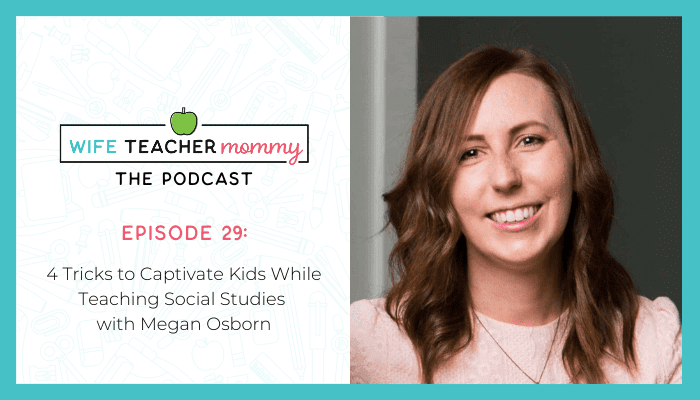
In education, we put more of an emphasis on the subjects language arts and math, but there’s so much value that comes from other subjects, such as social studies. On today’s episode, I have guest Megan Osborn, who is one of my team members on Wife Teacher Mommy, and she helps shed some light on the value of teaching social studies. More specifically, we’re discussing 4 tricks to captivate kids while teaching social studies.
Megan is a former middle school social studies teacher and a graduate of Utah State University. She stopped teaching when her first daughter was born, but has continued working in education working with homeschool families, and later coming to work at Wife Teacher Mommy.
With the big two subject areas (language arts and math) taking up a lot of time during the school day in an elementary classroom, Megan reveals how teaching social studies can open up a new world for students. She explains that it allows students to make connections to the world around them, provide a different perspective on ideas, and teaches them how to be a good citizen. By teaching students our history in a way they understand how that’s related to modern day, is a powerful idea of thinking.
While Megan admits that social studies might not be everyone’s favorite subject, she provides 4 tricks to captivate kids while teaching social studies. Those tricks are: organization of the content, telling stories, use of different media, and field trips. During the episode, Megan breaks down each trick and how to effectively use it in your classroom. She provides simple ways to incorporate them whether you teach in a traditional classroom or homeschool your kids.
Throughout our conversation, Megan emphasizes that teaching social studies doesn’t have to be an isolated event. In fact, using language arts concepts alongside your social studies content actually pair very well together. We discuss the idea of research as a way to incorporate both content areas, but there are many other ideas to merge the two together.
There’s a lot of value to teaching social studies and learning about the history and culture of the world around us. In this episode, Megan brings her knowledge and passion for the subject and shares ways to engage your students in the process. By incorporating her 4 tricks to captivate kids while teaching social studies, you’ll see a shift in engagement and outcome of learning.
Megan is a former middle school social studies teacher and a graduate of Utah State University. She stopped teaching when her first daughter was born, but has continued working in education working with homeschool families, and later coming to work at Wife Teacher Mommy. With another daughter welcomed recently, she now has 2 girls– Charlotte and Gigi. In her free time, she likes to cook and bake (especially new recipes!), listen to podcasts, quote The Office, spend time outdoors, and to travel (mostly to try new food).
Hey, everybody, I’m so excited for today’s episode with Megan Osbourne. And you may recognize her or recognize her name if you have been a part of the Wife Teacher Mommy community for a while if you’re in the club, or if you’ve attended Educate & Rejuvenate. She is one of our incredible team members at Wife Teacher Mommy. And while her main role is helping with a blog and social media and search engine optimization, she also really helps wherever she is needed. She’s kind of been a floater on the team lately, as we’ve had lots of different needs with Megan, I need you to help with these products, or I need you to help with doing a session at Educate & Rejuvenate. She’s always been ready. She’s been a go getter and ready to do whatever is needed. And I just wanted you all to meet some of my amazing team members. Because you know, I wouldn’t be able to do this podcast each week if I didn’t have a team supporting me and supporting all of you this our mission together to be here and support you as teachers. So I really want you to get to know some of the other incredible team members here. So today, I will be interviewing Megan. Megan is a former social studies teacher and a graduate of Utah State University. She stopped teaching when her first daughter was born. But she continued working in education first working with a homeschool charter where she was working with homeschool families. And now she works for me at Wife Teacher Mommy, as I explained, and she’s so incredible and helps me with so many things. So we just love having Megan on our team. She has two girls, Charlotte and Gigi and in her free time she likes to cook and bake, especially in new recipes, listen to podcasts, quote The Office, spend time outdoors and travel mostly to try new food. I think a lot of us can relate to that. Right. Okay, so without further ado, I would love to dive into this episode because Megan has so many great tips and strategies for teaching social studies. So let’s get to it.
Megan, I’m so excited that you were able to join us on the podcast today so our listeners can meet you.
Thanks. I’m excited to be here.
So can you introduce yourself to our listeners?
Yeah, so my name is Megan Osborne. I am a mom of two little girls. They’re almost four and two and my work background. So I got my degree in Social Studies, secondary education. I worked as a sub for a couple of years. And then I got my teaching job. I taught seventh grade history, which in Utah is Utah Studies; taught that for a few years until I had my oldest daughter, and then I decided I wanted to stay home with her. So I left the classroom then, but I missed working. So I worked as a homeroom teacher for a homeschool program, where every week the students would submit a learning log about what they did in their classroom. And I would read those and just have a little conversation with them about like, what they were learning and those kinds of fun things. And then I did that for a little while. And then I found Kelsey and Wife Teacher Mommy. Yeah. And so I’ve been with Wife Teacher Mommy for a year and a half. Yeah. Going on two, here soon. Yeah. And I’ve done I think my main job title, I don’t know if I have a job title, my main responsibilities are our blog and search engine optimization for our website. And then whatever else Kelsey needs.
You’ve been so good at just kind of floating to wherever we need help. Yeah, I mean, I do hope to have you know things a little more. little more clear for you. But you’ve just been so awesome. It’s been great. And I love that you’ve had the background and both being in the classroom and working with homeschool families. It’s been really great to have kind of some of that knowledge on our team too.
Yeah, I love it. It’s awesome. I love working for Kelsey. You’re fantastic boss and Wife Teacher Mommy is so cool. I love it.
Thank you, Megan. Okay, I want to hear what made you fall in love with social studies?
So I think my dad, first of all my dad was like, whenever we went on a vacation, my dad found a museum to go to so like, even the most boring museums, like we went to Mount Rushmore as a family. And my dad took us to like a wood carving museum, which was like fascinating to him. And it was actually pretty cool. But it sounded like terrible as a teenager, like wood carvings. So I think I always had that in me. And then I went to college, not knowing what I wanted to do. I had zero idea, but just loved my social studies, classes, like political science, and history was like, I loved those classes. And so I just loved learning about the world around me and how everything was connected. And it just gave me a perspective and an understanding. And I wanted to know more about it.
That is awesome. And I love that you just kind of followed that passion, like you weren’t really sure what you’re going to do. But you’re like, Oh, I love this and kind of lead you into, like you taught social studies, did the homeschool, and now you’re here. And, and I love how it can just kind of lead us different places than we expected. Because I didn’t expect to be like doing this either. It’s just really fun to see where life takes us for sure.
So most of our listeners are probably well, I mean, we may have listeners teaching all different grade levels. But we mostly serve elementary. So why do you think making time for teaching social studies in elementary school is so important, and also for those who homeschool, making sure that they fit that in too?
Right? I think that for me, when I started learning that I loved Social Studies was giving that perspective and making connections with the world around me. Like I was just editing our sub plans, like the text, text, text to world text to self, you know, and I think social studies really does that where you can make these connections are like, Oh, that’s why this happens. And that’s why these countries fight or get along, or these people are acting this way or whatever. So I think it gives that perspective. But I also think from a civics point of view, just learning to be a good citizen, and how you know, the government works and understanding what the Constitution is, and what’s in there, and those types of things, just that civic piece of it is really important.
I totally agree. I and I think you know, when kids like they don’t know, social studies, they’re not going to be aware of like all the current events happening around them, or like even how to vote or whatever. So it’s important that they learn these things, you’re able to form their own perspectives and everything. So that’s great.
Or even just the importance of it. Yeah, even if you don’t learn exactly like how to vote, learning that it’s important to vote, you know, is like a big part of it, and why you should learn more about it.
Absolutely. I love that. And that’s a good point. Because we’re not like, Okay, this is how you register. But yeah, just knowing that, hey, this is something that grownups do, and that you can do when you’re bigger. And it’s important, because, you know, so what are you talked about having four tricks to captivate kids with social studies? And I know, like you mentioned, sometimes, like, when I was a kid, there were times was like, social studies, you know, like, I loved language arts, and I loved the arts. And then when it came to social studies, I was like, man, but then there were times where teachers were able to make it really, really exciting too so what are your four tricks to captivate kids with social studies?
So for our organization, the way you organize how you teach it, telling stories, taking advantage of different uses of media and field trips.
I love those. And I think what I love about these tips you put together is our teachers can use them and our homeschool parents, I feel like that can be used either way. And it might look a little bit different. So maybe we can talk about like how each of them would use each one. What are some different ways that you can organize the way you teach social studies in the classroom or homeschool?
So there’s two ways. I mean, there’s probably actually could be more but the two ways that I’ve talked about are chronologically which is the traditional way, right, you start at the beginning of the time period, and you work your way through that time period. So if you’re teaching American History, you know, you usually start by I don’t know, there’s lots of places you could start there. But let’s say like, in Utah 11th graders use history to which strikes after reconstruction. So that would be like post Civil War up to the modern times. You’d start there. And you’d go through like Civil Var and the reconstruction area you’d move into World War One, Great Depression, World War Two, you like hit the highlights of like the big events in chronological order. And that’s like the traditional way of doing it. And for me, that’s the way my mind goes when I teach events is like this led to this and then this led to that and I think there’s a lot of advantages you can really see cause and effect when you teach that way, like, because of World War One which led to the Gilded Age and then rising credit, which led to the Great Depression, you know, like, it’s easy to teach that like cause and effect when you’re teaching chronologically. And so there’s some really good benefits of teaching chronologically. I noticed, especially in the classroom, and the homeschool is different because you don’t have the time constraints with a regular classroom does. But in the classroom of chronological, rarely do teachers get to modern times. I don’t know about you. But how often did we stop in World War Two, I don’t remember ever learning about like, Korean War, Vietnam War, Cold War, like the fall of the Soviet Union, we didn’t get that in high school. And so that’s one of the downfalls of chronological is you just simply can run out of time to teach everything. So the second way is thematically, which is like organizing based on a theme. So like you could do revolutions. And then you look at various revolutions across all time periods. So you could look at the American Revolution, the French Revolution, the Russian Revolution, Industrial Revolution, and how those like, or what do we call it now? I’m totally blanking on, like, the technology revolution that we’re going through, don’t have a name for it.
Oh, my goodness, I feel like I’ve heard the name. And I cannot think of it right now either.
But whatever revolution we’re going through with technology right now, and like comparing how some of those are easy to compare the American Revolution to the French Revolution, because it’s a government and a change. But like, how do you change that to the Industrial Revolution, or to the tech revolution of right now, you know, and like see those themes, and how they cross each other across time and across different things.
I think that’s so cool how you can teach it that way. Because I feel like Traditionally, it is taught chronologically, but I feel like thematically actually sounds like really engaging too.
And there’s all sorts of different themes. Like you could look at women’s rights or civil rights, you know, how did history of black people and how those like looking through that lens, I took a college course that we looked at the European history through Jewish history. So it was like the theme of Jewish people through European history and how they’re they fit in and like played a role. And it was just like, so eye opening to look at it from a different view. It was specially through that lens of like one specific group of people or one theme.
That’s really cool. I’m really glad you shared it. And you mentioned I think before that you kind of use both of these right? So how do you go about like using both in your teaching?
So mainly, it was chronological, right? We’d start like Utah, I taught Utah history. So we’d start with Native Americans, mountain men move into like, European settlement in Utah. And so we’d go through those, but then like, we’d stop when we talked about the Native Americans. We talked a lot about Utah geography. So that was our theme, Native Americans and our chronological time period. But the theme was geography. And we talked about these three regions of Utah, and how did each of the tribes use the resources in those three regions? And so then we moved on in time period. And then we got to more modern times. And we talked about economy. And so then our theme was economy, and how did the economy of Utah change over time, from a farming economy, to a mining economy to now a really like heavy tourist economy? And looking at that and how it changed throughout those time periods.
I like that how you were able to kind of combine the two and teach chronologically, but had these themes that make it more engaging. Okay, so number two, so that was number one of how we organize number two, you said how to use stories when you teach social studies. So I want to hear more about that.
So I think like when you’re talking about those teachers that we can all think of that were pretty boring, just stood up and we’re like, you know, this event happened and this year, you know, the Civil War went from 1861 to 1865. And that was the union and the Confederacy. And here are the names of all the generals. Here are some major battles, and that’s really dull and boring and leaves out so much of the story behind it and the feelings. And so I think when you teach social studies, adding in telling it like a story, turning it into a narrative instead of just like a relay of facts really helps a lot. In my session for Educate & Rejuvenate, I gave the example of the Dustbowl, and there was like a piece from a history.com, which read like a textbook, the dust will was from this date to this date, it happened in this place. It was big wind storms came and kicked up dust and like all of that, but as compared to a personal experience of somebody who lived through the Dustbowl who was like it came, we saw these dark clouds coming and we were scared. And when they hit, we couldn’t breathe. And people were stuck on the side of the road. And it just gives it more emotion to tell it like that as a narrative.
Absolutely. And that when you mentioned that, it totally reminded me of a book that I started and then I haven’t finished it yet, but it’s called The Four Wins. Have you read that one?
Yes. It’s so good.
So good, but I was like, This is so sad. I’m like, Oh, my goodness, but it made it so real. You know, I need to finish that one. I think we got into like Educate & Rejuvenate.
It gets sadder, just so you know, it gets I know, that’s kind of why I’ve been avoiding it. Am I doing? Do I need that. But I feel like it really does help you understand, like, what people went through? Yes, like hearing it in story format, right. And I think we’re gonna talk about using media in just a minute. But anytime you can use different media, like books, or podcasts or movies to help you tell the story. It just helps kids relate to it more and remember it a lot better.
For sure. And I know you mentioned kind of like a rule of thumb. So what what was that like for like, the amount of time.
If you’re showing a movie or a podcast or something every minute, depending on your kid’s age, times that by one to one and a half. And that’s how long you should go before you check in with it. So if you have like a 10 year old kid, or you’re teaching, what is that fourth grade, fifth grade, and they’re about 10 years old, every 10 to 15 minutes, you should stop and do a check in with them. So if you’re showing a movie, every 10 to 15 minutes, stop, ask a comprehension question. You know, do you understand what’s going on? Why are they doing this? Just to make sure that they’re following along, and yeah, comprehending what they’re taking it.
And I really liked that rule of thumb. And I feel like it totally makes sense to me, because like, when I taught, I taught third grade, but then, you know, when I was teaching my younger children, it’s like tension span is obviously, you know, not what those third graders were. And then, you know, as they get older, they’ll have a bit more, because now I’m homeschooling my kids. So it’s like, yeah, trying to keep that in mind for each of my children. Right? That’s a good. I mean, I hadn’t put it into actually quantifying it. So my I like that.
Yeah, I tested it with my students too like, times, I would just like, throw on a movie. I didn’t watch it. This makes it sound like I watched movies a ton in my classroom, but I did, but I would just like throw on a movie. And you know, the 45 minute class period. And then I’d say, See you tomorrow, whatever. And they didn’t remember it. They couldn’t recall. But the times that I took the time to stop every, like 15-20 minutes and check in with my 12 year old students was like, Oh, hey, that’s what it means. Or sometimes just as a teacher just to explain something be like, hey, you know, this is what they’re talking about here. It just really helps it solidify in their minds.
I find that to be super helpful tip. I’m sure our listeners will definitely use that. What are some other media options that could be used with teaching social studies?
So I talked about podcasts, I think podcasts are fabulous, and like a great way. And there are so many out there either for you as a teacher to take in and just to learn about social studies more so that when kids ask questions, you have answers. But also, there’s some great ones for kids specifically, like there’s one called Bedtime History that is like just for kids. Oh, that’s cool. They tell historical stories. And I think that that’s great. Even if you just play parts of it, again, with that, like minute to minute and a half rule of like, maybe not just playing the whole thing, but picking out short clips at about that range of time for them to listen to the podcast. Movies, reading books is a great way music, music is so helpful because it stays in your mind. You could play songs from the time period that you’re talking about. And like what what’s what did music sound like? Sometimes I’ve done that, like we were studying the Cold War. And so I just play like the Beatles in the background. Like, even though they had nothing to do necessarily with the Cold War, but it was like, here’s what people were listening to get a time period, you know.
Make it more of like an immersive experience.
Here’s what people were listening to. Or like taking popular songs and rewriting the lyrics to about an event. I had a good friend in high school who did that all the time. And it wasn’t like an assignment. But that’s how she remembered things was she would rewrite popular songs to help her remember what we were studying in class. I like that. Yeah, I still remember some of those little songs. So when I’m like writing, you know, or reading things, I’m like, oh, yeah, you know.
I did that in college. ledge to an old like, I mean, this is like back in the day Taylor Swift. So, you know, I think it was a world of dinosaurs class, and we didn’t know like all the different, like bones or types of dinosaurs. And I found out that dinosaurs were not my thing taking that class, but but it was like, I need to remember these for this test. So I put the names to a Taylor Swift song. And I totally, I did way better on that test.
Yeah, music just has a way of sticking in your mind. And so any way you can incorporate that I think is really helpful.
And I still remember the multiplication songs I learned in third grade, like I still find myself using.
Yes, are like pi. That’s the only reason I know pi pi equals 31415963535258, or whatever, something like that. Friday in middle school every year, they would play that song over and over again. So obviously, I don’t remember it super well, because I just, but I do remember a lot of it.
But you remembered more pie than I did. And I didn’t learn that song. So there you go. And if you want to hear more about music and how it can help in the Classroom, we talked all about music in episode number 21 of the podcast. So make sure to check that out, too.
I loved in that episode, how your mom talked about using it as cues in your classroom. Like when you hear this song, or when I play music, you know that you’re going to transition? And like how helpful that would be with transitions. I thought that was brilliant.
Yes, that was a great episode. I love these interviews. I feel like they’re so fun. Okay, so next you talked about making connections.
I think making connections using media because kids learn in different ways. And so they’re gonna relate to different types of things, right, some kids are gonna get a lot from reading a book, some kids are gonna get more from taking in a movie, some kids are gonna get more from music. And so when you use that, like mix that helps them connect more to it, but also making connections going back to the way you organize or making connections between time periods like this led to this event. This led to this war was the same as this war, because of, you know, these people or these countries anyway, that you can make connections, but especially relating to modern day, that’s the most important thing. The biggest piece of social studies that is often missed is how does this relate to me today? Yeah, my brother hates social studies. Actually, funny enough. He’s a woodworker.
He took something out of working, and you took this social studies. Yeah, right. That museum visit was really important in our lives. He hates social studies, but I think a lot of it is he never made those connections to why it relates to him today. So you know, when you’re studying anything, taking it into modern day, which can be really difficult. I’m trying to think of one just off the top of my head. So we studied mountain men. And we talked about the discovery of the Great Salt Lake. And there’s lots of debate over who actually, I mean, nobody discovered it. Native Americans were here. But the first white man was usually credited with Jim Bridger. But then like today, if you’ve followed the news at all, there’s a lot with the Great Salt Lake is drying up. It’s kind of freaky. Yeah. And so like when you talk about mountain men, and here’s Jim Bridger. And he thought it was like an inland ocean because it was so big and so salty, and like bigger than it is today, or like the Jordan River, which we live by that people had to use boats to cross when they first were crossing Utah. And it’s like this tiny river now, you know, and how does that change? And so like when you’re studying these things around you and being like, so what is it like today, you know, the Great Salt Lake that Jim Bridger found in the 1820s 30s. That’s now drying up and giving away bathtubs with toxic air? And how’s it going to affect us living here? So making those connections, I think really make connections? That’s perfect. Megan!
Yeah, I think that’s a great example. And actually, when you were mentioned the Salt Lake, I immediately made that connection before you even brought it up. So it just shows how you know when you relate it to today, it just makes it more like meaningful. You’re like, oh, yeah, you know, because you’re able to make that connection. And, and we talk about that a lot. And now I just keep, like thinking of other episodes, but it’s really activating your background knowledge, right, which is like a crucial comprehension skill is like, Oh, this is why I know about this. And now I’m adding this like, to my knowledge toolbox. And I think it’s like Episode Seven, where we like talk about that a whole time. I’m not sure it’s the one called activate and differentiate. Definitely check that one out, too. So yeah, that was really helpful, Megan, and how that applies to not just comprehension, like when you’re teaching language arts, but social studies, and how those can really go together too. And I feel like that really leads into my next question, actually. So can you talk a little bit about your ideas for research projects?
Yeah, language arts and social studies are like so well, you could teach your social studies through your language arts ideas for research projects. So I love student led research. I felt like in school when I was in school, it was like, we’re gonna do a research project. And it was like, oh, because that meant like a big old paper and like, a month long thing, which it can be and I think that those are beneficial too. But I think even smaller projects of like, Hey, can you go find the answer to this question? Here’s, you know, let me ask you this. You go find the answer. And then even just so small things as well, little mini research, but hands on research projects. So some ideas like you could sculpt or build something. So like for Utah history, like sculpt a landmark. And I guess you could use that for anywhere, right? Like the Delicate Arch in Utah. Could you build that out of clay or playdough? Or Legos? You know, like, what does that look like? And how was it formed, and then you could tie in science for weathering and erosion. So building something, playing a board game, you could have your own board game, there’s lots of different options there. But then just like have kids write their own questions and answers, and for review of each kid write 10 Questions about the topic and the answer and play a board game where they draw and the kids have to answer the question to be able to move however many spaces on the dice.
That’s such a fun idea, because kids always love games. Yeah.
And somebody told me once, like how important it is for kids to practice the skill of asking questions, like they’re such in the habit of answering questions, but how often do we get them to ask their own questions, so true. So that’s like a really good skill that they can practice. Design a travel brochure, or, and it doesn’t have to be about travel, but a brochure on a certain topic, like, you know, it helps them condense the material down and draw pictures and share the information. And along that same line of like writing a children’s book, or drawing a comic strip, some advice I got was like, if a kid can take all the information they’ve been given and write it into a children’s book in a concise way, they can really show that they understand the main ideas, because they’re like hitting the important parts, just very simply. And so I really liked using those ones to really help kids condense down the information and just share what’s really important.
That is such a good point. I love that. And just all those different ideas, I feel it can be used for pretty much like any topic, like it’s not like specific to oh, this has to be for your time, well, when you could use it for anywhere. But you could also like kind of like we do in our units with Wife Teacher Mommy is like, you know, like, you can have a project for basically any topic.
Once you know, the structure, like our Wife Teacher Mommy research units, the structure is the same for all of them. Like, here’s how you do the research project. You know, here’s some basic questions. Here’s how the write up, we’ve got great blog posts. Well, it’s like a video blog post that you did on the five steps of student led research, that you did that video training that I think is fantastic on the basic structure of a research unit and how to do that. And then hands on project for the kids to show off what they learn.
Yeah, so we’ll link to that blog post in the show notes. And also to those research units. If you’re one of our many club members listening to this, make sure to download those get the best use of your club membership. And if you’re not, they’re also available for individual purchase too or you can just check out the free video training as well. Awesome. Okay, and the final one, and I feel like this one is really fun. But also I feel like it can be a little daunting field trips. Yeah. So could you tell us a little bit about your ideas for field trips? And also that will look very different depending on whether you’re a teacher or homeschooler?
Right. Sure. Right. So I think my idea first came from homeschool, because I shared the story of when I was grading the homeschool learning logs, and this one family in my homeschool class and lots of family. So I’d hear from like several kids in the same family. And so they talked about how one day they were just driving down the road. And they saw a sign for like a farm. And it was like a sign farm whatever this way. And so they just turned and went. And they had this amazing experience. And they learned all about the farm and the history of the area, because it was a farm that had been there since like pioneer times. And so they just learned like tons and tons of stuff from this little outing of just like, hey, let’s go learn about somewhere near by us. And so I think field trips are so cool, because you can learn about the history around you and like why that’s important. So I taught Utah history, and I had lots of people be like, Why does Utah I think it’s important enough to have its own history class? Like I think everywhere should, I think that every place is important enough for its own history. And not just that it teaches you that history happened, where you live, not just like, it’s so easy to be like, Oh, I don’t live in New York, or Washington, DC or Chicago? Or maybe you do, it’s easy to think like history just happened there or history just happened in England and France. And that’s not true history everywhere has its own culture and history. And I think field trips exploring the world around you helps you learn that.
I love that. And I love that you mentioned like everywhere has history and like that little farm that was just like, you know, a little farm in their town or city wherever they were. And they went and explored that and they learned about the history of just right there. So it doesn’t even have to be your whole state. It can be like your smaller part of your community that you explore. I really love that.
And I think for teachers like homeschool, it seems easier, right? It’s just you and your kids, you can like go out and explore a lot easier than you can from a classroom. But that’s where I think using media comes into play is like without leaving your classroom. There’s lots of like museums that have virtual field trips that you can do, or one time one of my co workers found a bunch of pictures of like local churches and government buildings, important landmarks just around our city. And she created a whole game field trip out of just pictures. And so it’s really fun for the kids to be able to go out and explore and see, like, here’s what’s around me without ever leaving the classroom. But they learned a lot about our local history, just through that.
That’s really cool. I love that she took the time to do that. And I’m sure that is super memorable for every child who was in that class. I love that.
Oh, I was gonna say two more things about pictures. So this is just a story from when I was doing my practicum. I was at a high school history class. And the teacher stood in front of the class and read from a textbook, and it was about he was teaching on the JFK assassination. And he was describing what Jackie Kennedy was wearing. It was a very famous picture right of her and her pink dress. And like pink hat, which I’m I want to podcast I’m describing. But in the classroom, he didn’t even show the kids the picture. Like he was looking at the picture. And he didn’t even turn it around and show the kids the picture or like put it up on the screen or anything.
Oh my goodness.
My point is show we have so much technology available to us show what you’re talking about, find ways to show it. So it’s not just like, This is what it looks like. Like, here it is, you know, I think that’s why media is important. And then also if you can get kids involved in the picture. So in my Educate & Rejuvenate, I showed the Foursquare thing of are you cover three quarters of the picture at a time and just look at small portions of the picture at a time so that you look closely at it. Or you can put a picture up on the screen and have kids if you were in this outside of this picture pose like you were in the picture, like what’s happening just outside of this picture. Like when I did it in a class of teachers, they put the picture of Ruby Bridges walking out of school, do you know that picture? Yeah. And like, there’s like the adult, this crowd of white adults like screaming at her and holding signs. In the class that I took. They had us teachers be like, Hey, if you are in this picture, what would you be doing? And we had to pose like we were in that picture. And then we had to say it. And it was the hardest thing. So I like pose like I was yelling, and the teacher was like what you’re doing is like, well, I’m posing as a person who was yelling, and they were like, no, what are you doing? And I had to be like, I am yelling at this kid in this picture. And it was like the hardest thing to say it out loud. But it really stuck with me to be like made you feel like you were part of the moment part of the story of what was going on.
That’s a really interesting exercise. I hadn’t heard of that before. But it’s like kind of one you became part of it. But you’re also like trying to imagine what was going on outside of that little clip that you’re seeing. Right. That’s really cool. Okay, so we talked about four things today. Can you kind of recap those for us?
Yeah. So organizing your social studies. Are you going to do it completely chronologically or thematically? And what types of themes are you going to choose to highlight as you teach social studies? Incorporating stories, so finding ways to not just tell dates and times and names of people but making it a story, a narrative for kids to follow. Using different types of media to do that, to tell the stories and research projects for kids to show their learning to demonstrate what they’ve learned, and then to take field trips to explore the world around you so that you know that history happened, where you live, and not just somewhere else?
Those are so good, Megan, thank you so much for coming on the podcast and sharing these with everybody. So that this school year we can have some great new ideas for teaching social studies. I feel like sometimes it gets neglected for like math and language arts. But as we talked about, you can integrate it with language arts are these fun ways to use it and help teachers feel empowered that they can teach social studies this year, whether they’re in a classroom or homeschool, so thank you, Megan.
You’re welcome. Happy to be here.
Being an educator is beyond a full-time job. Whether you’re a teacher or a homeschool parent, the everyday to-do list is endless. Between lesson planning, grading, meetings, and actually teaching, it probably feels impossible to show up for your students without dropping the ball in other areas of your life.
Wife Teacher Mommy: The Podcast is the show that will bring you the teacher tips, practical strategies, and inspiration that you need to relieve the stress and overwhelm of your day-to-day. Your host, Kelsey Sorenson, is a former teacher and substitute turned homeschool mom. Tune in weekly to hear Kelsey and her guests cheer you on and help you thrive as a wife, teacher, and mommy. Because with a little support and community, you can do it all. For access to every single Wife Teacher Mommy resource, join the club at educateandrejuvenate.com/club.


