

Listen on Apple Podcasts | Listen on Spotify | Listen on Stitcher
As teachers, we have a lot of tasks to do each day. Whether it’s grading, assessments, or just general classroom management, teachers have so much to do. With how much teachers have to do, it can feel like there is not enough time in the day.
It is really easy to get overwhelmed when you look at your classroom and all you have to teach throughout the year. THEN, think of all the school activities and all those little things that take time out of your classroom teaching schedule. Talk about no time for everything!
That’s what this episode is all about- how to simplify your teacher work day and work less! And we have a very special guest on the show with us today. Jamie Sears from Not So Wimpy Teacher joins us to talk all about how to simplify your teacher work day and work less.
Jamie Sears is a wife, mother of 5 children, a former 3rd grade teacher, and creator of “The Not So Wimpy Teacher”, an education blog that spans across Facebook, Instagram, YouTube, email, and similarly named podcasts. With half a million teachers and administrators in her tribe, she teaches educators how to better help their students and themselves.
Whether you feel like you have no time, are stressed out or or just need some pointers on how to simplify your work day, this episode is the perfect listen for classroom inspiration and how to shift your mindset to simplify your work day and stress less. You won’t want to miss it!
Kelsey
You are listening to episode number 68 of wife teacher mommy the podcast how to simplify your teacher workday and work less with Jamie series from not so wimpy teacher are your teacher workdays longer than you would like. Today I’m joined by author Jamie series from not so wimpy teacher, and we’re talking all about how to create an intentional teacher likes to help people save time and benefits both you and your students. So if you’re pulling are 50 or 60 hour work weeks or even if you just want to be more intentional and work less. Listening to this episode today is exactly what you need. So let’s go
Kelsey
Welcome to wife, teacher, mommy the podcast. I’m Kelsey Sorenson, a former elementary teacher and current homeschool mom. And even though I’ve been a resource creator since 2014, I’ve realized that printables alone aren’t all you need in order to thrive as a teacher or homeschool parent. That’s why I also created this show and got certified as a life coach to help you finally kick burnout to the curb and feel competent with whatever challenges come your way. But the right mindset strategies and new teaching inspiration, you’re going to be well on your way to your best teacher life. Now let’s go.
Kelsey
Hey, everybody, I’m really excited to be here with you today. And today is a really exciting launch day. And there’s actually more than one really exciting launch thing happening today. So first is Jamie Sears, we have on the podcast today who I’m interviewing her book, How to love teaching again comes out today when you’re listening to this. So you’ll be able to go to Amazon, we’ve got the link in the show notes and grab a copy of this book that has been highly anticipated by teachers everywhere, you’re definitely going to want to get your hands on a copy. And then also you can grab a ticket to educate and rejuvenate it is live and open to the public. Just go to educate and rejuvenate.com and Jamie is also going to be a presenter at our event. We are so excited to have her this year. So while you can grab the book right now and get started reading should also be diving even deeper in how to set up your actionable strategies to do everything that she mentioned today. And you’ll be able to ask all your questions in the Facebook group too. So we’re so excited and honored to have Jamie as a speaker. And then be sure to go to educate rejuvenate.com to grab your ticket to the event to it’s just $19 and you’ll not only get the workshop with Jamie but over 60 breakout presenters choose from we have way more this year than last year because we have a teacher and a parent track so you can either pick one and stick to one or choose your own adventure and create your own experience. If you’re a parent and a teacher. This is definitely especially for you. And we also have some amazing keynotes we have Christina cuse me too, will also be on the podcast next week. We’re so excited to have her she is incredible. She has over 2.9 million followers on Facebook. She has been inspiring moms and people in general for years. She is so inspiring. And then we have Joe Dombroski. Mr. De he is so funny and I just rewatched his original April Fool’s spelling video the other day to celebrate April Fool’s Day and it is just like that one is just so funny. It never gets old. If you haven’t watched that definitely like Google April Fool’s spelling test prank you’ll find Joe’s video. It is so funny. He is going to be the other keynote at educating rejuvenate so you do not want to miss it to see either these people one of their shows you would pay more than just the ticket to our event and you get to see both of them and all these other speakers and there’s coaching there’s workouts I hope to see you there is going to be a lot of fun. Okay, so let’s dive into today’s episode with Jamie but first, I need to read her bio for you. So let’s check that out. Jamie Sears is a fun loving mom of six wife, entrepreneur and the author of How to love teaching again. After several years in the classroom. Her passion to make learning fun and effective for students and teachers alike inspired her to start not so wimpy teacher. Now she has the honor of serving hundreds of 1000s of teachers all around the world by providing easy to use hands on resources and engaging professional development that helps students to love learning and teachers to love teaching. So we are thrilled to have her on the podcast today. Let’s get to today’s interview. welcome Jamie. I’m so excited to have you on the show today.
Jamie
Thank you it is really my honor to be here. Yes. And I just want to
Kelsey
say they’d like a huge congratulations on your book, How to love teaching again, and to everybody listening. And it’s available on Amazon today, if you’re listening as this episode releases. So, so exciting. So Jamie, how do you feel when you think like, Man, I have been working on this book for like two years, and you’re just like, wow, I’m a published author.
Jamie
I mean, it’s like, it’s a childhood dream of mine to be an author. And so it’s a little bit like, like, this is a dream come true kind of thing. But also, honestly, the fact that this book needed to be written is a little bit sad, to me, the fact that teachers are leaving the classroom so, so fast, the fact that education, the system is so broken, I hate that part. But I am excited to get this book into the hands of teachers and hopeful that some of the strategies will help them today in the classroom.
Kelsey
Yes, we’re going to be talking a lot about that, like what teachers have been seeing and how your book is going to help them. And I know you’ve done a lot of work to make this book like accessible to as many teachers as possible, right?
Jamie
Yes, it’s so important to us, we’ve really pushed halt on the things that we’ve been doing in our business, because this book is so incredibly important to us, it’s become just a mission for me and for my teammates to get this out into as many hands as possible.
Kelsey
Yes. And I feel like it’s perfect timing for this book, like you said, because so many teachers who I’ve been talking with, like, I’ve been talking about teachers, I just certified as a life coach. So I’ve been talking to a lot of that like face to face. And there are just a lot of new struggles going on. And a lot of them are working like 60 hour weeks, and they really just need to know exactly what the title of your book is, which is how to love teaching again. And many teachers just need this. So how can they cut back on the time they spend on planning?
Jamie
On planning? Well, let’s just talk about cutting back on work in general. First and foremost, I think that planning is one of the most time consuming planning and grading are probably the most time consuming, but just cutting back on work. First and foremost, I think it’s important that you truly ask yourself, how many hours do I want to work? Thank you people ask, and a lot of people probably don’t think that it’s valuable to ask this question. Yes, you’re required to work a certain number of hours based on your contract. And you may even have to go back to your contract to figure out what that is. Because it’s been so long since you actually worked your contracted hours. But beyond contracted hours, how many more hours? Do you want to work and guess what? It’s okay to say, no more, I just want to earn my contract, it’s okay to say, Hey, I’m gonna put in five more hours than my contract. But what’s really important is that you are deciding how many hours you want to work first and foremost, not letting the tasks on your to do list, decide how many hours you’re going to work, but actually, consciously deciding, I’m going to work 40 hours a week, I’m gonna work 45 hours per week, and then prioritizing the tasks that you have into those hours, you can only do what there is time on your calendar to do and that’s, I think that’s a really important first step for teachers to make.
Kelsey
I 100% agree with you on that, like, because if we don’t ask ourselves that question, we just let those tasks like dictate how long we work. And, and we’ve seen how that works, right? Yeah,
Jamie
then then you’re letting the students, parents, administrators, society, decide how long you will work. And you do have a say in this. And I know that some teachers might be listening to like, yeah, right. You know, I have so much to do, there’s no way I can just decide to only work 40 hours per week. But we have to start there, decide how many hours we want to work, because then we can implement some new systems to help us get to that place because I have a feeling a lot of us aren’t there yet. And so we’re gonna need some new and better systems for how we work in order to get closer and closer to that number.
Kelsey
Yes, and like you said, it doesn’t have to be like, if it feels like scary to be like, Oh, I don’t I can’t do just my contract hours. Like they can decide to do like 45 or 48 Like you said, and they just decide and they need to like their reasons for it. Like I’m going to do it because like you know,
Jamie
yeah, yeah and and your season of life. Maybe right now working 48 hours a week feels good to you. Great, make that your target number, but some another teacher listening say in my season a life 48 hours is still so heavy. 40 is going to be hard enough meeting my contracted hours will be hard enough, then that’s your number. There isn’t one number for every single one of us out there and don’t feel like your number has to be the same as anyone else’s. But don’t be scared to put a number out there. That is not what you’re working right now. And you don’t have to know how you’re gonna get to that number yet. Just commit to work. To shaving off a little time each week until you get to that number.
Kelsey
I love that because they don’t need to feel like oh, starting next week, like if they’re working 60 Getting to 48 might be a big jump. So yeah,
Jamie
that’s a big jump. And it might that might stress you out, the idea of working less hours isn’t to be more, actually, to get more to personal time that you can spend on your heart with your hobbies, the people you love the things you love to do.
Kelsey
Yeah, so what about the teacher? I know there are teachers out there who are listening, and they’re like, No, you don’t know my situation or whatever. They’re just like fighting, kind of arguing back like, there’s no way I could work only 40 or 48 hours. But do you have to say to them, if their mind is just really arguing back with with you right now?
Jamie
Well, our brains do that to us. And I said it in the book, I said, your brain is kind of a jerk. And it’s kind of true, your brain is trying to keep you safe. And so your brain is going to tell you it’s not possible. That way you don’t feel bad. When you don’t work, the number of hours you really, truly want to be working. So it’s keeping you safe by saying no, no, no, you’re doing just fine. It’s 60 hours, she’s wrong. And that’s fine. We love our brain to keep us safe. But sometimes we have to challenge the brain and say, You know what, I’ve been working 60 hours and this isn’t sustainable. So I’ve got to find a way to start cutting back. And so yeah, saying 48 might seem too crazy to your brain right now. So start by if you’re at 60s are saying you know what? My goal is to get to 55. Now, I think your brain might jump on board a little bit easier, because that sounds a little more attainable than getting all the way to 48. And we’ll slowly get there. But it is possible. If we have some concrete ways to shave off time that we spend lesson planning and grading those types of things that take up a ton of our time.
Kelsey
Yeah, so speaking of that, How can teachers what are those practical strategies once they get over kind of that mindset hurdle, which I personally believe is always the first part is looking at how we’re thinking about it. But after that, we do need these practical strategies. So How can teachers save time on their lesson planning and grading?
Jamie
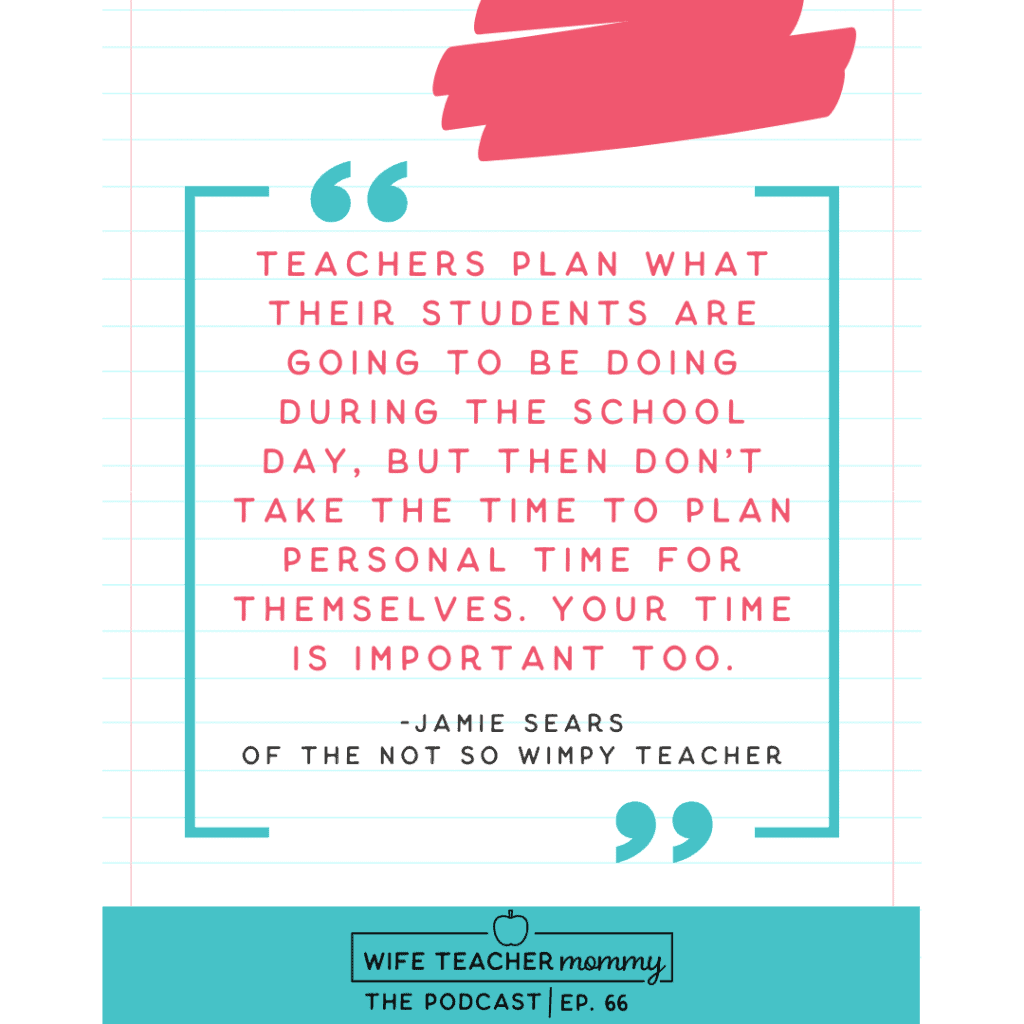
Yeah, and that’s why I wrote the book, there’s so many strategies inside of the book, How to love teaching, again, that are going to help you and I wanted to give a ton of strategies in hopes that you would pick a few that seem like the strategies that are going to work best for you right now and your season of teaching. But a couple of things that I think it would be really helpful. First and foremost is to plan your plan time. Too often, we’re letting our to do lists scare us scare the bejesus out of us into not using our plan time to its best. And so when I say plan time, it might be that you actually have a plan period. It might mean your before school, your after school. And for some people, it’s their weekends, that’s their plan time. And that’s what they choose in their season of life. But there’s a time where you were doing your lesson planning, you’re grading your extras. And so what a lot of teachers do, and I did it, too, is like, at the end of a really tough school that I walk into my classroom, like, Okay, I know I have a ton to do. Here’s this huge to do list. First of all, I look at the sheet. So I’m like, Oh, I’m not ready to get this done. And so I don’t even start, or I might start, but I don’t know what tasks to start with. So I kind of pick the easiest one. And then I might get distracted. And then I’m over here doing something else. Like I was answering email, and then I remembered I need to do something else. And I’m, and I’m flailing. So I’m either going home super late, because it takes me forever to actually get everything done. Or I’m going home. And I’m feeling like I didn’t get it all done. I’m stressed because there’s more to do not when I’ve set my alarm really early in common tomorrow morning, because I didn’t get it all done. So I think it’s extremely important that we start planning our time we plan our students time, like that’s something teachers are really good at, they plan minute to minute what their students are going to be doing during the school day. But then they don’t take the time to plan their own time. And so I’m going to challenge you to do this. And I’m going to suggest that you brain dump, everything you have to do, just grab a piece of paper or a notebook or use an electronic device, you can just voice to text it but brain dump everything you think you need to do, let your brain just get rid of it all because it’s wasting energy storing it. So everything that personal and professional. So your notice appointments, the math test, you have to grade the lesson planning, you need to do the meetings, you have brain, dump it all down and don’t get scared, because you’re not going to do all of it. And that’s okay, but it’s gonna look crazy after your brain dump, but you’re going to want to identify the most important tasks on that brain dump list. And so those are going to be things like meetings that are at a specific time. Those are going to be like your IEP meeting and maybe preparing for the IEP meeting really important it’s going to happen so you have to get it done on at a certain time. Those things I want you to put directly on your calendar. Go ahead and put them in a time block When they are going to be completed, now you have like a free market. As you look at your calendar, you now know like how much space you have to add any extra items. And real quickly, you’re gonna see, there’s not a ton of time to add extra items. So you’re going to have to get picky and the next next time you go to your brain dump and you look at all the things that are left, you’re really gonna have to ask yourself, Does this need to get done this week? Will there be some kind of consequence? If I don’t do it this week? Be careful your brain and go yes, you have to do it. But challenge your brain and say, but do I really have to do it all because I’m going to tell you what you jumped. There’s a bunch of stuff that we come up with whether we saw it online, we saw the teacher next door doing it, our brain comes up with a huge list of things you have to do. But when you challenge it, you go, you know what, I could delay this task. Till next week, I don’t have to change up my bulletin board today, or I don’t have to download the new apps to the iPad today. Those things could be done next week. All right, well delay that. There may be some things that you can flat out delete, you’re like, you know what this sounded like a good idea at first. But now that I see my list, and I see my calendar, I realize this isn’t really as important as I thought it was, I’m gonna go ahead and delete this from my list, it’s not gonna happen. Other things you might consider whether you can delegate, it is tricky to delegate. So look for ways delegate things at home, to your children, your spouse, think about in your classroom, too, if you’re able to have a parent volunteer to help with some tasks, if you happen to have any CO teacher that comes in are there tests that they could help you if I have even had my my own children cut out lamination and things for me for like a really low price, I felt great. I was teaching them about money, and having a job and responsibility, and I was getting stuff crossed off my list too. So look at things that you can, you’re going to go ahead and delay you’re going to delete and delegate the things that you can. And then what’s left, look at your calendar and put them in specific time blocks for when you will be able to finish the task, not work on it. But finish. So I still do this I catch myself like writing I counter work on and I’m like, no, no, you’re no problem with writing something like work on grading your reading assessments, we might only have a half hour. And so we start, we only get through a few of them. And our head tells us oh my gosh, I didn’t get it done, I failed, I’m gonna have to stay late. And you know, you don’t, you don’t know when to celebrate, you only had 30 minutes, you were never gonna get them all done. But you wrote work on it. And so your brain thinks you mean finish it. So instead, I want you to break down those tasks into much smaller micro tasks. So instead, if you only have 30 minutes, maybe you’re only gonna grade six of the assessments. So write that on your calendar, grade six, reading assessments, and put it in a time block, not just as a list, but it’s at from four to 430, grade six reading assessments. After you grade the sixth, you get to celebrate because you did exactly what you were supposed to do during that 30 minutes, even though you’re graded the same number assessments as in my previous example, now you actually have completed which you put on your calendar, which feels really good. And it’s very motivating, and helps you to move into your next time block and complete whatever you’ve blocked for that time, too. So thinking about putting things on the calendar that you can finish that takes that whole to do list into a to done last, which is going to shave off some time that you spend at work.
Kelsey
I absolutely love everything you said there, Jamie and I, I want to point out that what you said like you’re doing the same thing either way, if you’re breaking it down into those micro tasks, but instead you get to feel good about it and who doesn’t want to feel good about the work they’ve been doing. So such good ideas here. So how do teachers decide what they should and shouldn’t grade?
Jamie
Well, grading everything, it takes way too much time. And I know I’ve been there, I graded everything for a period of time. And I graded it a little bit out of guilt, like well, they worked on it. So I should grade it I graded a little because I thought oh, they’ll work harder if they know I’m grading it. But what I realized was I was losing track of why we grade things. And so really asking yourself, what is the actual point of assessment? Why am I grading? We are grading to show a student’s progress towards mastery of a standard. We want to know did they have they mastered it yet or not? We don’t need to grade every practice assignment on their way to mastery of the standard. And so a really important thing to think about is is have I given them enough time to practice is it time to assess them. If you’ve just taught a lesson, it’s not time to assess yet so great give Then the practice like you, you just a lesson. And now maybe they’ve got some kind of a practice, passage they’re reading, give them that opportunity to practice. And then once you see that most of your class is ready for the assessment, then you provide that graded assessment, but everything, all the practice, it doesn’t have to be graded, I would say, look at what your school or district says you have the number of grades you have to put in the grade book each week. If your school does not tell you then great, don’t go make an estate Gaskin if they don’t say that. Now you’re gonna get to decide. But if your school has said something like you need to reading scores a week, then make to your goal. Don’t try to be a superhero. Here, twos good, don’t aim for three or four, just keeping it real, that you you can do the minimum requirement here because it’s just have they met the standards. And if you wait until they’re ready to be assessed, it’s actually going to not only save you time on grading, but it’s going to help you to get a much better picture of where your students are in their journey towards mastery of these standards. So very good. Just get real, every practice assignment doesn’t have to be graded. Go ahead, put them in the recycle bin or let your kiddos take them home after they’ve practiced can also do some informal assessments along the way. So if you’re not sure, are my students really ready to be assessed? Try some informal assessments as simple as having your students do something on a whiteboard. And you’re walking by and checking him. Yep. Okay, looks like we’re ready to go to a more formal assessment, exit tickets, things you do in small group, you can just quickly glance and you’re like, that gives you an idea of what your students can do with before you give them a formal written assessment. This can help you to eliminate retesting, and you know, some not all of the poor test scores. And so I think that consider more informal assessments to save yourself time in the long run. Yes, I totally agree
Kelsey
that we want to question why we’re doing this in the first place. And it’s kind of ties into everything we’ve talked about is we want to do everything we’re doing as a teacher with intention. So for trying to cut down those hours, we need to be intentional about what we’re doing. So we don’t need to spend time grading every single paper and assessing every single one, I think some of those informal assessments and knowing when it’s time to assess, like you said, if you just assign to something, you don’t need to assess it quite yet. So it’s being super intentional about grading and planning and all those things. So that is wonderful. Jamie, thank you so much for sharing all that.
Jamie
I think it’s also really important. You know, we have a lot of students with anxiety when every assignment is tied to a green, that can increase that level of anxiety for students too. And so I think you’ll actually see even higher performance when you sort of remove the pressure.
Kelsey
Oh, that is such a good point. Because we have definitely, especially even since COVID, we’ve been seeing even more of that anxiety, like I mean, for everybody, for adults, too. But for children like this has been like it happened during a pivotal time in their development. So they do have this anxiety. And if we can do something like that, that both alleviates pressure off of us and our students. I’m all for that all for that. Absolutely. So Jamie, what other words of advice do you have for teachers who want to work less while still being an effective teacher?
Jamie
Well, first and foremost, let’s decide what it means to be an effective teacher because I know I had a poor definition of what it meant to be a great teacher, a good teacher, a successful teacher, I realized that my definition was based on things I had no control over. My definition was typically based on test scores and, and working more hours and doing all the things that people around me were doing. So my definition was so incredibly hard for me to ever meet it. It left me always thinking, I’m not good enough. I’m not doing enough. I didn’t do all of the Pinterest lessons I saw my classroom doesn’t look like the person next door. I need to work more hours. All my kids aren’t passing the shadows test. So I must not be a good teacher. And I really want to challenge this whole definition of success. What if you wrote your own definition of success? What would it mean to you to be a good teacher? Because when I talk to teachers about like, what does it mean to be a good teacher? If I just pose that question, none of them say, straight A’s are my students. Right? When you’re a teacher and you’re in the classroom, you know that the most important lessons are more about the way you make somebody feel. I would say that some teachers, their definition of success would be that they have inspired a love of learning, or inspired a love of reading. Those can be your definition of success. Your definition of success can be just yours. Your principal doesn’t need to create it. Parents don’t create it. Society doesn’t create it. They will if you don’t, but you should be the one to decide. So when you’re like how can we be more Effective teachers who work less, first of all, decide what it means to be effective to you. I’m guessing it doesn’t mean working 60 hours like, I’ll be a great teacher when I work 60 hours. That’s probably not your definition. Because I thought that great teachers worked every night and on weekends for the longest time because I saw teachers doing that. And so I thought, if I want to be like them, I’m going to have to do the same. And I want you to decide if that’s really what being a great teacher means to you. Make it personal, your definition of success, not your neighbors that can be so different. And yet, you can both be incredible educators. That’s the cool thing is that students get to have so many different teachers on their educational journey, you are one stop on that journey. And so if you are passionate about getting students to fall in love with reading, great, make that your definition of success that you’re going to help each student in your classroom, find books that they love, then each day you can kind of decide like what have I done today to help students fall in love with reading? If you did it, then you aren’t a successful teacher. It removes so much pressure from your shoulders, all the other stuff, because there’s a lot of stuff. Let’s just arrow it down. So then how can we still be effective teachers and work last? I would say other than you grading, I think lesson planning is another area that we can spend so much time on. And so much of it is just our heart wanting to do the best things for students. And that’s fantastic. But there’s good strategies for getting the lesson plan done faster, and it’s still being really quality. One thing that I did in the classroom that made such a huge difference was creating routines. So I like everything to be I love themes. I love cute stuff. I am a sucker for Pinterest, right? Like it was made for me, I everything on it, I think I’m gonna do that. I’m gonna do that. And as a new teacher, I got sucked into it. I would spend hours perusing Pinterest and you can replace Pinterest with whatever it is for you. Whether it’s Tik Tok or Instagram, I would spend so much time perusing it and then think I needed to do it all. And so every every week, I was searching things like fun activities for teaching verbs, fun activities for teaching multiplication. So every week looked different in my classroom, I was trying to do all the things, I realized I was wearing myself out, I was taking so much time researching and finding activities, preparing the activities, delivering the activities for my students. And then my students had to learn new expectations, new directions. And they weren’t feeling overly confident because it was all new every single week or every single day. But I realized like i This isn’t good for my students, this isn’t good for me, then I got to thinking about routines. So you can have daily and you can have weekly routines, you can have a combination there of but for instance, weekly routine, I have weekly routines for grammar. So every Monday I have a PowerPoint lesson where I teach the new skill. Every Tuesday we do an interactive notebook activity. Every Wednesday we do a writing activity. Every Thursday we do a task or excuse. Every Friday, we have an assessment. So I might be teaching verbs one week, I might be teaching plural nouns another week. But if you came into my classroom during grammar time, you could always see that same activity. And that mean, it’s so much faster for me to lesson plan, because I could pretty much go through my lesson plans for the rest of the year and on every Tuesday, right interactive notebook activity under grammar for the whole year, because that is what I’m going to do with few exceptions. Obviously, things pop up in our schedule. But I’m saving time because I’ve already decided how I’m going to teach every skill instead of starting each week with how am I going to do this. I’m saving myself so much time, but also when when my students feel confident because now there’s a routine. And they can get very used to the routine, they know the expectations and they start to produce higher level work. They can focus in on the skill that I’m teaching instead of how to do the activities, you’re going to start to see improvement even in their their academic success.
Kelsey
Yes, and one thing I’ve noticed like both with what you were just saying and honestly the full like 20 minutes we’ve been talking is that all of these things, if you do them for yourself, they benefit your students to you. So it’s just a win win all around.
Jamie
And it’s almost always the case. And so if you if you can learn to believe that then you will trust yourself on the decisions that you’re making for yourself because you’ll know they benefit your students. Students benefit from having a rested, happy and healthy teacher. They do and being happy, healthy and and enjoy like in the moment in your classroom means you gotta leave school you gotta go do the things you love. If that’s bike riding or hiking or sitting on the couch and watching TV, whatever it is, you’ve got to find time in your life for that. That will actually make you a much better teacher than the exhausted stressed out teacher that you We’ve all been at some point, some for longer than others. But we’ve all been there.
Kelsey
And you know, and there’s nothing wrong with having been there, it’s just noticing. And then now, applying all these skills, that Jamie, you just shared so much great information today that I feel like any teacher could walk away after listening to this episode and start applying it, which is amazing. And then can get even more, if they you know, head right over to Amazon and putting that link in the show notes for them to grab your book, How to love teaching, again, I’m so glad that you wrote this book to help all those teachers out there. And it’s really affordable, like it’s, you know, just buying a book and getting all this information, like, you probably could have put this in like a course and charge hundreds of dollars for it. But you wrote this book to make it so accessible to all these teachers out there. And I just love that.
Jamie
Yeah, it was really important to me, we kind of we fought a lot. We didn’t do hardcover, you know, a lot of times a new release is comes out hardcover first. And we were just coming up with ways that this book could be more reasonably priced. I mean, we fought, we fought to the point where we took we got them to take $1 off. And we’re like, yes, now we’re talking, because I know every dollar counts, especially for teachers. And so I wanted to put this information out in a way that most more teachers could get their hands on it. And it’s full of strategies. And what I encourage you to do is go through chapter one where you’re going to set your definition of success, and then use that definition. To help you decide which of the strategies you should prioritize right now, which of these things are going to be the most important pieces of the puzzle to get you the closest to your definition of success. That way you don’t feel like it’s just too much information all at once. Because I know as a teacher, I just felt like everyone was telling me what to do. Sometimes it was coming at me too fast. And so we’re we’ve been with a book that you can decide to work on one or two strategies, and then come back for more later.
Kelsey
Yes, totally taking it at your own pace. And I love that. And one other thing I want to mention super quick, because I’m just so excited that you are participating in our summer event, educate and rejuvenate this year. So I’m just so happy that you joined us. It’s going to be a great time.
Jamie
Yeah, I am really excited. I love to be a part of these types of programs. It’s so much fun. And I know how much work goes into this. So
Kelsey
I’m just so glad you’re joining us. It’s going to be so much fun, everybody, be sure to check that out as well. But we’ll be sharing about this for a couple of months now. But and you’ll and you’ll need to wait a couple of months like you can grab your ticket right now. But right now you can go ahead and grab that book starting today. They want to wait any longer than like Prime shipping or instantly download it for a digital copy. And are there other places so Amazon anywhere else they can grab your book
Jamie
Barnes and Noble? Yeah, pretty much any of the booksellers you should go to target.com hands it to so pretty much wherever you buy books. And I will tell you that the book started with a book but at your event this summer, I’m gonna go in a deeper dive on getting those lesson plans done quicker with a strategy of batching your time so I’m excited about that one.
Kelsey
I’m so excited. I mean, I can’t wait because I’ve been like looking through all of what everybody’s presenting on. I’m like, oh, that’s gonna be so good. It’s gonna be so good. It’s going to be an amazing event. So. Okay, well, thank you so much, Jamie, for coming on the podcast today. We’re so grateful for you. Where else can our audience connect with you online?
Jamie
Absolutely. You can head to my website not so wimpy teacher.com And I’m on Facebook and Instagram also under not so wimpy teacher.
Kelsey
Amazing. Thank you so much for your time, Jamie, I know your time is so valuable and you’ve just shared so much great information with us today. If you’re enjoying this podcast, be sure to hit subscribe so you don’t miss an episode. And if you’re ready to take the next step with me, then you are going to love wife teacher mommy club. Our top selling resources for pre K through sixth grades have been used and loved by 10s of 1000s of teachers. The club gives you one click access to all of them to meet the needs of every child to teach while saving tons of time. Plus, you’ll have our certified life coach in your back pocket. With several monthly workshops and an Ask a coach portal you can use 24/7 The combo of resources and coaching is our secret sauce to your best teacher life. Think of my team tonight as your personal team, doing the lesson planning for you and on the sidelines coaching you and cheering you on as you focus on what you do best impacting the children you teach. Plus, if you’re loving this podcast, you’ll also have access to our private podcast just for members, where I continue the conversation with all of our guests with members only bonus episodes. And don’t forget the club with VIP access to educate and rejuvenate our Summer Conference and our private Facebook community full of like minded educators supporting each other. You do so much for everyone else so it’s time to invest in yourself. Your teacher friends Johnson will drop when they see just how quickly you finish your planning. Not to mention the glow of the happier, more fulfilled you head on over to wife teacher mommy club dot dot com to learn more.
Being an educator is beyond a full-time job. Whether you’re a teacher or a homeschool parent, the everyday to-do list is endless. Between lesson planning, grading, meetings, and actually teaching, it probably feels impossible to show up for your students without dropping the ball in other areas of your life.
Wife Teacher Mommy: The Podcast is the show that will bring you the teacher tips, practical strategies, and inspiration that you need to relieve the stress and overwhelm of your day-to-day. Your host, Kelsey Sorenson, is a former teacher and substitute turned homeschool mom. Tune in weekly to hear Kelsey and her guests cheer you on and help you thrive as a wife, teacher, and mommy. Because with a little support and community, you can do it all. For access to every single Wife Teacher Mommy resource, join the club at educateandrejuvenate.com/club.


